A double negative is the use of two negatives in a sentence which cancel each other out and create a positive. In today's world double negatives are used a lot, but are considered bad grammar. How many times have you heard a child say "I didn't do nothing." If they didn't do nothing, then they did something. That is a typical double negative. But, true to form, Canadians give the double negative a different twist.
Have you ever noticed that we Canadians are in the habit of using negatives to express positive feelings and aspirations? Increasingly, when we look at our situations, we start from a negative perspective.
Just think about it. Ask someone "How are you today?" and the most frequent Canadian reply will be "Not too bad." Or ask them how they are feeling and the answer is quite likely to be "Could be worse." What is there about us that we cannot express ourselves more positively and with conviction, short of telling the truth on occasion about how lousy we might really be feeling.
The political visionary Preston Manning, founder of the now decommissioned Reform and Conservative Alliance parties, once suggested that Canadians are typically a bunch of fence sitters taking the middle ground approach because they are leery of committing themselves on any question or situation, hence we are "not too bad" and we "could be worse." Seems like we are right down the middle kind of people and old Preston may have have been on to something..
Ask a Canadian if they like something and it is not unusual to hear the answer: "Well, I can't say I do not like it, but..." See what I mean? If you can't say you do not like it, then you must like it. Here's another one where the same logic applies..."She is not unattractive." Maybe she's somewhere between attractive and unattractive, which in truth would no doubt apply to most of us.
Just the other day, I heard this mind-boggler: "Not that I'm not thankful or anything, but..." Wrap your mind around that one for a few seconds.
While not a double negative, but still on the subject of irritating expressions, have you ever made a request to a service provider or asked a coworker for a favor and they reply, “No problem!” That one always annoys me. “No problem!” seems harmless enough – even downright cheery. Kind of like “No worries” to the Aussies or “Fuggedaboutit” to actor Al Pacino.
When someone says “no problem” to a request, however, what they really mean is that the request potentially is a problem and they are not really interested in doing this particular favor. But they are forced to comply; hence, “no problem” nonchalantly rolls off the tongue. Some restaurants have started training employees to eliminate this response, both with customers and each other and this is a good thing. Nothing I hate more than a "no problem" after thanking a store check-out clerk or service provider for a handful of change after completing a substantial transaction. I often respond with a curse "I didn't expect that there would be a problem."
Now they should start working on the word "grab". How many times have you asked a waiter/waitress for a glass of water or a utensil and the reply is "Okay, I'll go and grab that for you!" There is something about the action of "grabbing" that just rubs me the wrong way. I much prefer to picture the person simply "getting" the requested item for me.
Really glad I got all of these sloppy language issues off my chest. It's not like it hasn't been weighing me down or anything, but it could be worse!
Now I'll get on with the rest of my day, no problem.
31 October, 2013


29 October, 2013
The Shadow Knows: My "scariest-ever" old time radio program, narrated by famous actor Orsen Wells, 1937. I still get shivers listening to this video. The program, loosely adapted from the popular pulp magazine series, told the story of Lamont Cranston, a wealthy young man-about-town who used his hypnotic powers to cloud men's minds so that they could not see him, fighting crime as an Invisible Avenger known only as The Shadow. As a five and six-year old I was pretty much held captive by my teenage cousins Jim and Norma Sharpe who delighted in my horror at the Shadow's heavy breathing as we listened to the program in my Aunt Hattie's living room.
15 October, 2013
"THE FORTY-FIVE GUARDSMEN" BY ALEXANDRE DUMAS: HOW DID THIS NOVEL END UP IN A DRESDEN SCHOOL LIBRARY 100 YEARS AGO AND WHAT ABOUT IT INTERESTED MY FATHER?

I cannot explain why this 484-page publication, the third in a Valois Romances series by Dumas, has escaped my scrutiny for all these years other than to say that it is one of the few books in the family library that I never got around to reading. The find, thanks to a Thanksgiving Day reorginization of book shelves in my study, sparked my curiosity and set me off on a new research project, leaving all else in its wake.
 It is really curious how this novel, written by a 19th century Frenchman with black bloodlines, ended up in a school library in the Southwestern Ontario Town of Dresden 100 years ago. Most of Dumas' writings were translated to English and "The Forty-Five Guardsmen", a sequel to "LaDame de Monsoreau", is a tough study especially for a continuation school student at the turn of the last century.

Here is what I have uncovered about one of the most famous and controversial French authors of the 1800s.
Dumas is best known for the historical novels The Three Musketeers and The Count of Monte Cristo, both written within the space of two years, 1844-45, and which belong to the foundation works of popular culture. He was among the first, along with Honoré de Balzac and Eugène Sue, who fully used the possibilities of roman feuilleton (serial novel or contempory soap opera). Dumas is credited with revitalizing the historical novel in France, although his abilities as a writer were under dispute from the beginning.
Dumas was born in Villes-Cotterêts, France. His grandfather was a French nobleman, who had settled in Santo Domingo; his paternal grandmother, Marie-Cessette, was an Afro-Caribbean, who had been a black slave in the French colony. Dumas's father was a general in Napoleon's army, who had fallen out of favor. After his death in 1806 the family lived in poverty. Dumas worked as a notary's clerk in Villers-Cotterêtes and went in 1823 to Paris to find work. Due to his elegant handwriting he secured a position with the Duc d'Orléans - later King Louis Philippe. He also found his place in theater and as a publisher of some obscure magazines. An illegitimate son called Alexandre Dumas fils, whose mother, Marie-Catherine Labay, was a dressmaker, was born in 1824.
 |
| Alexandre Dumas 1802-1870 |
As a master dialogist, he developed character traits, and kept the action moving, and composed the all-important chapter endings - teaser scenes that maintained suspense and readers interest to read more.
Dumas' role in the development of the historical novel owes much to a coincidence. The lifting of press censorship in the 1830s gave rise to a rapid spread of newspapers. Editors began to lure readers by entertaining serial novels. Everybody read them, the aristocracy, and the bourgeoisie, young and old, men and women. Dumas' first true serial novel was Le Capitaine Paul (1838, Captain Paul), a quick rewrite of a play. It was addressed to a female readership and added 5,000 subscribers to the list of Le Siècle when it was serialized. Along with Balzac and other writers, he also contributed to Emile de Girardin's weekly, La Mode, which became the voice of an aristocratic and wordly tout-Paris.
Dumas lived as adventurously as the heroes of his books, and his way of life created a number of anecdotes.
In 1851 Dumas escaped his creditors to Brussels. He spent two years there in exile and then returned to Paris and founded a daily paper called Le Mousquetaire. In 1858 he traveled to Russia and in1860 he went to Italy, where he supported Garibaldi and Italy's struggle for independence (1860-64). He then remained in Naples as a keeper of the museums for four years. After his return to France his debts continued to mount. Called as "the king of Paris", Dumas earned fortunes and spent them right away on friends, art, and mistresses. He was professed to have had dozens of illegitimate children, but he acknowledged only three. According to a story, when Dumas once found his wife in bed with his good friend Roger de Beauvoir, he said: "It's cold night. Move over and make room for me."
Dumas died of a stroke on December 5, 1870, at Puys, near Dieppe. It is claimed that his last words were: "I shall never know how it all comes out now," in which he referred to his unfinished book. Dumas' son Alexandre Dumas fils, became a writer, dramatist, and moralist, who never accepted his father's lifestyle.
Dumas did not generally define himself as a black man, and there is not much evidence that he encountered overt racism during his life. However, his works were popular among the 19th-century African-Americans, partly because in The Count of Monte-Cristo, the falsely imprisoned Edmond Dantès, may be read as a parable of emancipation. In a shorter work, Georges (1843, George), Dumas examined the question of race and colonialism. The main character, a half-French mulatto, leaves Mauritius to be educated in France, and returns to avenge himself for the affronts he had suffered as a boy.
As I said earlier, perhaps we'll never know how "The Forty-Five Guardsmen" ended up on the book shelves of a school in Dresden all those years ago, nor what there was about it that interested my father, but I plan to keep working on it, if only to speculate.
10 October, 2013
MY STRUGGLES WITH MISUNDERSTANDING INVOLVED RATIONALIZATION AND, IN THE END, FORGIVENESS; BUT YOU CAN'T EXPECT TO WIN 'EM ALL SO JUST LET IT GO...!
I recently ran into difficulty justifying a cautionary comment that I made in discussing an online virtual history group matter. Some of the responses I received were undeservedly borderline rude and insulting. I was accused of being overly critical, insensitive and ignorant. God Lord, I was even called "pompous". The more I tried to explain the reasons for my position, the worse the verbal attacks got. Plain and simple, I was not being understood by several young women who did not really know me.
Something had triggered their angst and they spared no punches in expressing themselves for reasons known only to them. After all said and done, the consternation caused by the exchanges was not warranted and totally misplaced, in my mind. I can only speculate on the timing of the reactions. I did not stoop to disrespectful retorts, although I did allude to the potential for libel in what was being said to me.
One male respondent, not fully familiar with the background of the issue, attempted to inject a little humour into the dialogue by saying that I was being "redickulous".
Eventually the moderator of the site cut off discussion(?) on the subject and deleted "heated" comments that were not in keeping with the spirit of the group. She questioned why I always found it necessary to have the last word -- "even when I think I am right." I'm still trying to wrap my mind around that one.
Something about that unpleasant experience penetrated my normally thick skin. My convictions had been tested. I was offended, frustrated and angered. My immediate response was to entirely cut myself off from Internet connection with the group. I even wiped out an entire web site dealing with fond recollections of my hometown (Dresden, ON) which represented years of work and personal passionate reflections...Gone with one click of a computer key -- never to be recovered. A knee-jerk reaction, perhaps. A mistake, maybe. I just wanted to distance myself from it all and erasing a previous labour of love was one way of doing it.
I kept replaying the scenario in my mind for many days and nights. Why was I not being understood? Why did I feel so terrible? Why could I not let go of the matter? Was I wrong to have had the courage of my convictions? For all intents and purposes, I was allowing resultant depression to rob me of passion and joy in my everyday life. Funny how things like that can fester and magnify if you let them.
Ultimately I found the following to be of great assistance in rationalizing this dark, nightmarish moment in my life. I know that there will be those who can relate.
"Do not hurry yourself in your spirit to become offended, for the taking of offense is what rests in the bosom of the stupid ones." Ecclesiastes 7:9 (Online Bible)
There are times when you aim to help others and people impute other ulterior motives. This can be very distressing. In 1 Chronicles 19:1-19 we read that when Nahush the King of the Ammonites died, David decided to reciprocate the kindness he had shown him and sent a delegation to his son Hanun to convey his condolences. However Hanun listened to his advisers who told him that David’s envoys had come to explore and spy out the country so that they could overthrow it. “So Hanun seized David’s envoys, shaved them, cut off their garments at the buttocks, and sent them away (verse 4)." As a result of this misunderstanding war was declared and more than fifty seven thousand people died.
Many relationships break because of misunderstandings: family, marriages, friendships and alliances/groups.
When others misunderstand, we should seek an opportunity to explain and make amends. However, this is not always possible. You cannot force people to understand you. If they put themselves in your place they might understand, but many people are led by their preconceived notions about you and selfish regard for themselves. Sometimes they have hidden motives and were looking for an excuse to blame you. Their experiences may also not have opened them up to understand or sympathize with your position.
Do not be unduly worried that you are misunderstood. Do your best. It is only important that God understands. Jesus’ message is plain and simple yet many people misunderstand it. If they listen with a discerning heart instead of closed minds, they will understand it but it is their choice, Jesus does not force. “When they hurled their insults at Him, He did not retaliate; when He suffered, He made no threats. Instead, He entrusted himself to Him who judges justly.”
When others misunderstand, we should always leave a door open so that people can explain their side of the story if they feel inclined to do so. Sometimes people are hot tempered and judge hastily. In Joshua 22:10-34 we read that some tribes of Israel built an imposing altar which others mistook for an idol and wanted to cause war with them, lest God’s curse fall on them all. However they sought for an explanation first and were pleased that the building was only a monument so that future generations could be reminded of God’s goodness.
When you are misunderstood remember also that you are not perfect and may have misunderstood others many times, and deemed them evil when they had only good intentions towards you.
God calls us to forgive others without any reservations. This is also for our own good because bitterness destroys the soul.
I pray that the foregoing helps others who may find themselves involved in similar misunderstandings as they "communicate" with friends or foes.
CLOSING NOTE: Earlier this week I posted an apology on the virtual history group site, not for wanting the last word but to those who felt that I had been overly critical in the past (I always thought that I was being constructive, but...). With time for the air to clear, I also offered one last rational explanation for my position on the subject of a century of racial discrimination in Dresden and why I originally responded the way I did. To date, five members of the virtual history group have "liked" my post while 190 remain silent. Happily, no "dislikes" -- yet.
Admittedly, my contributions to Dresden nostalgia had pretty much run their course. While this incident has tainted intense fond memories of my hometown and involvement in its virtual history, I refuse to let it curtail my sense of mission and commitment to passing on self-expressions and tidbits of human interest through my own web site, for what they are worth. I especially enjoy the exchange of pleasantries with true blue "friends" on Facebook...That's what it should be all about anyway. It would be wrong to allow a bad experience to deprive me of that.
Not one of my more popular posts, I am sure, but this too is reality.
--Mother Teresa
Something had triggered their angst and they spared no punches in expressing themselves for reasons known only to them. After all said and done, the consternation caused by the exchanges was not warranted and totally misplaced, in my mind. I can only speculate on the timing of the reactions. I did not stoop to disrespectful retorts, although I did allude to the potential for libel in what was being said to me.
One male respondent, not fully familiar with the background of the issue, attempted to inject a little humour into the dialogue by saying that I was being "redickulous".
Eventually the moderator of the site cut off discussion(?) on the subject and deleted "heated" comments that were not in keeping with the spirit of the group. She questioned why I always found it necessary to have the last word -- "even when I think I am right." I'm still trying to wrap my mind around that one.
Something about that unpleasant experience penetrated my normally thick skin. My convictions had been tested. I was offended, frustrated and angered. My immediate response was to entirely cut myself off from Internet connection with the group. I even wiped out an entire web site dealing with fond recollections of my hometown (Dresden, ON) which represented years of work and personal passionate reflections...Gone with one click of a computer key -- never to be recovered. A knee-jerk reaction, perhaps. A mistake, maybe. I just wanted to distance myself from it all and erasing a previous labour of love was one way of doing it.
I kept replaying the scenario in my mind for many days and nights. Why was I not being understood? Why did I feel so terrible? Why could I not let go of the matter? Was I wrong to have had the courage of my convictions? For all intents and purposes, I was allowing resultant depression to rob me of passion and joy in my everyday life. Funny how things like that can fester and magnify if you let them.
Ultimately I found the following to be of great assistance in rationalizing this dark, nightmarish moment in my life. I know that there will be those who can relate.
"Do not hurry yourself in your spirit to become offended, for the taking of offense is what rests in the bosom of the stupid ones." Ecclesiastes 7:9 (Online Bible)
There are times when you aim to help others and people impute other ulterior motives. This can be very distressing. In 1 Chronicles 19:1-19 we read that when Nahush the King of the Ammonites died, David decided to reciprocate the kindness he had shown him and sent a delegation to his son Hanun to convey his condolences. However Hanun listened to his advisers who told him that David’s envoys had come to explore and spy out the country so that they could overthrow it. “So Hanun seized David’s envoys, shaved them, cut off their garments at the buttocks, and sent them away (verse 4)." As a result of this misunderstanding war was declared and more than fifty seven thousand people died.
Many relationships break because of misunderstandings: family, marriages, friendships and alliances/groups.
When others misunderstand, we should seek an opportunity to explain and make amends. However, this is not always possible. You cannot force people to understand you. If they put themselves in your place they might understand, but many people are led by their preconceived notions about you and selfish regard for themselves. Sometimes they have hidden motives and were looking for an excuse to blame you. Their experiences may also not have opened them up to understand or sympathize with your position.
Do not be unduly worried that you are misunderstood. Do your best. It is only important that God understands. Jesus’ message is plain and simple yet many people misunderstand it. If they listen with a discerning heart instead of closed minds, they will understand it but it is their choice, Jesus does not force. “When they hurled their insults at Him, He did not retaliate; when He suffered, He made no threats. Instead, He entrusted himself to Him who judges justly.”
When others misunderstand, we should always leave a door open so that people can explain their side of the story if they feel inclined to do so. Sometimes people are hot tempered and judge hastily. In Joshua 22:10-34 we read that some tribes of Israel built an imposing altar which others mistook for an idol and wanted to cause war with them, lest God’s curse fall on them all. However they sought for an explanation first and were pleased that the building was only a monument so that future generations could be reminded of God’s goodness.
When you are misunderstood remember also that you are not perfect and may have misunderstood others many times, and deemed them evil when they had only good intentions towards you.
God calls us to forgive others without any reservations. This is also for our own good because bitterness destroys the soul.
I pray that the foregoing helps others who may find themselves involved in similar misunderstandings as they "communicate" with friends or foes.
CLOSING NOTE: Earlier this week I posted an apology on the virtual history group site, not for wanting the last word but to those who felt that I had been overly critical in the past (I always thought that I was being constructive, but...). With time for the air to clear, I also offered one last rational explanation for my position on the subject of a century of racial discrimination in Dresden and why I originally responded the way I did. To date, five members of the virtual history group have "liked" my post while 190 remain silent. Happily, no "dislikes" -- yet.
Admittedly, my contributions to Dresden nostalgia had pretty much run their course. While this incident has tainted intense fond memories of my hometown and involvement in its virtual history, I refuse to let it curtail my sense of mission and commitment to passing on self-expressions and tidbits of human interest through my own web site, for what they are worth. I especially enjoy the exchange of pleasantries with true blue "friends" on Facebook...That's what it should be all about anyway. It would be wrong to allow a bad experience to deprive me of that.
Not one of my more popular posts, I am sure, but this too is reality.
**************
"People are often unreasonable and self-centered. Forgive them anyway. If you are kind, people may accuse you of ulterior motives. Be kind anyway. If you are honest, people may cheat you. Be honest anyway. If you find happiness, people may be jealous. Be happy anyway. The good you do today may be forgotten tomorrow. Do good anyway. Give the world the best you have and it may never be enough. Give your best anyway. For you see, in the end, it is between you and God. It was never between you and them anyway."--Mother Teresa
A QUESTION: WHERE DO WE GET OUR ETHICS?
A new study from the University of Pennsylvania suggests that people who strongly believe in God are more likely to reject the notion that life has no purpose than people who believe less strongly in God. Even so, most people who believe less strongly in God still rejected the notion, challenging the assumption that God is necessary to give life purpose. We must then ask ourselves: if God does not necessarily give life purpose, what does?
Respondents were asked whether they believed in God without a doubt, or whether they did not believe or were unsure. They were then asked whether they agreed or disagreed with the statement, “In my opinion, life does not serve any purpose”. Of those who believed in God without a doubt, 33% mildly disagreed with the statement, and 61% of them strongly disagreed with it (for a total of 94%). Of those who did not believe or were unsure, 42% mildly disagreed, and only 49% strongly disagreed (for a total of 91%).
What the figures show is that most people in general reject the notion that life has no purpose, but strong believers slightly outnumber non-believers and weak believers in their rejection of it. Most importantly, although the level of general disagreement was similar between the two groups, a significantly greater number of people who believed in God with certainty disagreed strongly with the notion. That is, strong disagreement with the statement correlated with strong belief in God.
The fact that most atheists and agnostics still have a sense of purpose in life without a rock-solid belief in God means they have to derive their sense of purpose elsewhere. Perhaps the purpose of life is to practice compassion, and this life purpose is determined by ethical reasoning. In other words, helping the sick and needy is meaningful in and of itself because it alleviates suffering.
Respondents were asked whether they believed in God without a doubt, or whether they did not believe or were unsure. They were then asked whether they agreed or disagreed with the statement, “In my opinion, life does not serve any purpose”. Of those who believed in God without a doubt, 33% mildly disagreed with the statement, and 61% of them strongly disagreed with it (for a total of 94%). Of those who did not believe or were unsure, 42% mildly disagreed, and only 49% strongly disagreed (for a total of 91%).
What the figures show is that most people in general reject the notion that life has no purpose, but strong believers slightly outnumber non-believers and weak believers in their rejection of it. Most importantly, although the level of general disagreement was similar between the two groups, a significantly greater number of people who believed in God with certainty disagreed strongly with the notion. That is, strong disagreement with the statement correlated with strong belief in God.
The fact that most atheists and agnostics still have a sense of purpose in life without a rock-solid belief in God means they have to derive their sense of purpose elsewhere. Perhaps the purpose of life is to practice compassion, and this life purpose is determined by ethical reasoning. In other words, helping the sick and needy is meaningful in and of itself because it alleviates suffering.
Most people seem to believe that life has a sense of purpose, but not everyone agrees that this purpose is rooted in the existence of God. Whatever our belief, hopefully we can all agree that doing good is its own reward. At the same time we as Christians cannot afford, by ignorance and apathy, to quit the field and give ground. If we do, this entire culture will pay the price when those with no Biblical foundation are left to determine the the aforementioned "ethical" standards of future generations.
Just think, where would we be today were it not for the biblical "Ten Commandments" passed down to us, generation to generation? Something for all of us to ponder as the proverbial handcart to hell awaits.
Just think, where would we be today were it not for the biblical "Ten Commandments" passed down to us, generation to generation? Something for all of us to ponder as the proverbial handcart to hell awaits.
30 September, 2013
ALL TOGETHER NOW, LET'S HIT IT WITH GREAT EXUBERANCE
Singing together can be an emotional experience. As churchgoers, choir singers or sports fans raise their voices as one, they feel connected. Turns out, that connection may have a physiological foundation. A small study suggests people who sing together have synchronized heartbeats. Good friend, choir director, organist Marjorie Tite and I are convinced about the accuracy of the study because of what we have experience first-hand.
 Singers often inhale and exhale at similar times. When your heartbeat is connected to your breathing pattern, it’s called respiratory sinus arrhythmia, or RSA which can have a soothing effect on the cardiovascular system. For instance, past studies have shown guided breathing – like what’s done in yoga – can be beneficial for high blood pressure problems.
“If this is correct, singing would probably have the same effect,” said Bjorn Vickhoff, a professional singer/songwriter-turned-neuroscientist at the University of Gothenburg in Sweden. Vickhoff is fascinated by music’s effect on the human body. He hopes to eventually find new ways music can be used in medicine, rehabilitation and preventative care. His latest study, published this week in the journal Frontiers in Psychology, focuses on how song structure can affect a singer’s heart rate.
Vickhoff and his colleagues gathered 15 healthy 18-year-olds at a high school in Gothenburg. They had the group perform three different choral exercises while recording the heart rates of each person. The first exercise was monotone humming, where the participants were told to breathe as needed. For the second exercise, the teens sang a popular Swedish hymn and took breaths whenever. The third exercise was a slow mantra; participants were instructed to breathe only between the long phrases.
These three exercises allowed the researchers to see how coordinated (the mantra) and uncoordinated (humming) song phrasing affected the participants’ heart rhythms while they were singing. Fascinating, to say the least!
The researchers found that each singer’s heartbeat was linked to the song’s melody – i.e. the speed and structure of the music. They also found that when the choir sang together, their heart rates tended to increase and decrease at similar times. “As soon as the singing begins, (the hearts) start following each other,” Vickhoff told CNN in an e-mail. Humming and performing the mantra as a group resulted in more synchronized heart rate variability, or HRV, than singing the hymn.
“The impression is that the heart cannot completely follow the respiration (guided breathing) when it has a more complex, hierarchical structure,” the study authors wrote.
Four of the heart rate monitors malfunctioned, so only 11 sets of data were collected and analyzed. That’s a very small study sample to make any steadfast conclusions. The study will have to be duplicated with more participants. The researchers did not look at whether the increased HRV had a positive effect on the study participants. And any effect would be temporary, Vickhoff said.
“We do have the ambition to map the body responses to music and make medical applications,” he said. “But we (need to) test this as rigorously as new drugs are tested.”
Vickhoff likes to go beyond what his study analyzed to talk about the possible implications for this kind of music-body connection. In the journal article, he discusses the evolutionary question of why music is a universal phenomenon. “David Huron, the cognitive musicologist, has suggested that music promotes bonding, and thus strengthens groups, which would have a survival value,” he said.
“Ultimately the knowledge that singing coordinates hearts is mind-blowing. If we, for instance, starting singing a slow hymn together in church, we now know that the hearts in the hall are coordinated. And the thrilling question is: How does this affect us?”
The study authors note that breathing together, whether it’s through meditating, praying or singing, is done in most religions. “Joint action leads to joint perspectives,” they write. “In other words, singers may change their egocentric perspective of the world to a we-perspective, which causes them to perceive the world from the same point of view.”
Note from Dick: I intend to expand further on this subject in future posts. Meantime...
With thanks to Jacque Wilson -- Health writer/producer
24 September, 2013
NOSTALGIA: FOLKS LIKE ME ARE NOT CRAZY AFTER ALL ... WE'RE SIMPLY FILLING A VOID(?) IN OUR ABNORMAL LIVES
As a nostalgist in the truest sense, I found the following of particular interest to me...There is comfort in knowing that I am not alone.
SOUTHAMPTON, England — Not long after moving to the University of Southampton, Constantine Sedikides had lunch with a colleague in the psychology department and described some unusual symptoms he’d been feeling. A few times a week, he was suddenly hit with nostalgia for his previous home at the University of North Carolina: memories of old friends, Tar Heel basketball games, fried okra, the sweet smells of autumn in Chapel Hill.
“I told him I did live my life forward, but sometimes I couldn’t help thinking about the past, and it was rewarding,” he says. “Nostalgia made me feel that my life had roots and continuity. It made me feel good about myself and my relationships. It provided a texture to my life and gave me strength to move forward.”
The colleague remained skeptical, but ultimately Dr. Sedikides prevailed. That lunch in 1999 inspired him to pioneer a field that today includes dozens of researchers around the world using tools developed at his social-psychology laboratory, including a questionnaire called the Southampton Nostalgia Scale. After a decade of study, nostalgia isn’t what it used to be — it’s looking a lot better.
Nostalgia has been shown to counteract loneliness, boredom and anxiety. It makes people more generous to strangers and more tolerant of outsiders. Couples feel closer and look happier when they’re sharing nostalgic memories. On cold days, or in cold rooms, people use nostalgia to literally feel warmer.
Nostalgia does have its painful side — it’s a bittersweet emotion — but the net effect is to make life seem more meaningful and death less frightening. When people speak wistfully of the past, they typically become more optimistic and inspired about the future.
“Nostalgia makes us a bit more human,” Dr. Sedikides says. He considers the first great nostalgist to be Odysseus, an itinerant who used memories of his family and home to get through hard times, but Dr. Sedikides emphasizes that nostalgia is not the same as homesickness. It’s not just for those away from home, and it’s not a sickness, despite its historical reputation.
Nostalgia was originally described as a “neurological disease of essentially demonic cause” by Johannes Hoffer, the Swiss doctor who coined the term in 1688. Military physicians speculated that its prevalence among Swiss mercenaries abroad was due to earlier damage to the soldiers’ ear drums and brain cells by the unremitting clanging of cowbells in the Alps.
In the 19th and 20th centuries nostalgia was variously classified as an “immigrant psychosis,” a form of “melancholia” and a “mentally repressive compulsive disorder” among other pathologies. But when Dr. Sedikides, Tim Wildschut and other psychologists at Southampton began studying nostalgia, they found it to be common around the world, including in children as young as seven-years-of-age (who look back fondly on birthdays and vacations).
“The defining features of nostalgia in England are also the defining features in Africa and South America,” Dr. Wildschut says. The topics are universal — reminiscences about friends and family members, holidays, weddings, songs, sunsets, lakes. The stories tend to feature the self as the protagonist surrounded by close friends.
Most people report experiencing nostalgia at least once a week, and nearly half experience it three or four times a week. These reported bouts are often touched off by negative events and feelings of loneliness, but people say the “nostalgizing” — researchers distinguish it from reminiscing — helps them feel better.
To test these effects in the laboratory, researchers at Southampton induced negative moods by having people read about a deadly disaster and take a personality test that supposedly revealed them to be exceptionally lonely. Sure enough, the people depressed about the disaster victims or worried about being lonely became more likely to wax nostalgic. And the strategy worked: They subsequently felt less depressed and less lonely.
Nostalgic stories aren’t simple exercises in cheeriness, though. The memories aren’t all happy, and even the joys are mixed with a wistful sense of loss. But on the whole, the positive elements greatly outnumber the negative elements, as the Southampton researchers found by methodically analyzing stories collected in the laboratory as well as in a magazine named Nostalgia.
SOUTHAMPTON, England — Not long after moving to the University of Southampton, Constantine Sedikides had lunch with a colleague in the psychology department and described some unusual symptoms he’d been feeling. A few times a week, he was suddenly hit with nostalgia for his previous home at the University of North Carolina: memories of old friends, Tar Heel basketball games, fried okra, the sweet smells of autumn in Chapel Hill.
“I told him I did live my life forward, but sometimes I couldn’t help thinking about the past, and it was rewarding,” he says. “Nostalgia made me feel that my life had roots and continuity. It made me feel good about myself and my relationships. It provided a texture to my life and gave me strength to move forward.”
The colleague remained skeptical, but ultimately Dr. Sedikides prevailed. That lunch in 1999 inspired him to pioneer a field that today includes dozens of researchers around the world using tools developed at his social-psychology laboratory, including a questionnaire called the Southampton Nostalgia Scale. After a decade of study, nostalgia isn’t what it used to be — it’s looking a lot better.
Nostalgia has been shown to counteract loneliness, boredom and anxiety. It makes people more generous to strangers and more tolerant of outsiders. Couples feel closer and look happier when they’re sharing nostalgic memories. On cold days, or in cold rooms, people use nostalgia to literally feel warmer.
Nostalgia does have its painful side — it’s a bittersweet emotion — but the net effect is to make life seem more meaningful and death less frightening. When people speak wistfully of the past, they typically become more optimistic and inspired about the future.
“Nostalgia makes us a bit more human,” Dr. Sedikides says. He considers the first great nostalgist to be Odysseus, an itinerant who used memories of his family and home to get through hard times, but Dr. Sedikides emphasizes that nostalgia is not the same as homesickness. It’s not just for those away from home, and it’s not a sickness, despite its historical reputation.
Nostalgia was originally described as a “neurological disease of essentially demonic cause” by Johannes Hoffer, the Swiss doctor who coined the term in 1688. Military physicians speculated that its prevalence among Swiss mercenaries abroad was due to earlier damage to the soldiers’ ear drums and brain cells by the unremitting clanging of cowbells in the Alps.
In the 19th and 20th centuries nostalgia was variously classified as an “immigrant psychosis,” a form of “melancholia” and a “mentally repressive compulsive disorder” among other pathologies. But when Dr. Sedikides, Tim Wildschut and other psychologists at Southampton began studying nostalgia, they found it to be common around the world, including in children as young as seven-years-of-age (who look back fondly on birthdays and vacations).
“The defining features of nostalgia in England are also the defining features in Africa and South America,” Dr. Wildschut says. The topics are universal — reminiscences about friends and family members, holidays, weddings, songs, sunsets, lakes. The stories tend to feature the self as the protagonist surrounded by close friends.
Most people report experiencing nostalgia at least once a week, and nearly half experience it three or four times a week. These reported bouts are often touched off by negative events and feelings of loneliness, but people say the “nostalgizing” — researchers distinguish it from reminiscing — helps them feel better.
To test these effects in the laboratory, researchers at Southampton induced negative moods by having people read about a deadly disaster and take a personality test that supposedly revealed them to be exceptionally lonely. Sure enough, the people depressed about the disaster victims or worried about being lonely became more likely to wax nostalgic. And the strategy worked: They subsequently felt less depressed and less lonely.
Nostalgic stories aren’t simple exercises in cheeriness, though. The memories aren’t all happy, and even the joys are mixed with a wistful sense of loss. But on the whole, the positive elements greatly outnumber the negative elements, as the Southampton researchers found by methodically analyzing stories collected in the laboratory as well as in a magazine named Nostalgia.
04 September, 2013
Thanks for dropping in to Wrights Lane...
*After more than 900 posts and with fading faculties, I will now be making occasional entries only to this site when the spirit moves me. When the well runs completely dry, then "that's all she/he wrote".
*After more than 900 posts and with fading faculties, I will now be making occasional entries only to this site when the spirit moves me. When the well runs completely dry, then "that's all she/he wrote".
*A Special Note for Kenzie L. Medd:
Thank you for your recent comment Kenzie. Unfortunately I am unable to reply to you without a return email address. I would sincerely like to communicate with you about your post request. Please include your email address in another comment herewith and we can chat privately.
-- Dick Wright (old friend of Larry and Doug)
12 August, 2013
TODAY, HIS CHURCH IN TARA...TOMORROW, GRAND OLE OPRY
28 July, 2013
WHEN A FELLA NEEDS A PRAYER IT'S ROSANNE TO THE RESCUE
It is customary for Rosanne to prayerfully ask her late Polish grandmother to "come into my heart" when I am involved in certain activities or challenges. She firmly believes that her much beloved "Baba" watches over us with angelic care from her Heavenly resting place.
This morning I undertook a particularly challenging ministerial assignment and Rosanne knew that I was a bit apprehensive. Her health does not allow her to accompany me, but when I returned home after the service, she was quick to ask "How did things go?"
"One hundred per cent," I replied. "It could not have been better!"
"Oh, I'm so happy," Rosanne said. "I prayed continually that everything would be alright for you. I didn't ask Baba for help this time though, I prayed to God instead....I thought, what the heck, I might as well go right to the top with this one!"
God love her!
This morning I undertook a particularly challenging ministerial assignment and Rosanne knew that I was a bit apprehensive. Her health does not allow her to accompany me, but when I returned home after the service, she was quick to ask "How did things go?"
"One hundred per cent," I replied. "It could not have been better!"
"Oh, I'm so happy," Rosanne said. "I prayed continually that everything would be alright for you. I didn't ask Baba for help this time though, I prayed to God instead....I thought, what the heck, I might as well go right to the top with this one!"
God love her!
12 July, 2013
I publish the following story on Wrights Lane, not only because of my love for the game of baseball and admiration for those who play and coach it at any level, but also due to the fact that it reflects the honesty and integrity of a young man who did "the right thing".
Money Can’t Buy A Clear Conscience
Posted by BRIAN HORROBIN on July 11, 2013 in COLUMNS, FEATURED STORIES, RELIGION AND SPORTS BY PASTOR BRIAN HORROBIN
 |
| Jeremy Affeldt |
In fact, it’s often what happens off the field that gets the most attention. The recent arrest of New England Patriots’ tight end, Aaron Hernandez, on murder charges highlights an ever-growing trend of high-paid athletes making poor decisions away from the game and ruining their careers in the process. It is hard to read one of these sad stories of successful-players-gone-bad without feeling skeptical of every good, young player taken in a draft. Who can you trust these days?
Enter San Francisco Giants’ pitcher, Jeremy Affeldt. The veteran reliever signed a contract back in 2010, which gave him $500,000 more than was actually agreed upon. The conscience-stricken hurler chose to do the right thing and give the money back to the ball club. Since the ink had already dried Affeldt was actually entitled to keep the money, as it was a mistake on the Giants’ part. Even an assistant General manager encouraged him to keep the windfall. However, Jeremy Affeldt is not like most athletes. No, in this world of fat salaries and sometimes even fatter egos, he chose principle over prosperity.
Said Affeldt, “I talked to Bobby (the Giants’ GM, Bobby Evans) the next day and said, ‘I can’t take that money. I won’t sleep well at night knowing I took that money because every time I open my paycheck I’ll know it’s not right.’”
The point is not really the money, even though the amount is very significant. Yes, it was half a million dollars! I think we can get all bogged down in the amount and lose sight of the actual act of integrity. If Jeremy Affeldt was buying a couple of packs of gum at the local Dollar Tree, was given 89 cents too much change, and then went back and returned it, would we be hearing about it from the sports media? Likely not. But to the Lord, the principle is the same. If something doesn’t belong to you, give it back. It’s the right thing to do and someone who walks in integrity does the right thing because it’s the right thing to do. Period. No photo op. No bells and whistles.
Today, Jeremy Asffeldt is $500,000 poorer but spiritually richer and a whole world wiser because of the choice he made that day.
In Psalm 15 we read, “LORD, who may dwell in your sanctuary? Who may live on your holy hill? He whose walk is blameless and who does what is righteous… who does his neighbour no wrong… who keeps his oath even when it hurts.” Is it any wonder that this past winter Jeremy Affeldt was given a lucrative 3-year contract with the Giants? Money can buy a lot of things but one thing it cannot buy is a clear conscience. Just ask Jeremy Affeldt.
Thanks to Facebook friend Larry Balkwill of Chatham for bringing this story to my attention.
08 July, 2013
LITTLE GIRL SAW BEAUTY IN AN IMPERFECT AFRICAN VIOLET
I was shopping in our local Foodland grocery store (an almost daily routine for this chief cook and bottle washer these days) when my attention was drawn to a grandmotherly woman and a little girl hovering painstakingly over a display of African Violets. It was obvious that the object of the exercise was to pick out one of the plants for the five-year-old to take home with her.
Without hesitation, the little girl reached into the middle of the display of several dozen brightly coloured purple and lavender plants and made a selection. You could almost hear the wheels turning in her tiny mind and the expression of serious resolve on her face spoke volumes -- she had made her choice.
"But that one doesn't look very healthy," said the woman. "Why don't you pick a better one? Look, this one is very pretty," she added taking the less-than-perfect plant from the child's hand and replacing it with one that had lush green leaves and was in full, beautiful bloom.
Without saying a word, the child studied her grandmother's choice for several long seconds before setting it aside and re-claiming the plant with a lopsided small cluster of pale flowers, holding it in her chubby hands with the tender-loving care of the mother that she would some day become.
"I think that she has made up her mind," I could not help interjecting. "Yes, but I'm the one paying for it," replied the grandmother.
As I pretended to be pre-occupied with a stand of tomatoes and cucumbers, I continued to watch the rather one-sided African Violet discussion out of the corner of my eye. Finally, still yet to speak a word and clutching with childish determination what in animal terms would be the runt of the litter, the youngster walked away from the floral display as if to say, "Enough talking gramma, I'm taking this one!"
"I'm fighting a losing battle," the woman remarked with reservation and a smile as she hurried to catch up to the little girl making her way down the aisle hugging that sickly-looking African Violet firmly to her chest.
I could not help but think about the wonderful life lesson that had just been played out before me. Beauty is truly in the eye of the beholder. We should all be more childlike in our observations and human relations.
Without hesitation, the little girl reached into the middle of the display of several dozen brightly coloured purple and lavender plants and made a selection. You could almost hear the wheels turning in her tiny mind and the expression of serious resolve on her face spoke volumes -- she had made her choice.
"But that one doesn't look very healthy," said the woman. "Why don't you pick a better one? Look, this one is very pretty," she added taking the less-than-perfect plant from the child's hand and replacing it with one that had lush green leaves and was in full, beautiful bloom.
Without saying a word, the child studied her grandmother's choice for several long seconds before setting it aside and re-claiming the plant with a lopsided small cluster of pale flowers, holding it in her chubby hands with the tender-loving care of the mother that she would some day become.
"I think that she has made up her mind," I could not help interjecting. "Yes, but I'm the one paying for it," replied the grandmother.
As I pretended to be pre-occupied with a stand of tomatoes and cucumbers, I continued to watch the rather one-sided African Violet discussion out of the corner of my eye. Finally, still yet to speak a word and clutching with childish determination what in animal terms would be the runt of the litter, the youngster walked away from the floral display as if to say, "Enough talking gramma, I'm taking this one!"
"I'm fighting a losing battle," the woman remarked with reservation and a smile as she hurried to catch up to the little girl making her way down the aisle hugging that sickly-looking African Violet firmly to her chest.
I could not help but think about the wonderful life lesson that had just been played out before me. Beauty is truly in the eye of the beholder. We should all be more childlike in our observations and human relations.
18 May, 2013
BRITISH WW2 WAR HERO WAS A DRESDEN, ONTARIO, NATIVE
 |
| Quiet and shady Hughes Street in Dresden (circa 1910) as young Graeme Black would have known it. |
Young Graeme Delamere Black was a tall, handsome lad -- blond hair, quiet, adventurous. He was the youngest son of Dresden Bank of Commerce manager Redmond Black and his wife Grace. The oldest son, by a couple of years, was Redmond Jr.
The Black family lived on the corner of Hughes and North Street in my hometown of Dresden, several hundred yards from the Wright homestead on Sydenham Street. Graeme was born on the 9th of May in 1911, and in a few years would be kicking stones and picking up sticks on the same dirt sidewalks and streets as had my dad, Ken, a few years earlier. He would also take the same one mile hike to school as my dad and, several decades later, me.
Redmond Sr. immigrated from England while Grace was a Scottish lass. (It is not known if the Redmonds married before or after coming to Canada.). They were staunch Anglicans.
 |
| Capt. Graeme D. Black |
Bedraggled, beaten, starved and manacled, seven British soldiers captured on an undercover sabotage mission in occupied Europe were hauled from their cells at the infamous Sachsenhausen concentration camp in Nazi Germany. Their private war was over. Forced to their knees beside an open trench, they were shot in the back of their necks by SS troops. Their summary execution 70 years ago on October 18, 1942, was a landmark of World War II.
They were the first to die as a result of Adolf Hitler’s notorious (and illegal) Kommandobefehl or Commando Order, his revengeful instruction for dealing with members of the elite British Commando force who fell into German hands. But more about that later.
The Commandos were the poster boys of the British military in World War II, the toughest and the bravest, cherry-picked from every regiment, ruthlessly trained and then let loose on clandestine missions in German-occupied Europe. Hundreds of them died on what in many cases were suicide missions, operations so daring and dangerous that the commanders who sent them were grateful if any got back alive.
It was Winston Churchill who set up the Commando units, in the aftermath of Dunkirk. Britain stood alone and under siege, and until the country recovered the strength to fight back in numbers, the Commandos would be the ones to take the battle into the enemy’s backyard. They would be the inspirational daredevils who would defiantly battle on for Britain and pave the way to eventual victory.
The Rambos of their day, they dashed across the Channel to cause mayhem in French ports, infiltrated enemy positions in the North African desert, blew up power plants, lighthouses, gun emplacements, anything whose loss would inflict damage on the enemy. They were trained to march, run, climb, swim, canoe, shoot and brawl better than anyone else. And to kill without compunction — a strong arm round a sentry’s neck from behind, a quick jab with a knife in the neck, another enemy down.
 |
| Capt. Black in 1941 photo. |
The British public loved their exploits, graphically retold in newspaper articles and radio broadcasts. A man in a green beret was guaranteed to be "stood" drinks all night in any pub by a grateful, doting public. But Hitler came to loathe them as they stormed the walls of Fortress Europe and opened up chinks in his armour. Hence his secret order, issued after 18 months of incursions, to execute each and every one of them.
Even if they were in uniform and even if they had surrendered, Hitler fulminated, they were not to be treated as prisoners-of-war. They were "bandits" and "criminals", to be "eliminated", no questions asked. A month later, 34 more commandos were dead when the gliders taking them on a secret mission behind enemy lines crashed. Those who didn’t die in the wreckage were summarily shot.
And the carnage went on as Hitler pursued his vendetta against a force that so dramatically mocked his mastery of the Continent. That the Fuhrer felt compelled to respond so ruthlessly was, bizarrely, a back-handed compliment, a badge of honour for his tormentors.
The mission for which those previously-mentioned seven brave men paid with their lives that day in Sachsenhausen was typical of the damage and the irritation they were causing. Twelve hand-picked men, comprised of two officers, eight Commandos from No. 2 Commando and two Norwegian corporals working for the Special Operations Executive (SOE), set out on what was designated Operation Musketoon. The mission was led by dashing 31-year-old Captain Graeme Black — whose pre-war occupation, improbable for a hardened warrior, had been making handbags for the couturier Norman Hartnell.
Yes, that "Captain Black" was the same young lad whose roots were planted in good old Dresden, Ontario. He was without question the bravest of the brave. Much decorated, he led by example. Who would have known? As it turned out, virtually no one in Dresden knew what had become of him. If anyone did know of his exploits, it was certainly a well-kept secret. He deserved better.
Black's mission was to penetrate deep into enemy-occupied Norway and shut down a smelting plant producing much-needed aluminium for the German army. His squad spent four days crammed in the hull of an ageing submarine in the North Atlantic before being infiltrated into the coastal waters of enemy-occupied Norway in rubber dinghies. The power station was located at the head of Glomfjord. Black anticipated that the Germans would be well prepared for a frontal attack since access from other directions was very difficult especially with the onset of the Arctic winter. To achieve the element of surprise he decided to disembark in Bjaerangsfjord immediately south of Glomfjord, the original choice. They paddled four miles to the shore, hiked up a mountain carrying 60 pounds of gelignite apiece and hauled themselves across a glacier on ropes. Their target was not the plant itself but a hydro-electric station that powered it. The team split in two, with Black leading the main force to the generator building, creeping in the dark past the barracks where 100 German soldiers were sleeping.
 |
| Re the above illustration (still trying to find the name of the artist): The Free French submarine "Junon" was selected for this raid because it had a silhouette similar to some German U boats. This was a useful attribute especially when working close to enemy coastlines. She slipped her moorings in the Orkney Islands at 11.40 a.m. on Sept.11, 1942 escorted for a while by submarines HMS Sturgeon, Tigress and Thunderbolt. On board were the crew, Capt. Black's Commando squad, two rubber dinghies lashed to her casing and a variety of guns, ammunition, explosives and supplies |
Meanwhile, the other team had climbed high above the building to plant collars of gelignite around huge iron pipes feeding water to the plant. A second explosion sent millions of gallons of water and ton after ton of mud and gravel cascading down into the remains of the turbine room. Soon the machinery was under 15 feet of silt and sand. Job doubly done.
But now the saboteurs faced the hardest part of their mission — getting away. Ahead lay a 40-mile trek to neutral Sweden across tough mountainous terrain, with what seemed like the entire German army now on their tails. They paused on a ridge, taking pot shots at their pursuers, hoping to hold them off. salvos of German bullets sent them scurrying on. There was a life-and-death struggle with an enemy patrol in a hut where they sought shelter and one Commando was fatally wounded. The rest split up but for the seven there was no escape. They emerged into an open bowl to see field-grey uniforms lining the rim on all sides. Captain Black crouched behind a rock, but when a couple of grenades were tossed towards them, they stepped out with their hands up. It was all over.
Of the others, three battled through blizzards and snow drifts, waded rivers and hid from tracker aircraft buzzing overhead for a week before making it to safety. The other went half-mad with hunger and cold but was helped by locals until, after 13 days on the run, he crossed into Sweden.
The captured Commandos, meantime, were transported to the most heavily guarded concentration camp in Europe. Unaware of the degree of security, Black attempted to organize an escape plan which was doomed to failure and effectively aborted. He and second-in-command, Joseph Houghton were resultantly transferred to prison cells in Berlin where they were executed by firing squad and their bodies burned. Black was posthumously awarded the Distinguished Service Order. It is said that Hitler was confused over the fact that Captain Black came from a place called Dresden. He thought that it was Dresden, Germany, and that his captive was a German traitor. Black was apparently able to convince Hitler of his true nationality, but it had little bearing on his immanent brutal death.
It is a cruel twist to the story that the hopes of relatives and friends were raised when the Germans let it be known that the Commandos had escaped. This of course was a cover-up to prevent the grotesque truth being revealed. Hopes and expectations for many back home had remained high and it was only after the war that the real fate of the men became known. The mission, however, was trumpeted a great success. Once again Britain’s shock troops had made their mark, as they had done in dozens of daring raids on the coast of France, in Italy and North Africa, inflicting pain and retribution on the enemy and hampering the German war effort.
The image of the invincible British Commando, dagger between his teeth, striking night after night in a carefully co-ordinated campaign of sabotage and raiding, was a symbol of defiance against all the odds. No wonder Hitler wanted to crush it.
The Commandos were a magnificent exercise in bravado and guts at a time when Britain’s very survival was in doubt. Those six brave Britons and one Canadian who went to their gruesome death in a Nazi concentration camp and prison 70 years ago, might have taken some final comfort from knowing that.

In a public statement issued several years ago, British Army Veteran Robert Bishop reflected on first-hand impressions of his then training officer, Lt. Graeme Black.
 |
| WW2 Vet Bob Bishop |
"After No. 2 Commando had been decimated in the St. Nazaire raid, Lieutenant Black was promoted to Captain and became my Troop Commander. He was held in high esteem and we were sorry when he departed for another operation in Norway. I have never forgotten him.
"During the course of World War II, the British Army Commandos earned 38 battle honours and many other awards, including eight Victoria Crosses. It was a record which prompted the Founder of the Commandos, Winston Churchill, to pay the following tribute to the Commandos:
'We may feel that nothing of which we have any knowledge or record has ever been done by mortal men, which surpasses their feats of arms. Truly we may say of them, when shall their glory fade?'
"I like to think that maybe Sir Winston had Captain Black in mind."
~~~~~~~~~~~~~~~~~~~~
So, there you have it -- an amazing story about a British war hero who was a Canadian, and a boy from my hometown of Dresden to boot. I cannot help but wonder if in his final hours, Black took solice in thinking fondly of those childhood days in his home on the quiet and peaceful corner of Hughes and North streets. It would be nice if he did.
 |
| Last known photo of Capt. Graeme Black (standing, centre) with members of his Commando unit. |

Memorial for British and Commonwealth Soldiers at Sachsenhausen Concentration Camp in Oranieburg, Germany.
17 May, 2013
MY TESTIMONY AS PUBLISHED BY THE ELDER'S INSTITUTE

A publication of the Elder's Institute, Vancouver, B.C.
15 May, 2013
JAMES NAISMITH TRADED THE PULPIT FOR PEACH BASKETS
After graduating from Presbyterian College in Montreal, James Naismith, a young ministerial candidate decided he could have a greater impact through sports than he could in traditional congregational ministry. And how right he was!
 While training to be a YMCA director in Springfield, Massachusetts, in 1891, Naismith was given a class assignment to invent a competitive, less violent alternative to such contact sports as boxing and rugby that could be played indoors during the cold, winter months. Naismith’s original name for his new game was “Box Ball,” but when all he could find were two old peach baskets to hang on the ten foot high railing that surrounded the gym, he changed the name to “Basket Ball.” Years later there were attempts to rename the sport, “Naismith Ball,” but Naismith refused. He went on to become the first basketball coach at the University of Kansas (ironically he is the only KU basketball coach to have a losing record) and lived to see basketball become an Olympic sport in 1936, three years before his death in 1939. Naismith himself awarded the medals, gold to the U.S. and silver to Canada.
Naismith never patented his game; it was truly his gift to the world. As the inventor of basketball, the enduring impact of James Naismith is inestimable. Today basketball is the third most popular sport in the world, and even the President of the United States holds national news conferences when he fills out his basketball bracket for the NCAA Basketball Tournament held each March. Perhaps most importantly, the sport has brought together rich and poor and helped to overcome the racial barriers that separate us from one another.
One will find basketball backboards in the driveways of the wealthiest homes and in the poorest neighbourhoods and ghettos, in public parks as well as the gymnasiums and parking lots of schools and churches and YMCA/YWCAs around the world. Many churches have used basketball as a means of reaching new generations of young people with a living experience of Christian community; indeed, the Chinese Presbyterian Church in Toronto began as a mission outreach to Chinese male immigrants to Canada in 1910, providing them with a place to live and a place to gather for recreation. They built a basketball court long before they built a sanctuary! The James Naismith Foundation, established in 1989, maintains the Naismith Museum in Naismith’s hometown of Almonte, Ontario, and supports basketball programs in First Nations communities.
And it all began with one Canadian Presbyterian who dreamed of bringing his love of Christ and love of sports together, and who could only find two old peach baskets to teach his new game of “Box Ball” to his gym class.
With thanks to PConnect
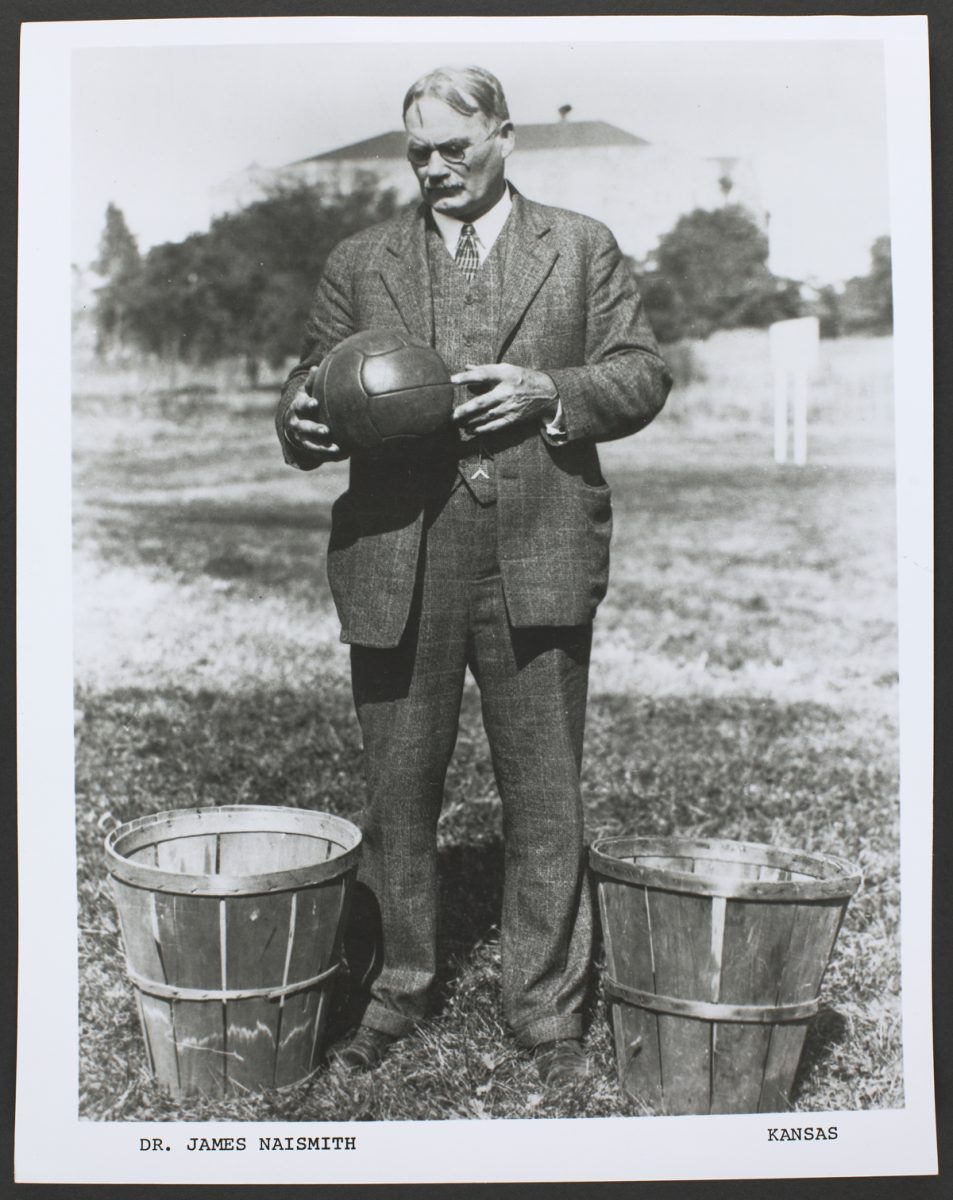 While training to be a YMCA director in Springfield, Massachusetts, in 1891, Naismith was given a class assignment to invent a competitive, less violent alternative to such contact sports as boxing and rugby that could be played indoors during the cold, winter months. Naismith’s original name for his new game was “Box Ball,” but when all he could find were two old peach baskets to hang on the ten foot high railing that surrounded the gym, he changed the name to “Basket Ball.” Years later there were attempts to rename the sport, “Naismith Ball,” but Naismith refused. He went on to become the first basketball coach at the University of Kansas (ironically he is the only KU basketball coach to have a losing record) and lived to see basketball become an Olympic sport in 1936, three years before his death in 1939. Naismith himself awarded the medals, gold to the U.S. and silver to Canada.
 |
| Naismith monument in Almonte, Ontario |
One will find basketball backboards in the driveways of the wealthiest homes and in the poorest neighbourhoods and ghettos, in public parks as well as the gymnasiums and parking lots of schools and churches and YMCA/YWCAs around the world. Many churches have used basketball as a means of reaching new generations of young people with a living experience of Christian community; indeed, the Chinese Presbyterian Church in Toronto began as a mission outreach to Chinese male immigrants to Canada in 1910, providing them with a place to live and a place to gather for recreation. They built a basketball court long before they built a sanctuary! The James Naismith Foundation, established in 1989, maintains the Naismith Museum in Naismith’s hometown of Almonte, Ontario, and supports basketball programs in First Nations communities.
And it all began with one Canadian Presbyterian who dreamed of bringing his love of Christ and love of sports together, and who could only find two old peach baskets to teach his new game of “Box Ball” to his gym class.
With thanks to PConnect
09 May, 2013
BARRETT: MY LATEST LITTLE BUDDY
 |
| Barrett with new sunglasses -- and a stick. |
My latest tiny tot chum is 22-month-old Barrett. Already he gets "Bear" for short. He lives across the street from me with his young mom and grandparents.
Barrett likes lawn mowers, snow blowers, tools of all kinds (his grandfather's) and sticks, any kind of stick. He has a two-word vocabulary, "hi" and "bye", both of which sound pretty much the same. We have great conversations, all one-sided; but I often catch him studying me as if thinking "what a funny guy." When he wants me to sit down he pats a chair, the ground or a step with his chubby hand. I try to comply in spite of my very stiff arthritic ankles. By the time I get down to his level, he is generally off to something else that has caught his attention. He is a great waver and shouts "bye" long after I have left the scene.
His folks are trying to get him to say "please" and "thank you", but I am waiting for the first time he calls me the way he no doubt sees me -- "funny guy".
I've already told Barrett that I think that he is a pretty funny little guy. He makes me laugh!...All kids do.
06 May, 2013
SOLVED: THE MYSTERY OF A 100-YEAR-OLD SHOE SHINE BOX
 |
| I've always had a "shine" for this old box! |
One small wooden box, approximately 8x8x6 inches, has been a life-long possession and has always mystified me. As a matter-of-fact, for a combined 90-plus years, my late father Ken and I have used the box to store shoe shining items (polish, brushes and polishing cloth, etc.).
"Are you kidding? Who shines shoes in this day and age?" you might well ask. And I would tend to agree...I cannot truthfully say when I last polished a pair of my shoes, let alone opened the box.
The interesting thing about this particular box however, which I understand at one time belonged to one of my grandparents, is a sticker or label on the inside of the lid which reads: "The Jones-Eucamed Electro Medical Bandage, manufactured for Dr. William Jones, magnetic physician, Berlin, Ontario No 1.2.3." Berlin, of course, was the former name of the City of Kitchener. It was the Town of Berlin from 1854 until 1912 and the City of Berlin from 1912 until 1916. So my old shoe box has to have been in the Wright family for at least 100 years.
But what about the "Jones Eucamed Electro Medical Bandage" made for Dr. Jones? Curiosity finally got the best of me today as I opened the box to check on the condition of shoe polish which has to be more than a decade old. Two hours of research revealed that during the years 1873 and 1876 Thomas A. Edison made and marketed an electro-medical apparatus he called the "Inductorium" which was reputed to cure rheumatism and to provide "an inexhaustible fount of amusement".
The device consisted primarily of an induction coil with battery and electrodes which were held by the person applying the current to a specific area of the body.
The complete apparatus sold for six dollars ($6.00) and was also said to be used in the treatment of hysteria. For at least two thousand years of European history until the late nineteenth century, hysteria referred to a medical condition thought to be particular to women. I will not go into further detail on that subject nor the "inexhaustible fount of amusement" claim, except to say that doctors stopped "treating" hysteria" in the 1950s.
I was also interested to find that The Thomas A. Edison Papers, Rutgers University, in New Jersey is anxious to know if any of Edison's Inductoriums survive anywhere, public or private, and if any other material related to the devices are still in existence.
I wonder if they would be interested in my box? Nowhere does it say "manufactured by Thomas A. Edison", but there is a very good chance that it was. I wonder too, whatever happened to the original contents. Unfortunately, I have been unable to find information on Dr. William Jones of Berlin, Ontario.
The rest of the story I will never know and maybe that is a good thing. I'm just glad that I finally got around to doing the research and solving the mystery of what was originally in my old shoe shine box.
And, oh yes, the shoe polish is still in useable condition -- if I ever want to shine a pair of shoes.
 |
| Copy of an ad for Edison's "Inductorium" |
25 April, 2013
JUST IN PASSING...
If your prayers are not being answered, there are those who might suggest the possibility that you are beseeching the wrong deity. They might also say that you are making your supplications in an inappropriate fashion. Personally, I do not think that there is a wrong way to pray. There is a wrong way to wish for things, however. Sincere wishes, expressed in a spiritual way and given over to God's universe, are similar to the act of praying and have every possibility of being granted. If that possibility makes you feel uncomfortable, you may be well advised to wish (or pray) for something else.
I like what someone said about addictions the other day...We all have them, right? We might readily allude to the "little" addictions in our life, but some are not quite so little. We might think, "I'm fond of my coffee in the morning." But on that odd morning when we run out of coffee, we realize that we are more than fond of it, in fact we are hooked on it. My friend suggested that situations like that can present opportunities for us. "It is just when we realize just how reliant we have become on something that we are blessed with the greatest chance to learn how to overcome that dependency." Certainly, we do not need to feel trapped by anything in life, but if I'm going to be "hooked" on something I'll take coffee every time.
I like what someone said about addictions the other day...We all have them, right? We might readily allude to the "little" addictions in our life, but some are not quite so little. We might think, "I'm fond of my coffee in the morning." But on that odd morning when we run out of coffee, we realize that we are more than fond of it, in fact we are hooked on it. My friend suggested that situations like that can present opportunities for us. "It is just when we realize just how reliant we have become on something that we are blessed with the greatest chance to learn how to overcome that dependency." Certainly, we do not need to feel trapped by anything in life, but if I'm going to be "hooked" on something I'll take coffee every time.
23 April, 2013
Vote for Madison Brennan - Harrow, ON in the 2013 National Mobility Awareness Month "Local Hero" contest!
NOTE FROM DICK: I am supporting highly-deserving teenager Madison Brennan in conjunction with a National Mobility Awareness Month initiative. Madison is the granddaughter of a friend, Robbie Davis of Southampton, and the daughter of Jay and Carol Brennan of Harrow, ON. A vote for Madison could help her win a 2013 wheelchair accessible vehicle. Just look for her (*Enter to Win...Find A Local Hero) on the National Mobility Awareness Month web site at www.nmeda.com. You can also Google "Madison Brennen, Harrow, ON." to gain access to the voting site.
 |
| MADISON BRENNAN |
Madison is a bright, sociable, enthusiastic 17-year-old girl. She has overcome and surpassed countless obstacles in her life. She was born at 24 weeks, weighing only 1lb 10oz and was given only a10% chance of living. She is profoundly deaf and has Cerebral Palsy which has completely confined her to a wheelchair and is unable to move independently. She has faced many adversities but still has the most contagious smile and laugh you have ever seen or heard. She struggles with the day to day things in life that we take for granted and at the same time you’re inspired by her strength and persistence. Madison enriches the lives of everyone she meets, but as she gets older and bigger she is having increased health issues such as severe chronic tone pain for which she receives regular injections to control the pain and is only comfortable using her electric wheelchair.
Even though she tries to look beyond her disabilities and fit in, she still feels the frustration of her limitations regularly. Now only being able to feel comfortable in her electric chair she is limited even further because school and home are the only places she can go in her electric wheelchair. This vehicle would enrich Madison’s life tremendously. It would help her be able to live a productive life. She would be able to go places like the mall with her friends and out in the community to dances and other events and even to doctor’s appointments in comfort. It would also give her back some of her independence and freedom and help her live her life to the fullest and enable her to continue to inspire and enrich everyone she meets.
Gramma Robbie thanks you in advance for supporting Madison with your vote...I do too! Note also that you can vote for Madison every day until the contest closes.
Gramma Robbie thanks you in advance for supporting Madison with your vote...I do too! Note also that you can vote for Madison every day until the contest closes.
06 April, 2013

02 April, 2013


15 March, 2013
BOY, WHAT I COULDN'T DO WITH $12.5 MILLION
I thought my readers would be interested in an email I received yesterday from a woman in Malaysia. For some reason I get a lot of similar urgent pleas from people (usually women with pathetic stories) wanting to give me large sums of money. I guess I have "sucker" written across my forehead or maybe wrightwords@sympatico.ca has some other giveaway meaning in certain foreign languages. Anyway, should I pass up another opportunity for a cool $12.5 million in hard cash U.S.? Just think of the good that I could do with it...Maybe even skim a mil or two off the top to supplement my fixed income. Ideas, anyone?
From Mrs. Misael Garcia:
Life itself is a misery and nobody can tell what can be of it. Those that can tell what can be of it are those who cannot tell us because they are far from us (dead). if u will want to hear my story. I am the above named person but now undergoing medical treatment for cancer.

I am married to Dr. Garcia who worked with American embassy in Malaysia for nine years before he died in the year 2006.
well i will only try to let you know who Dr. Garcia is by stating his philosophy of life ."life is worth living only if lived to the service of mankind" and "You make a living by what you earn, but you make life by what you give" This will give you an insight of the spirit behind what i believe and what i will live for because he is my mentor.
To continue with my story, We were married for eleven years without a child. He died after a brief illness that lasted for only four days.Before his death we have made something of and from life. Since his death I decided not to re-marry or adopt a child, this is basically my own decision to honor him for the love we shared and the life we lived for. My late husband deposited the sum of$12.5Million (twelve million five hundred thousand U.S. Dollars) with one finance/security company in Europe before his death.

Presently, this money is still with the Security Company.
Recently, my Doctor told me that I would not last for the next three months due to cancer problem. Though what disturbs me most is my stroke. Having known my condition I decided to donate this fund to a church, better still a Christian individual or a Muslim that will utilize this money the way I am going to instruct herein. first you must abide and live with my husband's philosophy, as stated you can't remember please i refer you to read through from the introduction of this letter cause that is the most important aspect that you must uphold.
Secondly I want an organization or an individual that is God fearing who can invest the money and continuously use the money to fund orphanages,widows,the less privilege,the disabled and all those afflicted with strange illness or diseases.

Thirdly this money should not be used in an ungodly manner, or any form of evil or selfishness for that will warrant evil to that persons life and family from generations to generations. For you cannot use the hard earned money of my husband and i for evil or ungodly purposes. If these conditions are met i am not afraid of death for i know where i am going to and my heart will rest in peace.
I do not need any telephone communication in this regard because of my health, for as soon as I receive your reply I will refer you to the contact of the Finance/Security Company in Europe and my doctor who shall arrange
you the letter of claim from the Malaysia High Court of Justice. This will be done if i see from your response that you satisfy the above conditions stated.

As i stated My doctor will issue you a letter of authority that will empower you as the original- beneficiary of this funds (consignment). i choose this means to locate you because i am sure i will be lead by a good spirit to the kind of person that will be honest.
Delay in your reply will not be of benefit to me due to my health condition and this will propel me to search for someone else.Please assure me that you will act accordingly as I stated herein.

Please do get to me immediately

Hoping to hear from you.
In His Services.
Mrs. Misael Garcia