Sharing with you things that are on my mind...Maybe yours too. Come back to Wrights Lane for a visit anytime! And, by all means, let's hear from you by leaving a comment at the end of any post. THE MOTIVATION: I firmly believe that if I have felt, experienced or questioned something in life, then surely others must have too. That's what this blog is all about -- hopefully relating in some meaningful way -- sharing, if you will, on subjects of an inspirational and human interest nature. Nostalgia will frequently find its way into some of the items...And lots of food for thought. A work in progress, to be sure.

27 June, 2016

WE SHOULD ACKNOWLEDGE OUR BLESSINGS

Dream inspired version of what happens in Heaven

A man dreamt that he went to Heaven and an angel was showing him around. They walked side-by-side inside a large workroom filled with angels. The angel guide stopped in front of the first section and said, "This is the Receiving Section.  Here, all petitions to God said in prayer are received."

The visitor looked around the area, and it was terribly busy with so many angels sorting out petitions written on voluminous paper sheets and scraps from people all over the world.

Then the pair moved on down a long corridor until they reached the second section. The angel then explained "This is the Packaging and Delivery Section. Here, graces and blessings requested through prayers are processed and delivered to the living persons who asked for them."  The man again noticed how busy it was there. There were many angels working hard at that station, since so many blessings had been requested and were being packaged for delivery to Earth.

Finally at the farthest end of the long corridor they stopped at the door of a very small station. To the man's great surprise, only one angel was seated there, idly doing nothing. "This is the Acknowledgment Section," the angel guide quietly admitted. He seemed embarrassed.  "How is it that there is no work going on here?" the man asked.

"So sad," the angel sighed. "After people receive the blessings that they asked for, very few send back acknowledgments."

"How does one acknowledge God's blessings?" the man asked.

"Simple," the angel answered. "Just say: Thank you, Lord."

"What blessings should they acknowledge?" was the next obvious question.

The angel was quick with one last answer before disappearing down the corridor:  "If you have food in the refrigerator, clothes on your back, a roof overhead and a place to sleep you are richer than 75 per cent of this world. If you have money in the bank, in your wallet, and spare change in a dish, you are among the top eight per cent of the world's wealthy.  That is a good place to begin with an acknowledgement of your blessings."

So dear reader, if you woke up this morning with more health than illness, you are more blessed than the many who will not even survive this day.  If you have never experienced the fear in battle, the loneliness of imprisonment, the agony of torture, or the pangs of starvation...you are ahead of 700 million people in the world.  Be a thankful acknowledger!

If you can attend a place of worship without the fear of harassment, arrest, torture or death you are envied by, and more blessed than, three billion people in the world.  If you can hold your head up and smile, you are not the norm, you are unique to all those in doubt and despair.  Be a thankful acknowledger!

If you can actually read this Wrights Lane post, you just received a double blessing in that someone was thinking of you as very special and you are more blessed than over two billion people in the world who cannot read at all.  Be a thankful acknowledger!

Have a good day, count your blessings, and if you want, pass this along to remind everyone else of how blessed we all are to be living in this great country of ours.  Help give that solitary acknowledgment angel something to do!

23 June, 2016

A PASSING THOUGHT:

Imperfection is perfection

How many times have your heard someone say..."It's not a perfect world, but..."?

To my way of thinking it is really a pointless statement.  It's all a matter of how you interpret "a perfect world."

The fact that there are imperfections in the world is what makes it perfect. Without negative, there is no positive. It is this balance, and our human ability to experience a range of emotions that makes the world perfect. 

That being said, it is true that there are individuals suffering all around the globe, many of whom would not agree. That negative/positive balance extends to humanity as a whole however, and that means that some lives have to be worse in order for others' to be great. 

Is it not true that we often feel better about our own situation by looking at others who are worse off than we are? If we all had wonderful lives, we would have no frame through which to view them and therefore great would seem mediocre. Our world is perfect because the ups and downs give everything meaning. 

It is funny then that these very ups and downs are often what lead people to wonder what the purpose of life is. Well, newsflash: The purpose of the individual life is to live, and to add our experiences to the overall human experience.

No one (including God) ever promised us a rose garden.  But we have been given a world to nurture into the best garden possible, even going so far as to turning the inevitable imperfect seedlings into perfect productive specimen plants.  

So if you think that the world is not "a perfect place", get over it.  The world IS what you make of it, perfect or otherwise.  Your choice!

20 June, 2016

LET'S SHARE ENLIGHTENMENT!

Do you know what being “enlightened” really means? Does it mean you’re connected to something greater? That you’re more spiritual than most people? Or that you receive intuitive messages from the Universe? The truth is, the real meaning of enlightenment is not something many people truly understand. If you’ve ever experienced even a glimpse of enlightenment, you probably know that it’s one of the most profound, fulfilling and life-changing events one could ever have!

Enlightenment is the neurological vehicle of personal transformation, and it often happens in small or large bursts of insight – those “aha” and “Oh Wow!” experiences that shake up old beliefs when you discover a greater truth about yourself, the world, or the nature of reality.

Curiosity is one of main driving forces in every person’s brain and when we become interested in something new, dopamine is released from the nucleus accumbens, traveling to the frontal lobe and increasing our awareness and consciousness.

Curiosity wakes up your brain, and that “awakening” is the first step of the path toward enlightenment. In a multi-university study conducted in 2015, curiosity was the #1 quality that boosted a person’s sense of well being. Maintaining a high state of curiosity is one of the best ways to maintain a healthy brain because when curiosity wanes, clinical depression sets in.

I’ll have more to say on this subject on Wrights Lane in the days ahead as I explore “enlightenment” with Mark Waldman, one of the world’s leading experts on consciousness, communication, spirituality, and the brain. He recently published an amazing new book called “How Enlightenment Changes Your Brain”.

13 June, 2016

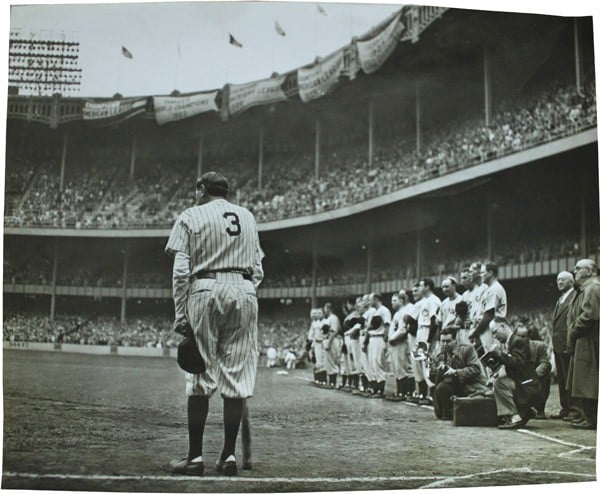
ANNIVERSARY OF THE BABE AND #3 IN ALL-TIME GREAT PHOTOGRAPH

Nat Fein described himself as “just a human interest photographer”, but on June 13, 1948, the young New Yorker captured one of the greatest images of all time as Babe Ruth made his final appearance at Yankee Stadium.

Entitled “The Babe Bows Out”, the original image won a Pulitzer Prize, the first sports photograph ever to earn the prestigious honor. In 1999, LIFE magazine called it “one of the greatest pictures of the 20th century”. Copies reside in the collections of the Smithsonian Institution and the Baseball Hall of Fame.


The story of the photograph begins in the offices of the New York Herald-Tribune on June 13, 1948. Fein was a copy editor, but also knew his way around a camera. When a sports photographer called in sick, the 33-year-old Fein was dispatched to Yankee Stadium to capture images from the 25th anniversary of the House That Ruth Built. In addition to an exhibition featuring past members of the Yankees, The Babe himself was going to be honored with a jersey retirement ceremony. Fein hustled to the ballpark just in time.

Although the word ‘cancer’ was never spoken or written, Ruth was nearing the end of his life and it was obvious from his appearance that he was very sick. He put on the Yankee pinstripes with the aid of two men and after a brief photo session, he waited in the visitors’ dugout for his name to be called. The day was overcast and dank, unusual for June in New York, but fitting for such a painful moment. When it was time, Ruth shrugged off the overcoat that was keeping the chill away, and ambled up the dugout steps. He grabbed a nearby bat—one belonging, it turns out, to Bob Feller, the Cleveland Indians’ star pitcher now in the Hall of Fame, and made his way toward the third base side of home plate using the bat for support.

“He walked out into the cauldron of sound he must have known better than any other man,” wrote W.C. Heinz. Heeding the advice of his picture editor that “natural light catches the mood of the occasion”, Fein chose not to use a flashbulb. He set up behind Ruth, at a low angle and captured the legendary image. Fein avoided shooting Ruth’s tired face and shot from the back, the only place where the now-retired #3 was visible.

There are countless reasons why the photo has been reproduced (most without permission) and stands as one of the most memorable of all-time. Ruth is the largest figure in the photograph, but stands humbled by the giant stadium that he had helped fill so many times, by the realization of time passed and by the adoration of 49,641 fans who had come to cheer him for the last time.

Too ill to stay at the ballpark much longer, Ruth went into the clubhouse and sat down. He shared a beverage with former Yankee Joe Dugan who had just made an appearance in the old timers’ game. According to Robert W. Creamer’s biography, Ruth admitted to Dugan that he was “gone” and the two cried before The Babe was helped from the ballpark. He died two months later.

Shot with a bulky Speed Graphic camera purchased by his mother, the photo became known as “The Babe Bows Out”.

Nat Fein’s career at the Herald-Tribune continued until 1966 when the paper folded, but he continued working until his death in 2000 at age 86. He photographed presidents, European royalty and countless other notables throughout the 20th century, but the image of Babe Ruth’s final moment in Yankee Stadium is his most famous work.

09 June, 2016

ALL YOU EVER WANTED TO KNOW ABOUT GEORGE ORWELL'S NEWSPEAK, BUT WERE AFRAID TO ASK...

Little did good old chum Bob Peters know when he posted a Toronto Sun guest column by Tom Harris on his Facebook timeline a few days ago, that he would send me off on a path of discovery that is rarely traveled by other than very deep thinkers and students of the Queen's English.

In this opinionated but strangely revealing item, Harris (executive director of the Ottawa-based International Climate Science Coalition) accused Prime Minister Justin Trudeau of using "duckspeak" in his approach to climate change; to which I respond: "What else is new?" Duckspeak is not exclusive to our young, otherwise breath-of-fresh-air PM.

U.S. President Barack Obama does the same, asserting in the Cutting Carbon Pollution in America section of the White House web site: “I refuse to condemn your generation and future generations to a planet that’s beyond fixing.”

Referring to greenhouse gases (GHG) as “carbon pollution,” as both Obama and the Canadian government do regularly, is difficult to overlook. “Carbon pollution conjures up subconscious images of dark and dangerous emissions of soot.  What they are almost always discussing is carbon dioxide (CO2). But were they to call it that, most people would be unconcerned, remembering from grade school that CO2 is a trace gas essential for plant photosynthesis."


In his Sun opinion piece, Harris went on to suggest that "We hear it all the time: 'Climate change is real', '97% of experts agree', 'we must increase our use of green energy to reduce carbon pollution'. But it is all 'Duckspeak', precisely what George Orwell warned us about in his novel 1984."
Eric Blair used the pen name
"George Orwell".

At the risk of customarily losing 90 per cent of my readers after the first couple of paragraphs in complex dissertations such as this, I should explain that "Nineteen Eighty-Four" is a dystopian (opposite of utopian) fictional novel by Orwell published in 1949. The story is set in Airstrip One (formerly known as Great Britain), a province of the superstate Oceania in a world of perpetual war.

Further explanation is also necessary at this point.

Thanks to Orwell, Doublespeak, Oldspeak, Newspeak and Duckspeak all reflect deliberately ambiguous or evasive language; any language that pretends to communicate but actually does not. Does this sound familiar?

Duckspeak was a form of speech consisting entirely of words and phrases approved by the controlling party in Orwell’s disturbing vision of a dystopian future. As Harris puts it "Someone who had mastered Duckspeak could fire off ideologically pure assertions like bullets from a machine gun, without thinking, their words emanating from their larynx like the quacking of a duck."

Being called a "Duckspeaker" was a compliment in 1984 since it indicated one was well-indoctrinated in the official language and views of the state.

To properly background these assertions, it is pertinent to take a look at the appendix to Orwell's novel "The Principles of Newspeak", but more about that later.

The term "Duckspeak" first appears in Orwell's novel as being uttered by a chap by the name of Syme (no first name), a philologist and researcher engaged in the compiling of the Eleventh Edition of the Newspeak Dictionary.  Orwell explains that Syme and British Prime Minister Winston Churchill were lunching together in a small underground store cafeteria, jam-packed with chattering patrons.

Syme apparently had reservations about his so-called friend Churchill. He immediately detected Winston's certain lack of enthusiasm for discussing the Newspeak Dictionary project.

"You haven’t a real appreciation of Newspeak, Winston," he said almost sadly. "Even when you write it you’re still thinking in Oldspeak. I’ve read some of those pieces that you write in 'The Times' occasionally. They’re good enough, but they’re translations. In your heart you’d prefer to stick to Oldspeak, with all its vagueness and its useless shades of meaning. You don’t grasp the beauty of the destruction of words. Do you know that Newspeak is the only language in the world whose vocabulary gets smaller every year?"

"Winston did know that, of course," writes Orwell. "He smiled, sympathetically he hoped, not trusting himself to speak. Syme bit off another fragment of the dark-coloured bread, chewed it briefly, and went on. Eventually he fell silent for a moment, and with the handle of his spoon was tracing patterns in the puddle of stew. The voice from the other table quacked rapidly on, easily audible in spite of the surrounding din."

"There is a word in Newspeak," Syme was prompted to interject. "I don’t know whether you know it: DUCKSPEAK, to quack like a duck. It is one of those interesting words that have two contradictory meanings. Applied to an opponent, it is abuse, applied to someone you agree with, it is praise."

"Don’t you see that the whole aim of Newspeak is to narrow the range of thought?" stated Syme with conviction. "In the end we shall make thoughtcrime literally impossible, because there will be no words in which to express it. Every concept that can ever be needed, will be expressed by exactly one word, with its meaning rigidly defined and all its subsidiary meanings rubbed out and forgotten. Already, in the Eleventh Edition, we’re not far from that point. But the process will still be continuing long after you and I are dead. Every year fewer and fewer words, and the range of consciousness always a little smaller. Even now, of course, there’s no reason or excuse for committing thoughtcrime. It’s merely a question of self-discipline, reality-control. But in the end there won’t be any need even for that. The Revolution will be complete when the language is perfect. Newspeak is Ingsoc (the political ideology of the totalitarian government of Oceania) and Ingsoc is Newspeak," he added with a sort of mystical satisfaction. "Has it ever occurred to you, Winston, that by the year 2050, at the very latest, not a single human being will be alive who could understand such a conversation as we are having now?"

Orwell had a brilliant, creative mind and remarkable ability to express it. I am in awe of his writings.

Now back to our boy Tom Harris.  He contends that rather than being merely ridiculous or social satire, the purpose of climate Duckspeak is ominous: To convince opinion leaders and the public to think about climate change only as the government and eco-activists want.

To support alternative points of view is "climate change denial", today’s version of thoughtcrime, punishable by excommunication from responsible citizenry, he adds. "Prime Minister Justin Trudeau sets the stage for climate change Duckspeakers by repeatedly asserting, 'climate change is real'."

Harris allows, however, that Trudeau’s claim is correct but trivial, since the climate is always changing. In his way of thinking, it is the Duckspeak equivalent of proclaiming “sunrise is real”.

It is not surprising, then, that language tricks like Orwell’s Duckspeak are being used today to justify the unjustifiable in the war of words over global warming, and for that matter, every other issue currently addressed publicly by government of all stripes and persuasions.  After all, why make honest admissions and concessions to the public at all costs when there is the technique of avoidance at one's disposal? 

I have half a notion that many politician are not even aware of the fact that they resort to Duckspeak.  It comes naturally to them, as if by the process of osmosis.  

Duckspeak is insatiable.  It has become a fact of not only our politics, but most other aspects of communications in today's society.  Orwell would undoubtedly get a kick out of that.

Like the proverbial bull excrement of current-day vernacular, Duckspeak is capable of baffling our brains -- if we're not careful.

I simply do not believe that the vast majority of Canadians are that gullible. We're just a tolerant breed that is often underestimated by those in higher places.

Let the ducks quack...Give them enough rope until they strangle themselves!
~~~~~~~~~~~~~~~~~~~~~~~~~~~~~~~~~~~~~~~~~~~~

NOTE: Read the following only if interested in further insight to Orwell's thought-provoking creation of the Newspeak Dictionary.  I find it fascinating, but I'm odd that way I guess.

An appendix to the novel, 1984
Written by George Orwell (Eric Blair) in 1948

Newspeak was the official language of Oceania, and had been devised to meet the ideological needs of Ingsoc, or English Socialism. In the year 1984 there was not as yet anyone who used Newspeak as his sole means of communication, either in speech or writing. The leading articles of the Times were written in it, but this was a tour de force which could only be carried out by a specialist, It was expected that Newspeak would have finally superseded Oldspeak (or standard English, as we should call it) by about the year 2050. Meanwhile, it gained ground steadily, all party members tending to use Newspeak words and grammatical constructions more and more in their everyday speech. The version in 1984, and embodied in the Ninth and Tenth Editions of the Newspeak dictionary, was a provisional one, and contained many superfluous words and archaic formations which were due to be suppressed later. It is with the final, perfected version, as embodied in the Eleventh Edition of the dictionary, that we are concerned here. The purpose of Newspeak was not only to provide a medium of expression for the world-view and mental habits proper to the devotees of IngSoc, but to make all other modes of thought impossible. It was intended that when Newspeak had been adopted once and for all and Oldspeak forgotten, a heretical thought -- that is, a thought diverging from the principles of IngSoc -- should be literally unthinkable, a least so far as thought is dependent on words. Its vocabulary was so constructed as to give exact and often very subtle expression to every meaning that a Party member could properly wish to express, while excluding all other meaning and also the possibility of arriving at them by indirect methods. This was done partly by the invention of new words, but chiefly by eliminating undesirable words and stripping such words as remained of unorthodox meanings, and so far as possible of all secondary meaning whatever. To give a single example, the word free still existed in Newspeak, but could only be used in such statements as "The dog is free from lice" or "This field is free from weeds." It could not be used in its old sense of "politically free" or "intellectually free," since political and intellectual freedom no longer existed even as concepts, and were therefore of necessity nameless. Quite apart from the suppression of definitely heretical words, reduction of vocabulary was regarded as an end in itself...

Newspeak was designed not to extend but to diminish the range of thought, and this purpose was indirectly assisted by cutting the choice of words down to a minimum. Newspeak was founded on the English language as we now know it, though many Newspeak sentences, even when not containing newly created words, would be barely intelligible to an English-speaker of our own day...

06 June, 2016

THE NIGHT ERNIE TERRELL AND THE WORLD LEARNED TO ACCEPT MUHAMMAD ALI'S CHOSEN MUSLIM NAME

Here is a newspaper column I wrote almost 50 years ago when I was Sports Editor for the Simcoe Reformer newspaper. I resurrected it this past weekend on the passing of the great heavy weight boxing champion Muhammad Ali. The significance of the column was that it was written at a time when Ali was still known by his birth name, Cassius Marcellus Clay, and he was scheduled to meet Ernie Terrell in a bout that would become part of Ali’s remarkable legend.

Little did I know then what the next couple of decades would have in store for the world of boxing.

The fight took place on Feb. 6, 1967, before a sellout crowd in Houston's Astrodome. To this day, boxing fans call the ring clash “The What’s My Name Fight,” because Ali taunted Terrell in the ring while punishing him for 15 rounds, demanding to be called by his Muslim name, not his “slave” name. But the fight has been terribly misunderstood. With Ali, nothing was ever as simple as it may have seemed.

There was no animosity between Ali and Terrell before the fight. Ali seemed to like Terrell. Both were Southerners. Both fancied themselves singers. Both had fought as light heavyweights in the Golden Gloves. And both lived on Chicago’s South Side through most of the late 1960s.

In 1966, while many state boxing commissions continued to recognize Ali as the heavyweight champ, the World Boxing Association had vacated Ali’s title because of his refusal to enlist in the Army. It awarded the title to Terrell, which lent extra importance to this fight. By winning, Terrell would prove he deserved to be called the champ.


On Dec. 28, 1966, the men were in New York promoting the fight. Terrell, a tall, lean, soft-spoken man, was telling reporters that he’d been waiting years to face Ali, whom he continued to refer to as Cassius Clay. Almost everyone still referred to Ali as Clay at that point. Certainly, every major American newspaper called him Clay. Ali’s parents continued to call him Cassius.

The boxers were in a small room talking to Howard Cosell of WABC-TV, jawing at one another in the way fighters often did while trying to hype a bout, puffing their chests and talking trash. Seemingly out of nowhere, Ali complained: “Why do you call me Clay? You know my right name is Muhammad Ali.”

Terrell didn’t understand why Ali was upset. He answered plainly. “I met you as Cassius Clay. I’ll leave you as Cassius Clay.”

“It takes an Uncle Tom Negro to keep calling me by my slave name,” Ali said. “You’re an Uncle Tom.”

Terrell leaned forward, suddenly angry. As Ali knew, there was no greater insult that could be delivered to a proud black man than to call him a Tom.

“You have no right to call me an Uncle Tom,” Terrell said.

AP_661228014

Ali leaped back and whipped off his jacket and took an openhanded swing at Terrell’s head. Terrell raised his hands to block the blow.

Terrell was no Uncle Tom, and he’d expressed no objection to Ali’s faith. Unlike former heavyweight champion Floyd Patterson, for instance, he had never said that Ali’s religion was inferior to Christianity.

Nevertheless, Ali vowed to punish Terrell for disrespecting his faith and his new name. “I want to torture him,” Ali said. “A clean knockout is too good for him.”

This, too, might have been part of Ali’s brand of psychological warfare, an attempt to get under Terrell’s skin while also hyping the fight to sell more tickets. But it served as a potent reminder that racial conflict permeated everything in the late 1960s, even a fight between two black men.


...And the rest is history!

As it turned out, it was Ali who ended up "buttoning" poor Ernie Terrell's lip and becoming undisputed world champion in the process.  Give Terrell credit, he did not go down for the count and gave a good account of himself; but he was no equal to his opponent's lightening fast jabs and unique bob-n-weave style.  He was methodically "punished" for not calling Cassius Clay by his new assumed Muslim name.

There will never be another Muhammad Ali!...No one will ever even come close to the most controversial, yet revered, boxer in the history of the sport.  Who will ever forget the career-launching, stunning upset over the previously "unbeatable" heavyweight champion Sonny Liston and the "Thrilla in Manila" that pitted Ali against the ring warrior Joe Frazier?

Truly an all-time legend who floated like a butterfly and stung like a bee.

*Here is an enlarged print copy of my column...At least you can get a better idea of what I wrote as a lead up to the fight.  


NOTE:  Ernie Terrell predeceased Muhammad Ali by a little more than a year. He died January, 2014 at 74 years of age.  He suffered from dementia the last few years of his life.  Ali died from complications of Parkinson's disease on Friday, June 3. He too was 74.     It is difficult to believe that the two perfect specimen gladiators in the accompanying highlights video are now gone.

02 June, 2016

WHAT KIND OF RELIGION WOULD YOU CREATE, IF YOU COULD?

In a tongue-in-cheek jab at the widespread reverence for religion, the left-leaning aggregated blog site Huffington Post not long ago announced a “create your own religion” competition for its subscribers. The humorous publicity stunt asked readers to submit a description of their own invented religion, which would be posted to the site to compete for followers. The religion with the most followers was to have won.  I do not recall ever seeing a followup to the competition proposal...The challenge may have been far too complex and presumptive for followers of the thought-provoking and often controversial site.

Needless to say, however, this was a fantastic and lighthearted way to find out what the public might say, but it also forces us to wonder what people believe in their heart of hearts. While the aim of the Huff Post competition was obviously comedic, if you could create your own religion, what kind of religion would it be?
The Cosmic Christ 

The competition gave examples of some of the most instantly recognizable images and symbols of the world’s major religions and faith traditions, asking readers how their religion would stack up with the others. Some of these religions were ancient and revered, and others, relatively novel and controversial, encouraging readers to be inventive and consider the possibilities. “You’ve got the long hair, the nice bushy beard, and lots of beliefs, but you don’t have the 2.2 billion adherents worldwide” the description read, alluding to the religion founded on the teachings of Jesus Christ; “[o]r perhaps you’re chubby and like to sit cross-legged, but no one is making statues of you”, it also read, evoking images of the Buddha of eastern thought. Even Scientology was hinted at: “maybe you’re a mediocre sci-fi writer that wants people speaking your pseudoscience [sic]”. Essentially, what the competition called on readers to do was to create a distinctive religious brand and market it as the most attractive product in order to win the most adherents.

This was all very amusing, but quite honestly I actually gave this subject some naive consideration at one time (before the Huffington Post article)...I quickly came to the rational conclusion that there would be many mind-boggling things to take into consideration in creating a new religion. One was the type of god or deity to be worshipped, or would I keep the old one?  Would my ideal religion be monotheistic, polytheistic, atheistic, or pantheistic? 

My religion could possibly have a single male god, or perhaps a goddess. It might have a god as well as a goddess, or a trinity, triad, or similar combined form in which a single deity takes on multiple aspects. Perhaps we could have no god, a gender-neutral deity, or an entire pantheon of gods. Holidays and rituals are also important, since they set aside a place and time to practise your religion. Would sermons, worship services, and ceremonies be held inside a special building, at home, or in nature? What type of holidays could we have, what would they commemorate, and what kind of rites and sacraments would they involve? 

Perhaps most important of all is the set of beliefs, doctrines, and creeds that would provide a foundation to theology espousing a moral framework, or blueprint, for living life. Naturally, you would need to provide a statement of beliefs and policies regarding things like marriage, sex and love, salvation and atonement for sins, crime and justice, war, and the role of other religions.  Of course, these were just off-the-top personal considerations and they were only the tip of the iceberg, but nonetheless an eye-opening starting point for me. 

Not too surprisingly, I eventually discovered that I was continually being influenced by the Presbyterian denomination in which I was born and raised. After all, more often than not, an honest person will be able to name at least something about his or her religion that could be improved, and other aspects of it that are appealing and have served the test of time.  Bottom line?  I had to concede that there was much more to religion than just going to church on Sunday, and it was far beyond my simple mind to consider changing any of it, let alone create something new to attract followers. 

In subsequent years, I immersed myself in church doctrine and was dedicated to delivering messages of inspiration and truth to those who would listen. Sadly, I perceived myself as being ineffectual as a lay minister...Perhaps it was because I was not ordained in word and sacrament sufficient (in my mind) to be accepted by the handful of faithful sitting in the pews.  Then again, I may have lacked the fortitude to cope with church politics, of which there is an abundance. I came dangerously close to developing a complex and have since given up trying to rationalize it all. Today, I simply walk alone with what is left of my religious convictions.  I find it easier this way -- marching to the beat of my own drummer!

...And what about New Age thinking?

Meanwhile, I struggle to accept The New Age era which is based on concepts that sound almost irresistible. Like Eve, some hear the spiels of modern gurus like Tolle and Willamson and begin to think the faith of their fathers is too rigid, too narrow – that God would never impose an "irrational" boundary between us and "full knowledge of the spiritual realm."

Sometimes the lie creeps in subtly as Christians begin to research natural or holistic medicine – alternatives which can be very God-honoring but for years were shunned by Christians, thus becoming New Age territory by default. Or a doctor may recommend yoga or meditation to reduce stress. No matter how uplifting and innocent some New Age practises appear, Christians need discernment in these areas, just as at the seashore they need to know where the undertow begins.

The more we understand the distinctions between New Age religion and Christianity, the less vulnerable we are ourselves and the better able to address the confusion of people who may be – as I once was – earnestly seeking the truth.

What exactly is the New Age? Impossible to narrow down, the New Age is actually a vast smorgasbord of beliefs and practises. Each New Ager fills his tray with whatever assortment fits his appetite. All is liberally seasoned with self-centeredness. It's really a Have-It-Your-Way religion – thus its modern appeal.

Although there are many branches of New Age thought – ranging from meditation to fire walking – they stem from an ancient stock. The roots of the New Age tree spread around the globe to India. One might think that the desperate, degraded human condition of a land dominated by Hinduism would speak louder than words about the truth of the religion. But New Agers seem blind to the contradiction.

New Agers do not believe in evil. Therefore, they do not accept man's problem as separation by sin from God. Instead, they believe that each of us has forgotten his or her own divinity. Therefore, the New Age solution is to seek "higher consciousness" through meditation, breathing exercises, yoga, diet, crystals, channeling. spirit guides, and more. Each of these diverse practises has the same purpose: to awaken the god in man.

While these practises may seem too far out to pose much of a threat to those abiding in the truth, Christians need to be on guard. In the past 20 years, New Age influence has been steadily creeping into our culture in schools, corporations, and doctors’ offices. Since Star Wars, movies have become dominated by New Age spirituality. Reincarnation, karma, the cosmic consciousness – all these once obscure ideas have become commonplace.

A true understanding of New Age practises makes one thing clear: Eastern practises cannot be blended into Christianity to produce something better. New Agers are Universalists, believing that all paths lead to God. They fault Christians for being intolerant and narrow-minded. But God's word anticipates this: "Enter the narrow gate. For wide is the gate and broad is the path that leads to destruction, and many enter through it. But small is the gate and narrow the road that leads to life, and only a few find it." (Matthew 7:13, NIV)

The good news is that, in a way, the New Ager's broad acceptance holds the key to getting back on the straight and narrow. Most New Agers hold Jesus in high regard, believing Him to be a great spiritual teacher, or guru. Many study the words He spoke, although they put a different spin on them.

How can we reach those under such subtle deception? The answer is Jesus Himself. Since Jesus is "the Way, the Truth, and the Life," He Himself can be the common ground on which the New Ager and the Christian can meet, though one stands in darkness and one in light.

And remember, God loves New Age seekers too!


It's the likes of me that I sometimes of wonder about!

25 May, 2016

GOOD NEWS: SALT IN YOUR DIET IS NOT GOING TO KILL YOU!


Once you're diagnosed with high blood pressure like me, you practically have to keep the salt shaker hidden under your mattress. You'd actually think the Morton's Salt girl was carrying a coffin instead of an umbrella!

But now a new Canadian study might just be the final end for the Great Salt Myth. Researchers have proven that if you have high blood pressure, cutting back on salt isn't just dangerous, it might in fact even kill you.

It doesn't seem to matter how many studies come out on the health benefits of salt -- or that our bodies can't survive without it. The mainstream -- and our government -- aren't about to admit they've been giving terrible advice to people with high blood pressure for decades.

Just ask Dr. Andrew Mente, a top researcher from McMaster University. Mente has been under constant attack since he released his new study proving that a low-salt diet can be a death sentence for people with hypertension. Of course, if the people who are attacking Mente would bother to read his study, they'd see he's right on the money.

I find it interesting that Mente actually pooled together the results of four different studies involving 133,000 people from 49 different countries. And he found that cutting back on salt is a lot more dangerous for you than eating too much of it.

In fact, people with high blood pressure who consumed less than 3,000 mg. of salt a day were a whopping 34 percent more likely to have a heart attack or stroke.

Even if you don't have high blood pressure, a low-salt diet can increase your heart attack or stroke risk by a frightening 26 percent. You'd think that would be enough to get the mainstream thinking twice about its war on salt. But it doesn't look like that's going to happen any time soon.

The minute the ink dried on Mente's study, a former president of the American Heart Association claimed he wasn't buying it -- and that it "should not be used to guide public policy." Are you kidding? If a study with 133,000 people won't convince the AHA, it looks like nothing will.

The AHA has spent years recommending a dangerous 1,500 mg. salt limit for high blood pressure -- and it's not about to admit it's been putting all of us in harm's way. These guys probably still believe that the Earth is flat and the moon is made of green cheese (and low-salt cheese at that)!

But the fact is, Mente's study wasn't the first to prove that the science behind low-salt diets is paper thin. A study out of Germany 12 years ago also found that ditching salt is unhealthy for seniors. Most North Americans consume about 3,400 mg. of salt a day -- and that's right where we should be, according to this latest research.

If you have high blood pressure and have been purposely depriving yourself of salt, print this article and show it to your doctor. See what he/she has to say about salt used with moderation in your diet.

Your taste buds may be glad that you did!

...And I'm glad to know that it is not going to kill me. I've never been a heavy salt user anyway but I always like it on my French fries.

19 May, 2016

TRUST THE UNIVERSE: THANKS GOOD FRIEND...I NEEDED THAT!


I take the liberty of publishing an email I received from a friend today.  I am sure she would not mind. There just might be one or two other friends who will appreciate it as much as I did.


Dear Richard,

Shit happens. It just does.

We have good days, bad days, and mediocre days. One day we feel great...top of the world.  The next day we feel like crap, get in a car accident, or worse.

Life is great. Life sucks.  This is just how it is......one step forward, two steps back.

So...here's the BIG question: Why do so many of us live as if feeling bad is so WRONG?

I think there are two answers to this question:

#1 is that we were raised on the old Alka Seltzer jingle "plop, plop, fizz, fizz, oh what a relief it is." We're programmed to believe that there is a pill to pop to alleviate every pain or discomfort. (Even though we all know that physical pain is a necessary signal that something is calling for our attention.)

#2 we don't believe that the Universe always has our back. Quite simply, we don't trust God. We assume that whatever is happening...whether it's loss of a job, heartbreak, illness, betrayal, unexpected money issues, or roadblocks to our heart's desires... we take it as a sign that we are doomed and more bad is on the way.

While just like everyone else I would rather avoid pain, in six decades on this planet, I've discovered that my greatest, most extraordinary "wins" in life have all come as a result of my most painful and difficult experiences. Over time I've learned to cultivate trust in the Universe.

As I began to witness in my own life that from the darkest times came the brightest results. I found the ability to trust both God and myself. I consciously sought out proof that the bad times were the soil in which my dreams came to fruition. (And yes, I admit, that I often wished for a genie in a bottle to make it all easier for me.)

If you are having a great day today, take a few moments to close your eyes, drop into your heart and really feel how grateful you are. Deeply breathe in this gratitude and savor it.

And, if today is a bad day, close your eyes, drop into your heart, and take a few moments to feel what you are truly feeling....and then see if you can conjure up true gratitude for the possibility of the most wonderful thing that will soon come to you as a result of this difficulty.

Wishing you love, laughter and magical kisses,

15 May, 2016

RUNS TO MARK "TOM LONGBOAT DAY" IN CANADA, JUNE 4

It is not likely that many of my readers will know that Saturday, June 4, is "Tom Longboat Day" in Canada.  Who was Tom Longboat, you might well ask?

Tom Longboad and his trophies
Longboat was a world-champion, long-distance runner who, in 1907, won the Boston Marathon in a record time of 2:24:24 and went on to win many other races and claimed the title of Professional Champion of the World in 1909. He was the first person of First Nation descent and only one of two to ever win the Boston Marathon.

His feats were on a par with those of the legendary American Indian Olympic champion Jim Thorpe.

Born on Six Nations Reserve, east of Brantford, in 1887 with his First Nation's name Kakwe.ik (Everything) and a Residential School survivor, Tom Longboat would go on to become a Canadian Army dispatch runner in France during World War I.
He was inducted into both Canada's Sports Hall of Fame in 1955 the Ontario Sports Hall of Fame in 1966 and the Indian Hall of Fame.  Each year, the Toronto Island 10K race commemorates his memory and First Nations' athletes from each province, both male and female are selected for the Longboat Award.

By no coincidence, the 28th Annual Huron Shores Run is also scheduled for June 4 this year and to commemorate "Tom Longboat Day", the event will begin with the dancers and drummers from nearby Saugeen First Nation in prayer at the Coliseum in Southampton.  They will then lead the runners and walkers down High Street to the starting line, both at 7:30 and and 8:30 a.m.  (I'm going to try to get up early enough that morning to take some photos, but I won't be wearing running shoes -- been there and done that!)

The run is for every age and ability -- Kids' Fun Run, 3k, 5k, 10k Runs, Half Marathon Walk and Run. For those who can't run, no problem...They can get their 10,000 steps in by entering the 5k Walk and collecting pledges or by sponsoring someone they know.

Again, this year, the Rotary Run is partnering with the Town of Saugeen Shores that will hold a Health and Wellness Fair at the Coliseum where the awards ceremony and a lunch for participants will also take place following the Run. Commendably, proceeds from the event are shared by the local Saugeen Memorial Hospital Foundation, Rotary projects in the community and the Saugeen Track & Field Club.


Tom Longboat runner athlete marathon Olympian NOTE:  In 1998, as one century was about to end and another begin, Maclean's magazine ran a list of the 100 most important Canadians in history, dividing them into 10 categories, with 10 names in each category. In the Stars category, reserved for the best in celebrity the country has had to offer, the number one spot went to Tom Longboat. And in the list of the top 10 Canadians in history overall, Longboat came in ninth spot, sharing the list with the likes of William Lyon Mackenzie King, Glenn Gould, Nellie McClung and K.C. Irving.  Tom is recognized in numerous books, articles, and web pages. As well, various races, scholarships, clubs and a school have been named in his honor -- even a Canadian commemorative postage stamp.

07 May, 2016

Cardboard Retreat - Jim Armstrong

Jim Armstrong's Cardboard Retreat is a powerfully poignant anthem about the plight of homeless Armed Services Veterans. An alarming number of service people are returning to their homeland with no real place to call home. Collaborating with America's non-profit, http://www.VoicesUnitedForVeterans.org and their sister organization in Canada http://www.Mats4Pats.ca, Jim and other like-minded artists performed their music to raise awareness and dollars to support the day-to-day work of helping returning heroes reclaim their dignity.....SEE JIM'S STORY IN THE POST BELOW and keep this video playing as you read it. 

06 May, 2016

JIM ARMSTRONG: WAS A RESPECTED MUSICIAN, SONGWRITER, DEFENDER OF THE UNDERDOG AND ALL-'ROUND GOOD GUY FROM SOUTHAMPTON

On Monday (May 2nd.) at 1:31 p.m. hikers walking along the Lake Huron shoreline at MacGregor Point Provincial Park, came across a body floating just off shore.  The body was transported to London where an autopsy was performed and later identified as that of missing person Peter James Armstrong. No foul play was suspected and the cause of death will not be determined until the results of toxicology are completed and reviewed by the coroner's office.

Armstrong was last seen at 9 00 p.m., March 9, at a relative's home along the Saugeen River in Southampton. An extensive search was conducted by the OPP Emergency Response Team, the Saugeen Shores Police Service and the Saugeen Shores Fire Service over the weeks that followed.

You may, or may not, have picked up on such sparse information from a press release circulated in recent days.  Fifty-three-year-old "Jim" Armstrong was a quiet, unassuming guy who flew under the radar most of his life but trust me there was much, much more to him than that.  To his friends and associates in the music world in and around Toronto he was well-thought-of and deeply respected.  Only in Canada, you say!

The body those hikers found along the shoreline earlier this week belonged to a songwriter, multi-instrumentalist and producer with decades of performing and recording to his credit.

Jim Armstrong, in concert
Jim's Armstrong's story deserves to be told.  His work was recently compared to the master singer-songwriters of Americana roots-rock — Bruce Springsteen, Steve Earle, Tom Petty and Canada’s own Fred Eaglesmith — in that their music shares a working-class sensibility and honesty.

He was a self-taught multi-instrumentalist with drums being his first instrument. His mother Marie's short-lived attempt at sending him off to a piano teacher as a young boy did not last too long. The teacher soon twigged to the fact that he was just playing back the songs he picked up by ear and not bothering to learn to read the actual sheet music. He was always creating music and was a touring drummer from the age of 10. He was a lifeguard; he played sports and earned two college degrees.

Jim never let epilepsy and encephalitis stop him from accomplishing things even when he was first diagnosed with his condition and spent many weeks and months in and out of hospitals as a youngster growing up in Southampton. However, by his late 20s, his seizure activity began to increase and the medications were not working as well anymore. He sometimes considered it a blessing in disguise that he was forced to stay home and concentrate solely on music. In his early 20s he was also playing guitar, bass, keys, harmonica, sax, and writing and recording solo pursuits. 

Jim underwent surgery in 1992 to minimize the effects his seizures.  It was an unnerving prospect because the risks were great -- death obviously, but also paralysis and a possible loss of musical abilities, brain damage, you name it. Faced with these risks Jim began writing a lot of new material as the surgery date approached. He felt he needed to stockpile as many songs as he could in case he could never create music again.

Fortunately, the surgery was fairly successful. He still needed medication and he continued to have some seizures "but I can cope," he said at the time. It wasn’t the easiest recovery though; he was temporarily paralyzed and had to force his body to pick up the guitar and drum sticks again. Three months after surgery he recovered sufficiently to begin recording and producing his first Sonic Deli Records release, a compilation CD entitled "Brown Bag Lunch" and forming his own band.

Four of the songs on Jim's "Mudtown" album were first included on Brown Bag Lunch; "Angel In Our Corner", "Hole In His Heart", "Tomorrow's Gonna Be Grand" and "Oxygen Kiss". They were from the pre-surgery time when he was madly stockpiling material. "Imagine my surprise though, when people kept telling me that they loved these songs and why wasn’t I out there performing them? Well, my performing days had always been spent behind a drum kit, not singing and playing a guitar or as a front man," he wrote on his web site a few years ago.

"Mostly, I’m just happy to still be alive; able to do the music I love to do and hope that people will get to hear that music, like my songs and even come out to hear my band perform them on occasion," he added.

In the early 1990's, Jim was fortunate enough to meet songwriting and business manager, Andrea Poulis, and began to collaborate with other artists.   Today Andrea is Director of Music and Canadian Programming, Radio 11.3X in Toronto and President, Artist Management, Sonic Deli Records. Together, Andrea and Jim worked with various singers and musicians in many different genres, developing their craft. It was also during the early nineties that they hooked up with bass player, Wes Miller. who had played just about everywhere in North America over the years and became an integral part of the writing process, co-engineering and co-producing Mudtown in conjunction with Sonic Deli Records.

Almost unbelievably, with the exception of the bass guitar and some of the lead guitar tracks, Jim played all the instruments on the Mudtown album.  The official bio for the album declared:

"Mudtown is a straight ahead alt-roots-rock album that shoots from the hip and aims at the heart. With his first solo CD, Mudtown, Toronto-based musician Jim Armstrong has crafted a collection of 13 songs with musical and emotional hooks that stick unshakably with the listener. He has also scored films such as Canton Film Studios' The Adulterer's Guide to Toronto (2007). Now, he’s stepping authoritatively in front of the curtain to unveil "Mudtown", his solo debut.  The title and driving spirit of Mudtown were born during Armstrong's wanderings through downtown Toronto, where he lives, works and walks his dogs. Armstrong explains, "Life can be dirty, rough and mean, but there's a breed of people who struggle against the grind and somehow keep their humanity. They don't get hard, like the city, and that's what makes Mudtown livable."

"They made me sound like a pro," the laid-back and almost embarrassed Jim was known to say about the glowing words on the album cover..

Jim Armstrong was a genuine hero and an inspiration to all who are faithful to their art. True enough, he defended the underdog through his music by dispelling the modern myth of perfection. He wrote songs about real characters from everyday life, singing their stories with the passion of the human justice activist that he was.  

Often labelled a "troubadour", Jim and his The Sonic Deli Band were annual regulars at the International Buskerfest run by the charity Epilepsy Toronto for which he was an official spokesman.

Not long ago, Jim had this to say about where he found himself in life: "If, four years ago, someone had told me that I would be back on a stage performing songs from my own album, I would never have dared to believe them. Oh, I knew that I wrote some great music and I loved creating new songs all the time, but I had reached the point where I was beginning to despair of living any sort of normal life – let alone be out singing my songs somewhere."  One has to wonder what was on his mind when he disappeared, lightly clad and supposedly without his medications, into the sub-zero dark of that Southampton night two months ago...Maybe it is better that we will never know.

He was reported to have been experiencing some mental health and emotional issues in recent months.

The 2 Kens (comedy team Ken Main & Ken Devoe) recorded a wonderful and revealing radio show tribute to Jim and his music today (Friday). Please scroll down and click on the mp3 link to have a listen...I leave it to those two good friends to have the last words on this post.  It is an extremely moving tribute.

"This week we lost our dear friend, Jimmy Armstrong, an extraordinary man who touched so many lives with his music and countless more with his great big heart. We put together a short tribute to our friend. You can immediately listen to the mp3 here. http://traffic.libsyn.com/…/2Kens_Remember_Peter_James_Jim_… Please share this freely with everyone who appreciates knowing that there are still good people out there who champion the underdog -- and never make a peep about it. Jim Armstrong certainly was that.

"While there seems no bottom to our sorrow, it is uplifting to learn from Andrea Poulis, Jim’s music partner, co-songwriter and BFF these past 25 years, of the massive outpouring of love, compassion, kindness and appreciation for Jim’s life, his loving way and, of course, his wonderful music. Jim believed in paying it forward. It goes on and will go on.

"We love you, Jimmy! Thank you for sharing your special gifts. Rest in peace, great friend. We’ll be okay, don’t you worry. We know because you promised, “Tomorrow’s Gonna Be Grand.”  -- Ken Main & Ken Devoe, 2Kens Comedy

Now you know the story that was not included in that earlier matter-of-fact "missing person found" news release.  Jim is no longer missing but he will be missed!


05 May, 2016

IS TRANSFERRING A BRAIN ONTO COMPUTER ANSWER TO IMMORTALITY?


Followers of Wrights Lane may think that I am a bit preoccupied with the brain-as-a-computer concept (or vice versa) but I find the subject a fascinating one worthy of consideration.
How long has the human race sought immortality? The fountain of youth is a famous legend for a reason, and we’ve all heard numerous stories involving potions of everlasting life. There is even an entire industry devoted to freezing your body in the hopes that future technology will be able to revive you. As humans, we’ve always sought to become immortal through the preservation of our physical forms. Aging, however, is a natural process – while we can certainly slow it down with modern medicine, we cannot stop it completely. But what if we’ve been looking at immortality from the wrong angle all along?

Cyber Immortality

Scientists are now suggesting that the answer to achieving immortality lies not in preserving our bodies, but in preserving our minds. If you think about it, the human brain is akin to a high-powered computer. So, what if we could copy all those files stored in our brain and simply transfer them to another computer? Many important thinkers agree that it may be possible.
“I think the brain is like a program in the mind, which is like a computer, so it’s theoretically possible to copy the brain onto a computer and so provide a form of life after death” – Stephen Hawking
This idea is reinforced by the fact that computer power has grown exponentially over the past few decades, and continues to do so. Google’s director of engineering, Ray Kurzweil, has suggested that we may be able to transfer the entire human brain to a computer within forty years.
The technology itself is also progressing quickly – scientists have already been able to replicate some functions of the brain. For example, a team led by neurology professor Henry Markram was able to successfully simulate part of a rat’s brain. Although replicating the entire human brain is still a long ways off, it’s likely to happen within some of our lifetimes. As with any revolutionary technology, it will undoubtedly come with a hefty price tag. However, think about the payoff. Can you really put a price on immortality?

Coding Consciousness

The biggest remaining question surrounding this issue involves consciousness. It’s one thing to replicate the computer-processing elements of the human brain, but what about the more complex aspects, such as feelings and emotions? Is it even possible to ‘code’ consciousness? On this important aspect, the experts disagree.
Some scientists are convinced that if given enough time and research, this technology will eventually succeed in simulating consciousness.  And in fact, this work is already underway. Leaders in the field of artificial intelligence are currently developing robots that can reason, think, and even learn by imitating the human brain. Recreating human emotions will be difficult, but the technology is progressing quickly.
However, other scientists remain highly doubtful about the possibility of ‘manufacturing’ consciousness. According to well-known neuroscientist Miguel Nicolelis, “there are a lot of people selling the idea that you can mimic the brain with a computer”. While this sounds good on paper, he says, “you could have all the computer chips in the world and you won’t create a consciousness.”  Until more progress is made, the jury may be out on this question.

Are We ‘Playing God’?

Either way, this is groundbreaking technology we’re talking about. Once it becomes affordable, we will be faced with an existential question: do we consider our mortal lives sufficient, or should our brains be allowed to live on in cyber form? There also exists a moral quandary here – some may argue that this technology is equivalent to ‘playing God’. 
Do we have the right to interfere with the universe’s plan for us? If it becomes an option, would you sign up to download your brain to a computer?  Personally, knowing me and my muddled mind as I do, I'd be afraid to!
Think I'll take my thoughts to the grave with me...That is, those that I have not already committed to Wrights Lane.