Sharing with you things that are on my mind...Maybe yours too. Come back to Wrights Lane for a visit anytime! And, by all means, let's hear from you by leaving a comment at the end of any post. THE MOTIVATION: I firmly believe that if I have felt, experienced or questioned something in life, then surely others must have too. That's what this blog is all about -- hopefully relating in some meaningful way -- sharing, if you will, on subjects of an inspirational and human interest nature. Nostalgia will frequently find its way into some of the items...And lots of food for thought. A work in progress, to be sure.

03 February, 2017

BILL VIGARS WAS A TERRY FOX CONFIDANTE AND AN INTERESTING GUY

Bill Vigars helped organize Terry Fox's Marathon of Hope in 1980. On Sunday, Sept. 18, 2016 he 
was in Port Coquitlam, B.C. for the Annual Terry Fox Run with a replica of Fox's artificial leg.
Bill Vigars was an unusual kid, but in a rather good way. He was impish, funny, clever and prone to the unexpected.

Growing up in the then "railroad city" of St. Thomas, ON in the 1950s and '60s, he was a member of a salt-of-the-earth Catholic family that was firmly entrenched in the community. It was while a student at St. Joseph's High School that Bill began to come into his own as a think-outside-the-box creative thinker. You just knew that, with a twinkle in his eye and a hint of a permanent smirk indicative of something mischievous going on in his mind, he was destined to march to the beat of his own drummer. And, boy, did he ever! 

He cut his teeth in communications as a student reporter/announcer with CHLO radio in St. Thomas at a time when I was toiling as sports editor for the local Times-Journal newspaper. I was secretly fascinated by the hidden potential of the young man, but little did I expect that four decades later the Toronto Star would call the same Bill Vigars "one of the Top Ten Public Relations People in Canada” and “The Rainmaker” and a publicity "guru" by Maclean’s Magazine.
Bill Vigars today

As fate would have it, Bill somehow stumbled into acting early in his career, among a number of other notable achievements in a remarkable span of 40 years, and counting.

His first thespian venture was on the 1980's CBS late night series "Night Heat", where he acted in more than 25 episodes as, oddly enough but not too surprisingly, either a drag queen or wino. He also worked with a wide range of talent from the Bowery Boys' Huntz Hall, to Diane Lane, Phyllis Diller, Buster Rhymes and Donald Sutherland.

But I am getting ahead of myself just a bit at the risk of not doing justice to the best part of The Bill Vickers Story -- his remarkable, abbreviated, behind-the-scene involvement with the iconic Terry Fox and the historic Marathon of Hope for Cancer in the summer of 1980, all of which was later chronicled in two movies "The Terry Fox Story (1982) where Bill was portrayed by Hollywood's Robert Duvall and the 2005 CTV version "Terry", where his character was portrayed by Canadian actor Matt Gordon.

In 1980 it seems, Bill landed the job as Director of Public Relations and Fundraising for the Canadian Cancer Society's Ontario Division. He explained in an interview his fateful brush with history this way: "I had only been with the Cancer Society for three months, when I received a note around mid April, from my boss about Terry's quest. At that point I began following him through the news at the beginning of his Run. My first interaction with Terry came when he called from a payphone in Nova Scotia. He was a little down, as things weren't going as planned and I wanted to boost his spirits. I asked him how I could help him in Ontario and he mentioned events that might involve the CN Tower, the Toronto Blue Jays and his hockey heroes Darryl Sittler and Bobby Orr."
It was in Edmundston, NB, that Bill first met Terry. With approval of the Cancer Society, he left his work behind in Toronto and drove east to meet Terry, his brother Darryl and best friend Doug Alward. "After sleeping for awhile in the back of my car, I rolled out of the vehicle at 4:00 a.m. to be greeted by Darrel Fox who inquisitively asked, 'You're the guy from the Cancer Society?'" Bill recalled.

The next four days Bill spent in the van, trying to get routes down pat and organizing an itinerary for the trip through Ontario, even arranging meetings with Terry's favorite hockey players, the aforementioned Orr and Sittler, and Prime Minister Pierre Trudeau. He never left Terry's side for the duration of the marathon and became a close friend and confidante. He said that Terry struck him as a regular guy who was incredibly determined, focused and who saw the run as an athletic feat. "Terry moved people as he spoke from the heart and had an incredible intensity of purpose. He also really enjoyed the company of children, a good debate and had a great dry sense of humor."

One thing that impacted Bill along the tour, was how emotional it was. "We heard stories all along the route from people who had lost friends and family to cancer. You could see the emotion in their eyes as they gave support to Terry. It was tough".

Throughout the Run, an interesting trend was noted. Dollars that were collected in hats, garbage bags or anything else, were often crumpled. "What was happening," Bill explained, "is that people waited along the routes, sometimes for a few hours and there was so much emotion in anticipation of seeing Terry, that they ended up clutching their donations in their hands until he arrived."  By contrast, today the Terry Fox Foundation has raised more than $700 million for cancer research, thanks in large measure to volunteers and organizers of the 9,000 runs across Canada each year, 

Bill remembers the heat of that summer — thick, wet, insufferable heat that would glue a shirt to your back in minutes. He remembers the crowds, too. Everywhere they went, folks waving and grinning from the sidewalks, kids standing on tiptoes to catch a glimpse of the man skip-hop running down the highway.

But by far the most vivid memory Bill has of that celebrated journey is the July afternoon at a motel on Highway 7, when Terry Fox threw a clubhouse sandwich and fries at his head.

This was a little more than halfway through the now-legendary marathon that began in St John’s, Nfld., on April 12, when Fox dipped his artificial leg into the Atlantic Ocean and headed west. He crossed into Ontario at the end of June.

Battling bone bruises, blisters, shin splints, cysts on his stump and extreme exhaustion, Fox ran a staggering 42 kilometres — pretty much a marathon — every day. He would do 20 km before breakfast, another 12 after a mid-morning break and the final 10 after a noon nap.In the evening, he would do brief public appearances, have dinner and go straight to bed.

The sandwich-throwing incident took place at a motel somewhere along Highway 7 in late July. Bill can’t remember the name of the place. He recently tried to find it by navigating the street view on Google Maps, but said he kept getting lost in all the new subdivisions that have since been developed.

Coincidentally, I stood curbside in a crowd on Queen Street East (Hwy. 7) in Brampton that same day in July as Terry and his entourage passed through. I vividly remember the feeling that I was witnessing history in the making as Terry hippidy-hopped three feet in front of me with a sense of purpose. He had a lopsided gait, dubbed the Fox Trot — two hops with his good leg to match the longer stride of his artificial leg. He was expressionless, as if in a trance, his eyes focused on the road ahead. I instantly detected a haunting aura about him that defies description to this day. As Terry disappeared into the distance with the red lights of his police escort flashing behind him, I just stood there for a few minutes processing what I had just experienced. I later purchased a Marathon of Hope T-shirt as a souvenir of the occasion.

The Highway 7 that Bill remembers was just a simple two-lane road with gravel shoulders in those days. Fox would run along the edge of the pavement with a police cruiser trailing behind him. His friend Doug and brother, Darrell, travelled ahead in a van. Fox’s trick to keep himself going was to run to the next telephone pole, then the next one, and the next one, a short stretch at a time.

After passing through Brampton, the crew had stopped for a break along Highway 7 near Keele St. in Woodbridge, just east of the city. Fox went to take his daily nap break in a small nearby motel. Meantime, Bill apparently popped into a restaurant to grab him a sandwich.

While he was waiting for the order, Bill got word of a problem. There had been a mix-up with the schedule and Fox was somehow committed to making two public appearances that night in two different places.

The dilemma meant the crew would either have to cancel one appearance and disappoint the crowds that showed up to catch a glimpse of the famous runner or ask the exhausted 21-year-old to do both events. The latter was a lot to ask of a man who was experiencing intense physical pain and in a constant state of exhaustion. The very same booking mistake — two events in one night — had been made 10 days earlier, too, and organizers had promised Fox it wouldn’t happen again.

In those days, without cellphones or Internet, there was no simple way to cancel or reschedule an event. Poor Bill ran outside to a pay phone, called head office in Toronto and explained the situation.

"You have to make him do both," Bill was told by a superior..."Or you're fired!"

Slightly agitated, he grabbed the sandwich wrapped in a tinfoil takeout package and walked back across the parking lot to the motel. He went into Fox’s room and sat on the bed across from him as he was waking up. Then he handed Fox his lunch and explained the situation.

“Terry, if you don’t go, I’m going to get fired,” Bill exclaimed

A pause...and Bill ducked as the takeout container sailed past his shoulder, flinging fries and toasted bread and bacon all over the room.

Forced to end his run after cancer spread to his lungs, 
Terry Fox prepares to board a flight from Thunder Bay,
to his home in British Columbia on September 2, 1980. 
Nearby, Terry's parents are embraced by Bill Vigars of
the Canadian Cancer Society.
Bill doesn’t want people to get the wrong impression from this story, however. “That wasn’t the usual Terry,” he says. “It was a combination of the heat and the stress.”  Fox did the two events, in the end. He made peace with Bill a few days later and the tour continued. At the time, neither could have predicted their journey would end abruptly in September when Fox’s cancer returned; that he would never finish the Marathon of Hope.

But on he went for the rest of that summer, running along the old Ontario highways, taking it one telephone pole at a time. When it was found in Thunder Bay, that Terry's cancer had returned, Bill was devastated. "I didn't see it coming and I was lost for weeks." *Take a few minutes to view the videos below for more first-person remembrances from Bill himself.

Reluctantly, Terry was forced to abandon his run after 143 days and 5,373 kilometers (3,339 mi). He refused offers to complete the run in his stead, stating that he wanted to finish his marathon himself, all the while promising to be back when he recovered.  He passed away on June 28, 1981 at 22 years of age.  There is not apt to be another like him in this lifetime!

Today, the 70 year old Bill Vigars resides in Vancouver, BC where he operates an extremely successful public relations business. He has also been CEO of major business associations, Director of Communications for two of Canada’s largest hospitals, Director of Communications for the Ontario Pavilion at EXPO 86, Director of Communications and Corporate Sponsorships for the Ontario Lottery Corporation and Director of Communications for the British Columbia Ministry of Small Business, Tourism, and Culture. Most recently, he played a key role in building the David Foster Foundation into a respected national charity.

In the entertainment industry, his clients have included many of North America’s most successful companies such as MGM, Lions Gate Films, and Alliance Entertainment. He has handled publicity for numerous hit TV shows and feature films.

As I say: "I knew Bill Vigars when..."

...and my brief glimpse of Terry Fox remains indelibly etched in my mind.


01 February, 2017

Further to my previous Trevor Thompson post (below):  Detroit Red Wings goaltender and Perth, Ontario native Jared Coreau had a special guest in the crowd during Detroit’s 3-2 overtime victory over the Ottawa Senators on New Years Eve.

In addition to several dozen friends and family, Coreau’s 92-year-old grandmother, Patricia, took in the game and saw her grandson play for the very first time. Fox Sports Detroit’s Trevor Thompson caught up with her and captured her feelings on the occasion.

“It’s the highlight of my life!” she exclaimed. What a remarkable lady!

31 January, 2017

DRESDEN'S TREVOR THOMPSON A DETROIT BROADCASTING STAR

The perils of a big league sports reporter, part of the job for Trevor Thompson.
When someone from your home town reaches the pinnacle of a chosen field of endeavor, one cannot help but feel a natural sense of pride.  Such is the case for me in following the remarkable career of Detroit sports broadcaster Trevor Thompson who just happens to be a native of Dresden, ON.

In fact, the very personable Trevor has become as much a celebrity in the Motor City as most of the athletes he covers in his reports and commentaries.  He follows in the footsteps of such Detroit broadcasting greats as Harry Heilmann, Ty Tyson, Ernie Harwell, Van Patrick, Bud Lynch, Paul Carey, Ray Lane and George Kell, to name but a few.
Trevor Thompson doing rinkside interview.

Consider for a moment that soon after receiving the Detroit Sports Broadcasters Association "Ty Tyson Award" for Excellence in Sports Broadcasting in June, 2015, he actually became president of the association. He has been a member of Fox Sports Net and Fox Sports Detroit’s on-air broadcast team since June, 2000.  A four-time Emmy winner, he has served as a network reporter and host in Detroit for the past 15 years.

Trevor's list of sports journalism credits include in-depth coverage of the NHL’s Detroit Red Wings and MLB’s Detroit Tigers, serving as a host and reporter on programs like “Red Wings Live” and “Wingspan”, as well as taking a leading role in the network’s post-game coverage of the Stanley Cup playoffs.  He exudes enthusiasm and has built strong personal relationships with players, managers and media counterparts alike.  (For a sample of his work and style, click on the attached video clip featuring an on-ice interview with Detroit Red Wings defenceman, Nik Lidstrom.)   He is as much at home on the ice and in a dugout as he is during an interview and behind a studio microphone.

Not bad for this son of Sandra and Al Thompson who graduated from Lambton-Kent District High School in Dresden and went on to attend Ryerson University in Toronto.

Make no mistake about it, "Trev" is no johnny-come-lately to the sports broadcasting scene...having spent several years with CTV Sportsnet and another three years with Orca Bay Sports and Entertainment in Vancouver before landing his job with Fox in Detroit.

Trevor Thompson is truly a class act and a guy who has fun doing the job he loves.  He also makes his job fun for his viewers and listeners.  Ya gotta love him!

30 January, 2017

WRITER H. L. MENCKEN HAD A CRYSTAL BALL BACK IN 1920

The following was written by H. L. Mencken in the Baltimore Evening Sun, 97 years ago. It eerily forecasts the results of the recent presidential election in the United State, especially the last paragraph as depicted in the above image.

"All of us, if we are of reflective habit, like and admire men whose fundamental beliefs differ radically from our own. But when a candidate for public office faces the voters he does not face men of sense; he faces a mob of men whose chief distinguishing mark is the fact that they are quite incapable of weighing idea, or even of comprehending any save the most elemental — men whose whole thinking is done in terms of motion, and whose dominant emotion is dread of what they cannot understand. So confronted, the candidate must either bark with the pack or count himself lost. All the odds are on the man who is, intrinsically, the most devious and mediocre — the man who can most adeptly disperse the notion that his mind is a virtual vacuum.

"The Presidency tends, year by year, to go to such men. As democracy is perfected, the office represents, more and more closely, the inner soul of the people. We move toward a lofty ideal. On some great and glorious day the plain folk of the land will reach their heart's desired at last, and the White House will be adorned by a downright moron."          
-- Baltimore Sun (26 July 1920)

Mencken (September 12, 1880 – January 29, 1956), a life-long resident of Baltimore, was an American journalist, satirist, cultural critic and scholar of  American English. Known as the "Sage of Baltimore", he is regarded as one of the most influential American writers and prose stylists of the first half of the 20th century. He commented widely on the social scene, literature, music, prominent politicians and contemporary movements.

As a scholar, Mencken is known for The American Language, a multi-volume study of how the English language is spoken in the United States. As an admirer of the German philosopher Friedrich Nietzche, he was a detractor of religion, populism and representative democracy, which he believed was a system in which inferior men dominated their superiors. Mencken was a supporter of scientific progress, skeptical of economic theories and, oddly enough critical of osteopathic and chiropractic medicine.

It is too bad he was born 60 years too soon. He would have a field day with today's American politics. One thing for sure, he would not be invited to any Donald Trump press conference.

26 January, 2017

SOMETHING TO BE LEARNED FROM ORWELL WHEN DEALING WITH TRUMP

STRANGE BUT TRUE FACTS: 

1) I have been sucked in by the unusual essence of the man Donald Trump. Try as I may I cannot pass up any news story, commentary or video clip involving this controversial 45th President of the United States of America.


2) While I have not always sided with him, I have long-held respect for the intelligence of Bob Rae who was elected 11 times to the federal House of Commons and the Ontario legislature between 1978 and 2013. He was NDP leader and Ontario’s 21st Premier from 1990 to 1995.


3) I have an ongoing fascination with George Orwell, the English novelist, essayist and critic, most famous for his sharp satirical fiction of the 20th century. 


You can imagine then my interest in an op-ed item penned by the aforementioned Bob Rae in the January 26 edition of the Toronto Star.  He contends that Orwell's insights into politics, propaganda and the uses of abuse of power have never been so apt as they are today and on reflection, I tend to concur.
Bob Rae

"Were the possible consequences not so serious, one could enjoy a good laugh," Rae suggests while adding that the ugly face of European populism after WW2 did too much irreparable damage for anyone to just walk away from the conceits and exaggerations that dot the landscape of current U.S. presidential utterances."

The underlying premise of  Donald Trump's rhetoric is that he alone understands the interests of The People, and that The People are a single unit to which he has a unique pipeline.  As The Leader, he alone knows how to communicate with The People.  A government which allegedly for the first time in history, has been returned to The People will be run by a cabinet dominated by millionaire businessmen and he sees nothing ironic with that, because the only humor he understands is sarcasm and character assassination.

Donald Trump
Rae points out that the dark, grim nature of Trump's views can be found in his book Crippled America, and in that extraordinary dark rift in his inaugural address where he described the "carnage" that had come to America, and which single-handedly he would bring to an end.  Threats to The People are perceived as threats to The Nation, which leads to a Mexican wall and anti-Muslim policies as well as the appeal to protectionism.  The media, meantime, is expected to support the president in his role as Unifier of The People.  Transgressors will be punished.

The first press conference of Trump's new official spokesman, Sean Spicer, presented an outline of the administration's attitude to dissent or differences of opinion and in a follow-up, another spokesman/woman for the administration passed off Spicer's inflated estimate of the inaugural crowd in Washington as "alternative facts," giving rise to a new phrase "alt-facts" to match the "alt-right" catchword.
George Orwell

The art of propaganda that Orwell taught the world, is not just to lie, but to repeat it over and over again, so that it will enter the lexicon as arguably true.  And, as he put it so aptly, there are times when simply telling the truth becomes a revolutionary act.

The central experience in Orwell's life was his exposure to the Spanish Civil War.  He learned that the propaganda and lies of the Stalinists could only be countered by the bitter tonic of reality.  All courageous people could do in the face of the totalitarian lie was to tell the truth.

"But it is also a reality that the U.S. government leads the largest economy in the world," states Rae. "It is the one with which we (Canada) do the most trade.  Since the end of the Second World War Canada has been committed to building a world base on the rule of law, not just because we're good guys, but because a rules-based trading system works for us better than one dictated solely by power."

It is clear from his speech that Trump's vision is a world system dominated by American self interest, and every president before him has completely failed to protect American jobs and values.  He attacks companies that do business in other countries.  He thinks that trade and investment are zero sum games.

Rae's conviction is that Canada has to do what it can to weather the storm south of the border, but it should be under no illusions.  "We shouldn't worry so much if Theresa May (UK Prime Minister, known to be soft on Trump) is the first in line to make the journey to Washington...We should be more self-confident in our values and the wisdom we can bring to the table.  We need to be working with other countries to see how to bring more perspective to these discussions," he adds.

In all of this, our Canadian government has to remember that rationality will not necessarily be on its side in future talks with the U.S. because the president operates under a different logic.

And remember Bob Rae's words:  "The first things a bully smells are fear and uncertainty."

Over to you, young Mr. Justin Trudeau!  Why not give Mr. Rae a call before your first sit-down with
The Donald...A nation is in your hands and you will need all the help you can get in the crucial days ahead!

23 January, 2017

ON TURNING WISHES INTO ACTION

As you get along in life you spend a lot of time wishing -- wishing that you'd accomplished more, wishing that you'd done some things differently, wishing that the world was a better place...At least I do.

But you know what?  Wishing alone never accomplishes anything.  It is what you do with those wishes that counts for something in life...and it is never too late to start doing your small part to make the world, at least, a better place.

The following poem "Wishing" by Ella Wheeler Wilcox was recently brought to my attention and I could not help but "wish" that I had written it myself.  I'll simply do the next best thing by sharing it here for the edification of my friends and others who may stumble upon it.

Do you wish the world were better?
Let me tell what to do ...
Set a watch upon your actions,
Keep them always straight and true.
Rid your mind of selfish motives,
Let your thoughts be clean and high.
You can make a little Eden
Of the sphere you occupy.

Do you wish the world were wiser?
Well, suppose you make a start,
By accumulating wisdom
In the scrapbook of your heart;
Do not waste one page on folly;
Live to learn ... and learn to live.
If you want to give men knowledge
You must get it, ere you give.

Do you wish the world were happy?
Then remember day by day
Just to scatter seeds of kindness
As you pass along the way,
For the pleasures of the many
May be ofttimes traced to one.
As the hand that plants an acorn
Shelters armies from the sun.

I strongly believe that we all tend to begin our reforms too far away from home. The persons who wish improvement strongly enough to first set to work on themselves are the persons who will achieve results.

22 January, 2017

HILLYBILLY WRITER'S BOOK INFLUENCED U.S. PRESIDENTIAL ELECTION

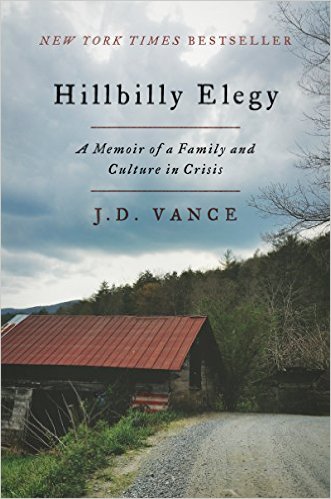
"I don’t know if J. D. Vance attended Friday’s Inauguration (in Washington). I don’t even know if this best-selling author even voted for the 45th American President. I do know his recent book, Hillbilly Elegy (HarperCollins, 2016) is purported to explain one major reason why Donald Trump is now making himself at home this weekend in the White House," writes Bob Johnston in the Saugeen Times.

Rev. Bob always impresses me with the amount of reading and research that he does and I found his reference to Vance and Trump to be particularly fascinating.

You can justifiably say a lot of negative things about Donald Trump, but he is no dummy.  He secured unexpectedly strong Presidential support among the so-called forgotten Americans, those most affected by the loss of well-paying factory jobs right across the “Rust Belt” states of Michigan, Pennsylvania and Ohio. He shoots from the hip; he’s not constantly afraid of offending someone; he’ll get angry; he’ll call someone a liar or a fraud. This is how a lot of people in the white working class actually talk about politics and politicians. Trump set himself up as a champion of the underdog, got their attention and eventually their vote.
J.D. Vance is the man of the hour,
maybe the year. His memoir 

Hillbilly Elegy  is a New York
Times bestseller, acclaimed for
its colorful and at times moving
account of life in a dysfunctional
clan of eastern Kentucky natives.
It has received positive reviews
across the board, with The Times
calling it “a compassionate and
discerning sociological analysis
of the white underclass.” In the
rise of Donald Trump, it has
become a kind of Rosetta Stone
for blue America to interpret that
most mysterious of species: the
economically precarious white
voter.

To her peril, in taking the high road, Hillary Clinton did not listen, or chose to ignore, this under-estimated and forgotten segment of the American population.

It should be explained that J.D. Vance is a self-described “hillbilly” whose grandparents migrated from Kentucky Appalachia country to Middletown, Ohio. Their goal was to secure a better economic future for children and grandchildren. These were the descendants of the millions of Scots-Irish immigrants who came to the United States in the eighteenth century and, finding the seaboard already occupied by earlier immigrants, pushed on to the vast backwoods, that mountainous hinterland from Georgia and Alabama and northward to New York State and Ohio.

Vance defines this sub-culture as fiercely loyal to family, faith and country. They are the “poor whites,” lacking a college degree and mostly left behind by massive manufacturing job losses in today’s American economy.

Vance’s grandparents, his beloved Papaw and Mamaw, escaped the poverty of Jackson, Kentucky, in 1946 to find better-paying work in the industrial town of Middletown, Ohio. Papaw was 16 and his new bride was 13 and pregnant.

Hill people like the Vance family were actively recruited by Ohio factories and the young father quickly found work at Armco, a thriving steel company, one of four major local factory employers. Gaining employment proved easier than finding social acceptance among the urban, more educated, already established white population. These reluctant 'now-neighbours' looked askance at the unsophisticated thousands of newcomers descending into their cities and towns.

Two generations later, the transplanted 'hillbillies' have fallen on hard times. Drug use is rampant. (The exciting new reality show, Southern Justice, documents this widespread use of meth, heroin and other illegal chemicals. On camera, the local police spend most of their shifts chasing drug dealers.) Family life has become fractured. Those good jobs in Middletown have moved off shore. The “blue collar economy” has never recovered following the recent Great recession, leaving Vance’s sub-culture pessimistic but also angry.

Vance outlines two options for America’s forgotten Appalachian workers: education or government-dependent welfare. He chose the former path, encouraged by his indomitable Mamaw who pushed school success as the ticket out of poverty and despair. After a stint in the Marines, Vance went on to study law at Yale. He has little sympathy for those able-bodied employables who have chosen the welfare route rather than work, describing how many have learned to scam the food stamp handouts.

One seeming purpose of Hillbilly Elegy is to provide a cathartic journal for Vance to publicly ventilate a mix of love, resentment, fears, sense of loss, anger and other deeply-held, troubling emotions. Emanating from his dysfunctional culture and disrupted family life---five “father figures,” Vance had carried these memories into adulthood.

A second thesis of Hillbilly Elegy is to explain how these “forgotten working class white Americans” gradually shifted their political allegiance, beginning with Ronald Reagan’s presidency, from Democrat to Republican. The Scots-Irish have always been fiercely independent, patriotic, pro-military and anti-establishment—a natural voting base harvest for Trump as it turned out.

Vance as an author is far more successful in achieving his former goal of catharsis than the latter one of socio-political interpretation. In Bob Johnston's view, a far better depiction of the Scots-Irish influence on the shaping of American culture is Born To Fight (Broadway Publisher, 2004), written by the former Virginia senator, Jim Webb. He illustrates how such diverse characters as Daniel Boone, Davy Crockett, Teddy Roosevelt and general George Patton were each from Scots-Irish stock.

With Trump’s presidency comes the revived hopes of those “hillbillies” whom Vance has described in his poignant and informative bestseller. In his inaugural address, the new president once again decried those closed American “factories scattered like tombstones across the land.” To the millions of forgotten ones, he thundered: “You will never be ignored again.”

Time will determine whether Donald Trump’s promises will be kept. He may not listen but his advisors will surely and gently remind him that many of those disappeared jobs were lost, not to China or Mexico, but to robots and better industrial technology. The Kentucky coal miner’s “enemy” was not Obama or the EPA. If and when off-shore jobs do return to the United States, it may happen not as a frightened response to Trumpian threats, but as a reaction to Chinese pollution, endemic corruption and frustrating red tape in many off-shore countries, rising wage demands by off-shore workers and escalating transportation costs to ship finished manufactured goods back to the USA.

In the interim, along with J. D. Vance’s transplanted Appalachians, the world anxiously awaits the dawning of this unprecedented new chapter in American history.

What my friend Rev. Bob did not realize when he wrote his piece for the Saugeen Times is that, surprise of all surprises, Vance did not vote for Trump (he voted for Evan McMullin, an independent candidate supported by anti-Trump conservatives) and he has a couple of reasons why..."He (Trump) used rhetoric that's not in the best interest of the party or country. I happen to think that conservatism, when properly applied to the 21st Century, could actually help everybody. And the message of Trump's campaign was obviously not super-appealing to Latino Americans, black Americans and so forth. That really bothered me," he explained in a recent interview. "In some ways even more importantly than that, while I think Trump had clearly diagnosed very real problems, I didn't see any real evidence that he had much in the way of positive solutions that would address a lot of these concerns...I'm sort of taking a wait-and-see approach, but if he doesn't [provide solutions], that's going to leave people in an even worse position than they were four years ago," he added.

I could not agree more, but isn't it ionic that a writer who undoubtedly strongly influenced Donald Trump's controversial election victory, is not convinced about the new president's ability to deliver on out-spoken election campaign rhetoric and chose not to vote for him?

Indeed a crazy time in American politics.  It will undoubtedly get crazier in the next four years and that is a frightening prospect even for those of us watching from a vantage point ever so close to the Canada-U.S. border.

I'm not sure I'm up for it!  Are you?

17 January, 2017

AN INTERESTING HISTORY BEHIND MY VINTAGE PIGGY-BANK

I have an old friend that I have been neglecting for a good 70 years and I recently thought that I should dust him off and feed him something just for old times sake.  I'm talking, of course, about my childhood piggy-bank that has held its age remarkably well considering the passage of time.  In fact the eight-inch tall, hand-painted, molded clay figure it is now considered "vintage" in the antique collector's world.
My 76-year-old piggy-bank.


To tell the truth, I do not recall when I first opened a bank savings account but I do remember saving quite a bit of money in my "piggy", a penny and nickel at a time starting from about three or four years of age. Regretfully, the savings habit of those formative years seemed to fall by the wayside as I grew older.

These days the piggy bank is taken for granted. Kids still love them, but where did they really come from? Why do people around the world stuff loose change into small plastic pigs? Research has revealed some interesting history.

The origin of piggy banks dates back nearly 600 years, in a time before real banks even existed. Before the creation of modern-style banking institutions, people commonly stored their money at home -- not under the mattress (or hay rack), but in common kitchen jars. During The Middle Ages, metal was expensive and seldom used for household wares. Instead, dishes and pots were made of an economical orange-colored clay called pygg. Whenever folks could save an extra coin or two, they dropped it into one of their clay jars -- a pygg pot.

Vowels in early English had different sounds than they do today, so during the time of the Saxons the word pygg would have been pronounced “pug.” But as the pronunciation of “y” changed from a “u” to an “i,” pygg eventually came to be pronounced about like “pig.” Perhaps coincidentally, the Old English word for pigs (the farm animal) was “picga,” with the Middle English word evolving into “pigge,” possibly because of the fact that the animals rolled around in pygg mud and dirt.

Over the next two hundred to three hundred years, as the English language evolved, the clay (pygg) and the animal (pigge) came to be pronounced the same, and Europeans slowly forgot that pygg once referred to the earthenware pots, jars and cups of yesteryear. So in the 19th century when English potters received requests for pygg banks, they started producing banks shaped like pigs. This clever -- albeit accidental -- visual pun appealed to customers and delighted children.

Early models had no hole in the bottom, so the pig had to be broken to get money out. Some people say that’s where we get the expression “breaking the bank,” but serious academics disagree. The idiom “break the bank” means to ruin one financially, or to exhaust one’s resources. The term is believed to originate in gambling, where it means that a player has won more than the banker (the house) can pay.

So that explains where the “pig” part came from, but how about the word “bank.” Way back when, the word “bank” originally meant the same thing as “bench.” You see, when money first started changing hands in Northern Italy, lenders did business in open markets, working over a table. These Medieval Venetian banks were set up in main squares by men who both changed and lent money. Their benches would be laden with currencies from the different trading countries. The Italian word for bench or counter is “banco” from which the English word “bank” is derived. (Some argue this is where the term “broke the bank” comes from. The Italian expression “banca rotta” means “broken bench,” with a broken bench possibly symbolizing that a money lender was out of business.)

I readily admit that this is probably much more than you ever wanted to know about piggy-banks. Like every other tradition, there are those today that maintain that piggy banks are not an effective tool in teaching children wise money-handling habits.

This is where I bow out...I was never a good money handler, but I can't blame it on my vintage piggy-bank who served me well.  I just never earned enough folding money to handle properly after piggy retired!

06 January, 2017

UNDERSTANDING ECCENTRICS AND TODAY'S POLITICAL HOSTILITY

Even the most pragmatic and boringly practical among us, in moments of nostalgia, must confess to having done crazy things on a whim. Ironically, the realistic kind of people often romanticize about those moments in their lives where they followed their hearts and did things in the name of a craze, love or passion which they wouldn’t dream of doing now.

But an eccentric person, in the true sense of the word, is not one who follows his heart and does unusual stuff once in a while. Definition of the word is someone who deviates from an established or usual pattern or style and from conventional or accepted usage or conduct especially in odd or whimsical ways. Edith Sitwell says that geniuses and aristocrats are called eccentric because "they are entirely unafraid of and uninfluenced by the opinions and vagaries of the crowd."

Many of us wish we had courage and originality to be able to live life on our own terms. We may have creativity, but responsibilities and the fear of the consequences of non-conformity make us suppress that fantasy.

Psychological studies point towards certain signs of eccentricity. Some of these could be: a non-conforming attitude, idealistic, intense curiosity, happy obsession with hobbies, knowing very early in his or her childhood they are different from others, highly intelligent, opinionated and outspoken, unusual living or eating habits, not interested in the opinions or company of others, naughty sense of humour and being usually the eldest, or an only child.

Eccentricity is often associated with being unusually gifted. This could mean genius, intellectual giftedness, or creativity. The unusual behaviour could be an outward reflection of extraordinary intelligence, talent or passion. The minds of eccentrics are so original that they cannot conform to societal norms. Eccentricity is also believed to be associated with great wealth. Stories of wealthy business tycoons or celebrities with peculiar idiosyncrasies are legendary.

In this regard, U.S. president-elect Donald Trump, with his outrageous pronouncements, penchant for mistruths, disrespect and illusions of grandeur,  fits the "eccentric" bill perfectly.  Americans voted for The Donald because, down deep they saw a little of themselves in him.  In protest to the status quo in Washington, they made a statement by voting for change -- perhaps the most controversial and potentially dangerous change in political history, bringing with it a general increase in public aggression.  In was not as much a vote for Trump as it was a vote against Obama and his time in the Oval Office.

Closer to home, a still wet-behind-the-ears Justin Trudeau swept to an upset victory in last year's Canadian federal election because he represented a new direction and breath of fresh air.  Several months after the fact, Trudeau bashers are proving to be alive and well. The novelty is wearing off and hostile criticism of "the Trudeau government" is mounting, however warranted or unwarranted.

It is now clear to me that in North America we are increasingly stuck in a cycle of political hostility bordering on outright hatred. Political parties encourage citizens to “take a side,” and taking a side too often entails becoming irrationally defensive over that side, while ruthlessly bashing the other.

This aggression has ultimately resulted in a range of violence, from citizens being assaulted at political conventions for supporting a candidate of their choice, to students being ostracized in classrooms if they dare to share a political view that opposes the majority. Day after day, Facebook and Twitter newsfeeds are filled with one-sided political messages which fuel anger and polarization, while leaving no trace of collaborative solutions to pertinent issues.

How will defending a political party, mainly because it’s “your side,” and hating on the other side, make our country a better place to live? Bashing others, whether it be a person or a political party, does not lead to solutions.

This vicious cycle of aggression is serving as a barrier to collaborative solutions and rational compromise.  So what can you do?

The answer: Stop being a hater! Every citizen has the power to break this cycle of aggression, and to fuel a new cycle of collaboration. Here is how to start:

1) Recognize Defensiveness

We are all guilty. If we have chosen a political party, we have unfortunately become accustomed to being defensive of that party, even before we know the facts (not to mention that the “facts” are often difficult to come by). The first step to ending the cycle of aggression is to recognize our own defensiveness. Ask yourself these questions:

• Do I understand the wants and needs of both sides?
• Do I have all of the facts?
• Can I be sure that my “facts” are viable?
• Will being defensive of “my side” make this country a better place to live?

2) Stop Reacting, Start Listening

Once we recognize that we are being defensive, it is essential that we stop defending and start listening to what others have to say. Ask yourself these questions:

• What is the underlying want or need that is being argued for?
• Do I understand the want or need of all parties?
• Is that want or need a human right?
• Will that want or need cause harm?
• What might be a logical and fair compromise?

3) Recognize Flaws of political parties

Every political party is flawed, including our own. Every political party is guilty of repeatedly committing acts of hate and aggression. And every political party is failing at collaborating with one another in order to reach compromises and create positive change. It is essential that we choose to see and acknowledge these flaws, so that positive progression can be achieved.

Ask yourself these questions:
• Is my political party collaborating across the political spectrum to reach rational compromise and create positive change?
• Is my political party causing harm to anyone or anything?
• Is my political party discriminating against anyone or anything?
• Is my political party respecting human rights of all people?

4) Post Mindfully

What are you posting on social media? We are responsible for fueling the cycle of aggression. One-sided political posts often fuel anger and hate without providing opportunities for collaborative solutions. Instead of posting or sharing one-sided comments, problems or solutions, focus on the need and eliminate the bashing on others.

Before posting something to social media, ask yourself these questions:
• Will this post fuel anger, hate or defensiveness?  Will it offend (even some of my friends)?
• Will this post provide or deter an opportunity for collaborative solutions or rational compromise?
• Does this post bash anyone (a political party or a person)?
• Does this post focus on the need, or focus on the hate?

5) Choose Collaboration

The paradigm of “us versus them” serves as the greatest barrier to progress and solutions. Instead of focusing on the best interest of our political party, we need to focus on the best interest of all citizens, and the nation as a whole. We all have the power to choose collaboration by working to understand all sides of the want or need at hand, and by exploring and inviting compromises and solutions.

Political leaders, regardless of party affiliation, are failing to work together to understand all angles of issues in order to produce progressive solutions. Instead of commending the bashing between political leaders or candidates, ask for collaboration. Recognize that every time a political leader bashes another, they are perpetuating the cycle of aggression, and creating a barrier to collaboration.

Personally I am not impressed, yay I'm offended, by exposure to unsolicited opposition or criticism unaccompanied by the suggestion of a reasoned solution and note of conciliation.  Otherwise, please spare me!  I do not need the aggravation...I already have enough uninvited and unwelcomed negativity to last a lifetime.

31 December, 2016

TRUMP PATRONIZING THE NEW YORK TIMES...SUCH FUN!

I try very hard to avoid political commentary on my web sites, but I am fascinated by what is shaping up as a war of words waged against the American press by Donald Trump.

U.S. President-elect Trump’s incoming press secretary Sean Spicer is rubbing the legacy media’s nose in its irrelevance by telling them it won’t be “business as usual” once Trump takes office; that he cares more about what American workers, families and businesses think than what some elites at a dinner party say about him.
But here’s the ultimate backhanded compliment: Spicer told an American talk show host that they will maintain “some traditions” of talking to the press, because even though they’ll never get a fair shake, “we recognize that there’s, you know, a few thousand readers or so left that still look at The New York Times, and so it’s worth, probably, talking to them.”

It should be noted, however, that the New York Times has long been regarded within the industry as a national "newspaper of record".  It has been continuously published in New York City since September 18, 1851, and has won 117 Pulitzer Prizes, more than any other news organization. The paper's print version has the second-largest circulation, behind The Wall Street Journal, and the largest circulation among the metropolitan newspapers in the United States. NYT is ranked 39th in the world by circulation and has a weekday circulation of one million daily.
I don’t know which is Spicer's deepest burn: that the NY Times is “probably” worth talking to, or that that’s because they still have “a few thousand readers left.” There are going to be some awfully huffy barbs about Sean Spicer bandied about at cocktail parties during the weekend in the Hamptons!

The next four years are going to be very interesting, because we ain't seen nothin' yet. It it will be fun watching from this side of the border (wall?).  

I would not be surprised to see the Trump empire go into the newspaper business before it is all over.

26 December, 2016

UNLIKE MY LANCE, I AM BENT BUT NOT BROKEN

Unsubdued

"Poems that Have Helped Me"

                                      
I have hoped, I have planned, I have striven,
To the will I have added the deed,
The best that was in me I've given,
I have prayed, but the gods would not heed.

I have dared and reached only disaster,
I have battled and broken my lance,
I am bruised by a pitiless master
That the weak and the timid call Chance.

I am old, I am bent, I am cheated
Of all that Youth urged me to win;
But name me not with the defeated,
To-morrow again, I begin.


11 December, 2016

AN OLD SANTA'S REFLECTIONS ON CHRISTMAS PAST...AND PRESENT

Contrary to what many believe, Santa Claus as we know him today – sleigh riding, gift-giving, rotund and white bearded with his distinctive red suit trimmed with white fur – was not the creation of the Coca Cola Company. Although their Christmas advertising campaigns when I grew up in the 1930s and '40s, were key to popularising the image, Santa can be seen in his modern form decades before Coca Cola’s illustrator Haddon Sundblom got to work. Prior to settling on his famed red garb and jolly bearded countenance, throughout the latter half of the 19th century, Santa morphed through a variety of different looks. From the description given in Clement Moore’s A Visit from St Nicholas in 1822, through the vision of artist Thomas Nast, and later Norman Rockwell, Mr Claus gradually shed his various guises and became the jolly red-suited Santa we know today.

For most of my life I have enjoyed perpetuating the Santa Claus myth while integrating it with the traditional celebration of the birth of Christian Messiah, Jesus Christ of Nazareth.

As a youngster with a vivid imagination, I fully immersed myself in the idea of a workshop somewhere in the North Pole where a jolly old man employed elves to help him make toys for girls and boys which he in turn delivered in a sleigh driven by eight tiny reindeer on Christmas eve. Happy, harmless thoughts that brought joy to an impressionable young mind and helped instill the spirit of true Christmas giving.
A young Santa Me with then three-year-old
 granddaughter Alyssa.

As a father, I derived equal joy in reliving those happy Christmas memories with my children and making it become real for them.  So taken was I with all things Santa Claus that in time I became a professional "Santa's helper" in department stores and shopping malls, even making appearances at Christmas concerts, company parties, special events and community parades.  I prided myself in being as authentic and believable as possible, even going so far as to memorize the names of all Santa's reindeer just in case I was tested by an inquisitive youngster -- and I was.  A Santa's voice and trademark Ho, Ho, Ho was cultivated. When I donned that red suit, white beard and ample belly padding, I actually found myself taking on the persona of Santa Claus.  It was an exhilarating, magical experience of theatrical proportions.

Expressions of excitement and the wonder that was evident in the bright eyes of clamoring, awe-struck children made it all worthwhile for me.

I do not play the role of Santa anymore but if I did, I would not need a fake beard, wig and fat belly...I have ironically grown my own; in fact I am often called "Santa" by friends and strangers alike and I quite enjoy the recognition, especially the "you would make a good Santa" comment to which I respond "been there and done that!"  The other day a fellow took one look at me, stopped in his tracks and said: "You look like someone who might come down my grandson's chimney in a few weeks."

With a degree of remorse, however, I cannot help but think about how commercialized the concept of Santa has become today at the expense of the true reason for the celebration of Christmas.

The downside to the "stuff" of Christmas

Christmas, Chanukah, Kwanzaa, Bodhi Day, Winter Solstice, Yule, Pancha Ganapti -- you name it -- December brings with it a host of traditional holidays across the religious spectrum. Winter, for much of recorded human history, was a time for families to come together to enjoy the warmth of the hearth as they anxiously awaited the return of spring.

It seems that in recent times, however, a new holiday has arisen that has quickly supplanted all the rest, one that a fellow Universal Life Church writer calls (for lack of a better term): “Stuffmas”. Shoppers flock to retail stores during the “Stuffmas” season which has become the frenzied month-long celebration of jingle-y music, sweet pastries, and above all, stuff...lots and lots of stuff.

Throughout this season people around the globe are bombarded with advertisements to buy all of the latest, greatest, and newest pieces of plastic. Our quest to accumulate “stuff” has become so ferocious in recent years that shopping can be a deadly affair – literally. Each “Stuffmas” season kicks off with the aptly named “Black Friday”, an event where otherwise innocent people risk getting trampled to death as they rush to grab bargain-basement deals from their local superstore.

Indeed, devotees of “Stuffmas” are becoming increasingly fervent. One could easily argue that the secular celebration of giving and receiving is more than just a holiday, that instead it has become a full-hearted embrace of Earth’s true largest religion: Materialism. Has the true meaning of Christmas been lost to the worship of stuff?

Previous generations of children were taught to be on their best behavior because God was watching.
Today, the lesson remains the same – children are still encouraged to behave. However, the stakes are much different...God isn’t watching anymore, Santa is. Sins are punished not with eternal torment, but with the threat of withholding of presents. When kids are taught that their actions are monitored by a toy-bearing fairy-like man, and that good behavior is always rewarded with shiny new things, how could we expect them not to start worshiping the idea of stuff and the mythical old gent who delivers it while they are in bed sleeping at night.

Society created this new religion and, with some clever marketing (pioneered by the Coca Cola company), we indoctrinated ourselves into it. The entire course of our lives has been painstakingly engineered by economists to ensure maximum output, following this general course: We’re Born > We Work > We Buy > We Die. Too often a person’s value is determined not by the content of their character, but by the monetary value of their assets.

As mentioned earlier, winter has customarily been a time for reflection. Perhaps we should take some time to do just that this year.  As we look around at the world we created, are we happy with what we see? Regardless of what your traditional practises are, there is no doubt that “Stuffmas” is touching your life in some way. While it certainly does bring some feelings of joy (who doesn’t like receiving gifts?), there are some evils associated with it as well. Most of us have friends or loved ones that struggle with anxiety over finances, and these issues are always made worse during the holiday season when there is constant pressure to spend money on new things for ourselves and others.

Personally, I have experienced pangs of guilt as resources have gradually limited my Christmas spending. My wife and I have even agreed to not exchange gifts with each other.  Time with family (when health and circumstances permit) and a good Christmas dinner with as many traditional trimmings as possible, has come to suffice.

I truly feel that you would be hard-pressed to find anyone who did not think that perhaps it is time that we wind-down “Stuffmas”, at least by some degree. The question is: how? Actually, the question is, can we? Have we become so invested in our materialism that there is no true exit?

Sadly, it is beyond the comprehension of this old pretend Santa!

In this day and age, our entire economy depends on people continuing to buy stuff.  In many cases businesses actually depend on the month of December alone to make the difference between a good and bad year from a financial ledger standpoint.

...And the buying public takes the next 12 months to pay off their associated credit card debt so that they can put more stuff on it again next year at this time.

Somehow we have lost sight of the fact that Christmas is a "holy day" and was not intended to be the generic, free-spending, commercialized "holiday" that is now generally accepted in a politically correct world.

Oh well, Happy Holy Days everyone...and a Merry Christmas too!  I hope your particular Santa is good to you!

Enjoy your stuffing -- turkey variety that is.

07 December, 2016

THE FAKE NEWS INVASION

The line between truth and fiction has become blurry. As phony articles spread like wildfire across social media, our society seems more divided than ever.  People can say anything online and get away with it.  

In our internet age, there is a plethora of information available at the click of a button. So much so, that it’s hard to know what to believe anymore and leading me to ask "Is truth under assault?" The latest development on this issue involves reports of “fake news” circulating online. Some websites have been masquerading as legitimate news outlets and publishing outlandish articles that grab people’s attention. 

Writers create stories full of false claims from “unnamed sources”, slap on sensationalist titles, and then share them with the world. And it works! Curious readers can’t help but click on these catchy headlines. Most of the misinformation floating around on the internet is relatively harmless. However, given the contentious times we live in, fake news stories run the risk of further dividing us.  Consider too, that I am not even touching on the hate and bigotry that is frequently spewed on social media (a subject unto itself).  I am equally bothered by the malicious, mean and hurtful personal attacks levelled against individuals -- public figures or otherwise -- with gay abandon and often without deserved provocation.  But that too is another story and I digress...

Historical Context
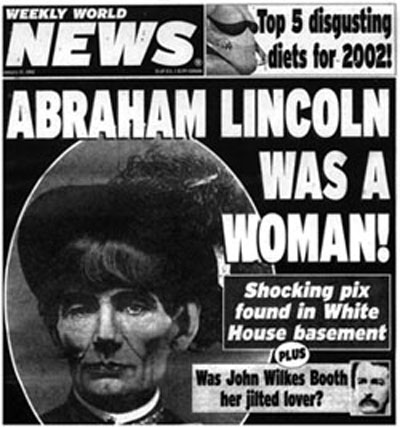
A fake news article about Abraham Lincoln

It is worth noting that fake news is not a modern creation. In fact, news publications have been writing bombastic stories and stretching the truth for years. Known as “yellow journalism”, it became a popular strategy for selling newspapers around the turn of the century. Even today, yellow journalism continues in the form of tabloids. For example, a well-known British tabloid recently claimed that “Prince Charles has seized the British throne in a palace coup.” He didn’t, of course. The entire piece was fabricated.

Dark Side of Social Media

So, what’s the big deal? Fake news has been around forever. Why are people worried about it now?  Partly, it’s the times we live in. The newspaper industry is in the midst of a decline, and more people than ever before are relying on the internet to keep them up-to-date. However, only a minority of people choose to read online versions of the New York Times, Wall Street Journal, Toronto Star or Globe & Mail --increasingly, North Americans are turning to social media for updates on current events. In fact, studies show that roughly 62 percent of adults are getting their news from Facebook.  How unfortunate!
Facebook has been accused of spreading fake news
Fake news articles are thriving in the Facebook environment, where users scroll quickly through their feeds looking for interesting stuff. People often share links based on the headline alone – without bothering to look at the authenticity of the source. This allows phony articles to spread like wildfire as they get shared over and over again.
Some fake news outlets even use legitimate-sounding names to further confuse people. For example, an article posted by “The Denver Guardian” was shared over half a million times on Facebook.  As it turns out, “The Denver Guardian” doesn’t exist. A curious news reporter decided to visit the listed address, and all they found was a tree sitting in an empty parking lot.  

Moving Forward

There’s no getting around it: a lot of nasty rhetoric has been thrown around over the past year and there is a sense that many of our brothers and sisters are feeling increasingly divided. However, the last thing we need moving forward is more finger pointing and name calling. We’ve now entered the holiday season – a time for coming together and spreading good cheer. Let us put aside any lingering animosity and make an effort to unify. There are many problems in the world, but we don’t stand a chance of solving them unless we work together.

Upholding Values
Upholding the virtue of truth

All the hubbub surrounding fake news also serves as an important reminder about staying true to one’s values and beliefs. One of the core tenets is “to do that which is right”. This means upholding a standard of truth and honesty at all times. Especially in these politically polarized times, it’s important to engage honestly with one another – even if we disagree. Starting a dialogue and listening to opposing ideas is the first step toward developing a mutual understanding.
Sure, there may be people out there seeking to make a buck off of spreading lies and misinformation – but that does not mean we have to stand for it. As individuals, we are obligated to resist these petty efforts to create divisions in our society. We cannot assume everything we read on the internet is true, nor should we allow ourselves to pass judgment without getting both sides of the story.

Do your due-diligence research before jumping to conclusions on any issue or cause.  Truth still matters...and eventually wins out in the end!

23 October, 2016

WHAT YOU NEED TO KNOW ABOUT THOSE EMAIL ATTACHMENTS

Internet fraud is not something that only happens to other people...If own own a computer for any purpose, there is no doubt that you have been victimized -- many times.

I found the following information released by the Ontario Provincial Police, to be most informative.

Reading the contents of an email should be safe if you have the latest security patches, but email attachments can be harmful. Email phishing scams can trick you into opening attachments or giving up personal information. They appear to be emails from people, organizations or companies you know or trust, but they're often the gateway to identity theft by automatically installing malware, viruses, worms, and trojans.

In some instances, email attachments are disguised as letters of reference, resumes or information requests and can infiltrate and affect businesses that are involved in legitimate hiring processes. Also known as “spearphishing campaigns”, high-value corporate and governments have been targeted through email attachments to take advantage of previously-unknown security vulnerabilities.

Many email servers will perform virus scanning and remove potentially dangerous attachments, but you can’t rely on this. The easiest way to identify whether a file is dangerous is by its file extension, which tells you the type of file it is. For example, a file with the “.exe” file extension is a Windows program and should NOT be opened. Many email services will block such attachments.

Other file extensions that can run potentially harmful code include “.msi”, “.bat”, “.com”, “.cmd”, “.hta”, “.scr”, “.pif”, “.reg”, “.js”, “.vbs”, “.wsf”, “.cpl”, “.jar” and more. In general, you should only open files with commonly-used attachments that you know are safe.

For example, “.jpg” and “.png” are image files and should be safe. Document file extensions such as “.pdf”, “.docx”, “.xlsx”, and “.pptx” should also be safe — although it’s important to have the latest security patches so malicious types of these files can’t infect systems via security holes in Adobe Reader or Microsoft Office.

If you or a business suspects they’ve been a victim of ‘spearfishing’, contact your local police service, the Canadian Anti-Fraud Centre, report it to the OPP online at http://www.opp.ca/index.php?id=132 or through Crime Stoppers at 1-800-222-8477 (TIPS) athttps://www.tipsubmit.com/start.htm.

For helpful tips and links during Cyber Security Awareness Month, follow the OPP on Twitter (@OPP_News), Facebook and Instagram and using the hashtags #CyberSecurity, #CyberAware and #OPPTips.

Insecure, infected or unencrypted email attachments can risk injecting a number of information and data security threats to your home or workplace environments. Your personal information and business systems need to be safeguarded and it starts right at your inbox.

"When it comes to email attachments, even those from innocent friends and family members, you should exercise extreme caution and assume the worst. Do NOT actually download or run an attachment unless you have a good reason to do so. If you’re not expecting an attachment, treat it with healthy suspicion,” says Superintendent Paul Beesley, Director of OPP Behavioural, Forensic and Electronic Services.

08 October, 2016

A "FULL GLASS" ON THANKSGIVING

Thanksgiving is an opportune time to consider whether we see our glass being half full or half empty. Why do we tend to focus on what is going wrong in our lives but ignore what is going right? Why do I take for granted the faithful rhythm of my heart or the continued function of my limbs, as painful and slow as they may be most of the time? Do I remember with gratitude that I had the good fortune to be born in Canada and not hurricane-battered Haiti, that I have a roof over my head and food on the table or that my wife, while now invalided, still thinks that I am the greatest guy in the world despite the fact that I am often frustrated and feel that we have been deprived by the way our life has "unfairly" unfolded in recent years? 

In spite of trials and tribulations, my “glass” is far more than half-full, when I just take time to rationally assess it.

Each of us can always find some ailment or problem to complain about. Yet, even in these late-life years, chances are that we have much more for which to be thankful. On this weekend of Thanksgiving, let us raise that overflowing glass of blessings and propose a toast, giving thanks for our good fortune.


Here's to your full glass, dear reader!

Can you smell the turkey in the oven?

22 September, 2016

CHRISTIANITY IN THE CONTEXT OF TODAY'S CHANGING WORLD

I believe: “The writing of the Bible was conditioned by the language, thought and setting of its time. The Bible must be read in its historical context.”

We cannot hold on to the past. We know that traditional structures disappear; however, these disappearances have cost dearly. We have responses in ourselves to which we must attend, if we want to appropriately encounter the new world that is bearing us into rapidly changing times.

As a reforming Christian who has withdrawn (temporarily?) from active church participation, I do not believe in scripture as the literal and inerrant word of God. I have come to understand that scripture was inspired by God, but written by human beings who were, just as much as we all are, limited by psychological, sociological, cultural and historical circumstances.

I was recently taken with the words of old friend Wes Denyer: "Scripture is the best ‘word’ we have in trying to understand the will of God for us, but it is not inerrant, and we should not limit God to the words of scripture."

In other words, is it possible, as we gain knowledge and insight, as our vision of humanity is expanded and as the circumstances of the world change, that we may be able to see more clearly the nature of the God who called us into existence?

I believe God is the same yesterday, today and forever, but is it possible our ability to understand who God is, and what God requires of us, may change, develop and grow? For example, in the sixth chapter of the Book of Joshua, after the fall of the city of Jericho, by order of the Lord (the will of God) “they devoted to destruction by the sword all in the city, both men and women, young and old.”

I do not believe for one minute that God ever commanded the slaughter of babies and old people! However, what I can understand is that people who lived in a time of continual fear and danger of violent death, and where life was “poor, nasty, brutish, and short” – would would be consistent with the nature of their own lives. They could imagine a God who called upon them to kill every man, woman and child, because that was the kind of world in which they lived.

To say that our understanding of who God was in the darkness of those times should continue to be the God we worship in 2016 is to limit God. We cannot continue to impose those cultural, historical and physical circumstances of the past on our understanding of God today.


As a for-instance and as society has advanced, in the past century our North American churches (to their credit) have moved away from gender bias and male-only leadership, racial bigotry and anti-gay positioning. Apologies have been made and reconciliation, in a number of instances, is ongoing.  

So, still staying within the Old Testament, we find the same Hebrew people who believed God told them to commit genocide, developing and growing into a new understanding of God.  We read things like:

• “They will beat their swords into ploughshares, and their spears into pruning hooks. Nation will not lift up sword against nation, neither will they learn war any more” (Micah 4:3).

• “What does the Lord require of you, but to do justice, and to love kindness, and to walk humbly with your God?” (Micah 6:8)

• When an alien lives with you in your land, do not mistreat him. Love him as yourself (Leviticus 19:34).

We learn and we grow, albeit slowly and often reluctantly.  We have a way to go...We should all attempt to understand our world and its people in new ways, allowing us to live with greater compassion and justice, with more freedom and opportunities for all. In so doing, we set God free from our old and limited (religious) prejudices, narrow-minded thinking, intolerance, racism and hatred.

God doesn’t change…but we can!  So must our churches, if they wish to remain relevant.


Sadly, however, I have to concede that we'll never completely catch up to the speed of change in our brief lifetimes.  We're only human, limited by circumstances that are not necessarily of our own making.

We tend to blindly cling to, even fight for, centuries-old traditions and belief systems because we think that archaic biblical scriptures still apply to us in the 21st Century.

Give the God of today more credit than that!  Look at the reality of the world freely and without prejudice.  The wise individual is the one who sees reality as it really is and who looks into the depths of things. We are not taken out of the world but thrust into the midst of the fray for that is the place that, in Christ, God has made his own.

Dream the impossible dream...We need to continually pray individually and corporately for an understanding that has universal acceptance.  

08 September, 2016

A SWAN SONG: INTUITION TELLING ME IT'S TIME TO MOVE AWAY AND BEYOND

I find it difficult to have anything resembling a real conversation with younger people today...Two or three-word utterances at best.  Equally unsettling is the reality that, for the most part, anything I write is taken with a grain of salt as coming from an old man who espouses old-fashioned ideas and values and is, at best, tolerated and given quick dismissal.

This morning I happened to eaves-drop on a conversation between a couple of folks in my age category. They mutually agreed in lamenting that "minding their own business" had become a reality in their lives and besides, "no one really listens anymore."  I could not help but think "Welcome to the club!"

For some time now I have struggled with the thought, or intuition, that I am wasting my time (countless hours of mind-rendering preparation) in writing pieces that in reality go absolutely nowhere.  The gratification in pride of authorship wanes in the isolation of advanced age and the realization that more and more as life progresses, one tends to talk primarily to oneself.

Is it healthy to listen to, and act upon, intuition?  I truly think so!

I read recently that "Intuition tells us intimate and important things nobody else will—and it will also tell you things your own mind will argue with." As a culture, we have learned to believe that being rational is what should prevail when making decisions. But what about our “inner voice,” our gut feeling -- that “little something” instinctual from within, which tells us how we feel beneath those layers of logic?

Intuition can be either a moment where you instinctively know if something IS right—or isn’t right. It’s our inner voice that “that just knows,” and it does understand what uniquely, sometimes seemingly illogically, will make you happy. It bridges the gap between between instinct and reason, between the conscious and unconscious mind.

Science tells us that only 20 percent of the brain’s gray matter is used for conscious thoughts, while 80 percent is dedicated to non-conscious thoughts.

What is Intuition?  Albert Einstein once said that it is our most valuable asset, and one of our most unused senses. He described it as “a feeling for the order lying behind the appearance of something.” Sometimes it is referred to as gut feeling, sixth sense, innate wisdom, inner sense, instinct, inner voice, or spiritual guide.

Many people will have an intuitive flash as they’re falling asleep or just waking up. It’s often described as a flash of understanding that can cut through our defense systems and allow a deep truth to be revealed.

Commonly, one's real life experience is that we walk into a house for rent or sale, and instantly know it’s the right place to live. For some married couples, it took just one look to recognize their partner in life. Dogs are known to howl at the moment of their master’s death, even if they’re separated by thousands of miles. And time after time, women will say that they had ‘a funny feeling’ about something or someone dangerous. Throughout history and in every culture, the communication of our intuition happens repeatedly in ways that current science can’t explain.

When you talk in depth to people about how they made their important life choices, the story often includes plot twists due to unplanned serendipitous coincidences, magic happening, and “going with their gut.” At some point in life, the journey gets kind of loose, and it is at that moment that the intuition is the right navigating tool -- it is alert to signs of change and opportunity.

We read the signs and omens of what life is saying to us through our intuition. Just as a movie director hints early in a film about a future plot development, hooking us into the story with a glimpse of how things might turn out—the intuition hooks us into our own journey in life. It’s a point at which we understand something new, or know something to be true.

Usually, the intuition comes and goes, informing abruptly, but it can also be called up at will. Whether out-of-the-blue or consciously conjured, it can be instantly there for you once you begin to exercise it.

The intuition’s most important role is that it alerts us to the path, people, and circumstances that we will uniquely find fulfilling. Using intuition or sixth sense is just like working a muscle. It will get stronger the more you use it. We often hesitate to follow our intuition out of fear. Usually, we are afraid of the changes in our own life that our actions will bring.

Let's face it...The inescapable realities of aging are no laughing matter. Even worse, there are a host of environmental and lifestyle factors that are constantly preying on the youth of every cell of our body. Things that turned my crank even five, 10 or 15 years ago ultimately lose their appeal and take effort to sustain, particularly in regards to relationships and communications.  The all-too-noble impulse to motivate and impart reasoned thinking on the outside chance that at least "someone out there will relate" suddenly becomes an idealistic expectation that cannot be justified.

Don't get me wrong, however.  Writing has been a passion for me...It filled a need.  For the most part, it was a labor of love that allowed me to express otherwise suppressed emotions and to share bits of human interest that held special meaning for me.  Every one of the now more than 800 posts on Wrights Lane in the past nine years was a sincere expression of myself. I am grateful for the modest following of readers that stayed with me and, I think, understood where I was coming from most of the time.

This is all by way of saying that my intuition is telling me that, while there is certain gratification in written pontification, a price is being paid -- a price that I can no longer afford.  I have no reason to fear necessary change because it is in my best interest.  It is now time for me to, as much as possible, eliminate stress-inflicted physical and mental clutter and part of the solution is to cease trying to influence the thinking of others who I barely know (or do not know at all) and to stop worrying about resultant perceptions.

I have very little left to offer these days and when I do, the over-riding impression is that no one listens anyway and very few really genuinely care about the message(s) I try to impart.

Why waste time that is better expended closer to home...Like keeping sane at a time in life when new focus is required, when personal needs and responsibilities increase in concert with diminishing coping mechanisms.  Sought-after gratification is better derived from kindly and thoughtful first-person intercourse with those I encounter on a daily basis, fully prepared still to win some and to occasionally lose some.

Intuition can be life-preserving, if only we listen to it and ultimately accept change when warranted.

If my posts on Wrights Lane are increasingly few and far between in the future, you will now know the reason why.

I am bowing to age-acquired intuition and the associated reality that comes along with it!

05 September, 2016

DRESDEN BLOG SITE SPRUCE UP

Anyone who has followed my "Dresden: Father and Son Turn Back the Clock" musings may be interested in checking out recent changes I have made to the web site.  Just click http://dicktheblogster3.blogspot.ca/
The downtown Dresden that I remember.