Sharing with you things that are on my mind...Maybe yours too. Come back to Wrights Lane for a visit anytime! And, by all means, let's hear from you by leaving a comment at the end of any post. THE MOTIVATION: I firmly believe that if I have felt, experienced or questioned something in life, then surely others must have too. That's what this blog is all about -- hopefully relating in some meaningful way -- sharing, if you will, on subjects of an inspirational and human interest nature. Nostalgia will frequently find its way into some of the items...And lots of food for thought. A work in progress, to be sure.

02 March, 2016

SPORTS VS. CHURCH IN BRINGING PEOPLE TOGETHER

When I was a young fellow I found myself in a real bind. I had started to play organized baseball and games were played on virtually every Sunday, May to September. The problem was that in those days recreational activities of any kind on The Lord's Day were very much frowned on, in fact if you were a practicing Christian it was considered a sin.

The Lord's Day Alliance, formed by Presbyterians, Methodists, and Congregationalists in 1888 to protect the sacredness of Sunday in Canada, was still a force to be reckoned with in the 1940s and '50s. I well remember that there was a 12-midnight curfew for Saturday dances and that in some communities no inning of a baseball game could start 10 minutes before the bewitching hour of 12:00 a.m.

My mother and father were staunch Presbyterians and it was only because of illness that I would miss attending Sunday School and the worship services that followed. At 16 years of age I even became a Sunday School teacher, so my formative years were firmly entrenched in Church and Christian beliefs and practices.

So it was without the blessing of my mother (my father had passed away) and struggling with pangs of guilt on one hand and a burning passion for the game of baseball on the other, that I began to venture onto the playing field with mixed emotions on Sabbath afternoons. Looking back, I always felt that I did not play my best on Sundays and if I had a bad game, or committed an error, I was convinced that God was penalizing me for playing baseball on His day of rest.

Boy, have times changed in the intervening 60 years. What pained and compromised me as a young athlete, families do not give a second thought today.  When you think of Sunday today, one of two things likely come to mind. Perhaps you think of going to church with your family, like you may do every Sunday. However, there are other activities that take place approximately five months out of the year that captivate a huge percentage of North Americans -- golf, football, fishing and baseball, to name only a few of the weekend distractions. In fact, there is a real argument to be made that sports in general are better at bringing people together than church ever was.


It is really not surprising people feel this way. When you go to a football or baseball game, for instance, suddenly you are best friends with tens of thousands of other people in the stadium. These people don’t care about your gender, sexual orientation, race, or religion. All they care about is that you are supporting the same team. It is a bond that can last for life. It sounds silly, but it’s amazing the extent to which mutual support for a team can draw people together.

Today, more people than ever before are choosing not to attend church. Maybe they simply don’t enjoy it, or maybe they haven’t been accepted into a church because of their lifestyle. There are a lot of different lifestyles that certain denominations have trouble with. One of the most common is the refusal to accept members of the Gay community or views on contraception and abortion. Many religions teach that homosexuality, condoms, and abortions are sins, and that can be ostracizing to some. Thankfully, there are plenty of churches who accept people for who they are.

Watching and playing games on Sunday afternoons can be a great escape. Whether you are watching from home, physically at the game or participating in a recreational activity, it is a wonderful way to forget about the everyday stresses of life, including work, health, and personal relationships. Going to church does not necessarily do that for people. While some might find comfort in going to church and having people pray over them, it can also be a great source of anxiety.
One of the most widely watched television events is the Super Bowl. Even those who do not care about sports attend Super Bowl parties, even if it’s just an excuse to get together with friends. Companies spend millions of dollars just to get a 30 second commercial that will air during the Super Bowl. In fact, it is now expected that the commercials you see during the game will be the best you see all year. Why do advertisers put so much money and energy into these commercials? Because they know they have a larger audience now than they will at any other point in the year. The Super Bowl and Grey Cup bring the American and Canadian people together for one Sunday every year – it is a massive cultural event comparable only to the World Cup in terms of popularity.

While I can take or leave football, some people really do enjoy the game that much. However, some may do it because it is a distraction from everything else they are dealing with. They might feel the most accepted when they are supporting their team on Sunday afternoons, so they have thrown themselves into it completely. In the past, this was a central function of church services. In some ways, sports have supplanted that.

Even though churches are left competing with sports for attention on Sundays, church still does have its place. There are many people who are committed to their faith and those who will put their beloved sport on hold to attend a church service. Still, it’s interesting to think about how much more accepted people might feel watching or playing a game.

Personally, I do not attend church services anymore, but it has nothing to do with acceptance or a preference for sports...It goes much deeper than that and I might write about it some day, when I'm ready.

In retrospect, I am still in that moral bind of my youth.  It has just taken on a different perspective.

27 February, 2016

THERE IS AN INCREASING NEED FOR SIMPLICITY AS WE AGE, SO GO FOR IT!

Accepting major life changes and setbacks can be painfully difficult as we age. We have to overcome fears, anger, and resentments. Reducing expectations is also a part of the aging process but it takes time and patience to overcome our feelings of helplessness and accept our “losses.”

Being a macho kind of a guy, I have always subscribed to the lyrics of a song sung by good ol' country music boy Toby Keith: "I ain't as good as I used to be, but I'm as good once as I always was..." Sadly, I have reached a stage in life where I have to admit that I am no longer even "as good once" as I used to be. So why pretend otherwise?


The older I get the more I admire simplicity. Increasingly, I have the urge to simplify my life, in fact I crave it. By that I mean I only want to spend my time on what is important for me. The first question is: What is that? And the second question is: How can I do it as a caregiver who is required daily to multi-task and juggle more than one ball in the air at a time?

Sometimes living a simple life is actually not that simple to achieve. As soon as we do something meaningful and hopefully successful in our lives, a once simple idea becomes more and more complex. Somewhere along the road we need to simplify again. If we forget to simplify, life gets more complex, confusing and most likely stressful.

Simplicity, I believe, is what is left when we have taken away all that is not necessary. Simplicity is all about essence...and purpose. It means to simplify as much as possible — but not more — to reduce it to it’s essence.  But how do you know what is essential for you? And what is your purpose in life?

The most simple answer: "It’s what is most important" and nothing much else. Personally, "focusing" is the key for me.  I stay away from distractions as much as possible as I focus on one task at a time. It is when I am distracted that I forget something and subsequently get into trouble.  In fact, short-term forgetfulness has become the bane of my existence.  It is routine for my wife to say, "We talked about it not long ago" or to add chastisingly, "I reminded you just a few minutes ago..."  In response I make the oft repeated request: "Don't tell me about it.  If it is important, write it down for me.  Don't overload me with verbage...It tends to go in one ear and out the other."  By degrees, she is catching on to the fact that I ain't as good as I used to be!

Tolerance for irritations, large and small, tends to lessen with the passage of time.  I struggle daily to not sweat the small stuff.  I do not always succeed.

I am victimized by forgetfulness...It adds stress and anxiety to my bi-polar existence and I desperately seek solutions.  The older I get the more too much repetitive information piled on me in one swell swoop overloads me and drives me to distraction.

Clarity helps in staying on what is important and avoiding what is not is very important. Clarity creates simplicity. In order to become clear on what I want or need, I engage in self-reflection through my writing.  Quite honestly, that is my purpose in constructing this post and thanks to readers who are good listeners and stick with me through to the end.

To reduce unclarity(?) we can also set goals that express what we really want. A clear goal helps a lot to get to and to stay on the right track. The moment you set a goal you make a decision about what is more important to you.  But how do you do less and get more?

Doing less may seem pretty hard at first. After all, there is all this stuff on your to-do list, right? The only real thing to ever worry about is not how much you’ve managed to do, but have you done the things that are your top priorities? That’s all you have to really care about.

To make things simple, we can start to systematically get rid of the tasks that just don’t fit in with what matters most.  So you won’t lose much by doing less. In fact, there is the possibility of gaining something.

For the better part of my life I was motivated by the false impression that I needed to be all things to all people.  In all honesty, I do not know where that came from...Perhaps it was the result of an attempt to overcome inadequacies in my own life.  Nevertheless, in retrospect it was an impossible load to place on myself and more often than not I paid a price for the thankless burden of spreading myself too thin.  How I wish now that I had some of that time back and to be able to apply it where it would do the most good in my own life.

People say nothing is impossible but, like Alan Alexander and without apology, I now try to do nothing every day and have learned to to say “no” more often than I used to. When I feel the overwhelming urge throughout the day to take a nap, I give in to the impulse whenever time and circumstances allow.  For instance, after a late lunch today I fell asleep (I call it passing out) with my empty plate on a TV stand in front of me and my dog Lucy on my lap. Seeing the two of us snoozing peacefully together, Rosanne also nodded off.  We all woke up some four hours later, far too late for me to go out for some much needed groceries.  But who cared...tomorrow is another day.

All the time management in the world will not help if I simply have too many commitments to fulfill, and I am too tired to accomplish them. Saying “no” with confidence, possibly with a brief explanation, will probably get more respect than saying “yes” and not being able to adequately deliver. 

And something else...More and more I find myself welcoming silence into my life, I am reminded of the Zen saying: “Do not speak unless it improves on silence.”  Have you ever noticed how energizing and refreshing it can be to do absolutely nothing by spending quality-time with yourself?  Taking time to reflect and to smell the roses...Letting the mind wander in wonderful and amazing ways.

“Loneliness is the poverty of self; solitude is richness of self,” said May Sarton. Solitude means to deliberately spend time alone. Use it to do deep self-reflection and to clear your mind of all the negative impressions life constantly throws at you. That way you create space for self-refreshment and self-renewal. At least that has been my experience.

As I say, to live a simple life is not an easy task in today’s world of constant distraction, information-overload and commitments that are often beyond our control. It needs some work and self-discipline, but for me it is a matter of self-preservation as I spend the rest of my days doing what I am purposely committed to do. It is as simple as that!

23 February, 2016

KIDS DESERVE A "VILLAGE" OF TEACHERS, COACHES AND MENTORS

We understand the benefits of mentoring young people when we hear the powerful stories of teens whose lives have been changed by a single, caring adult. If you listen, those stories are everywhere. Like me, you likely have a story about a mentor from your own youth.

I was thinking about all of this recently and realized that I could actually have a story for at least 50 people who influenced or mentored me in some way during 18 years of growing up in a small, tight-knit community -- parents, school teachers, church leaders, Boy Scout leaders, sports coaches, music instructors and first-time employers. Quite remarkable when you stop to think about it and there is a place in my heart for every one of them.


This all gives credence to the expression “It takes a village to raise a child.” It was for that reason that I tried to “give back” to my communities as a minor sports coach, Boy Scouts Leader, Sunday School teacher and Big Brother when I graduated to adulthood.

It is only natural that mentoring is a factor in positive youth development. Now, one of the largest mentoring studies ever conducted continues to support this thinking. The five-year study was sponsored by Big Brothers/Big Sisters of Canada and it found that children with mentors were more confident and had fewer behavioral problems. Girls in the study were four times less likely to become bullies than those without a mentor and boys were two times less likely. In general, young people showed increased belief in their abilities to succeed in school and felt less anxiety related to peer pressure.

Mentoring relationships with youth are complex and there is more to be learned about what makes them succeed, particularly when mentors are matched through organizations like Big Brothers/Big Sisters and other kinds of nonprofits. In my own experience, young people naturally develop mentee-mentor relationships with adults sometime during their middle and high school years. Non-parent mentors – teachers, clergy, and civic leaders – are highly instrumental in how these teens learn to believe in themselves and tackle challenging goals.

We know too that mentoring is particularly beneficial to disadvantaged teens. A university study showed that youth from disadvantaged backgrounds are twice as likely to attend college when they have a mentor, particularly a teacher. It also showed that less than half of disadvantaged students have any adult mentor at all and that only seven percent named a teacher as a mentor.

We also know that young people who experience discrimination, family stressors, and abuse are less likely to break the law or engage in substance abuse if they have a positive mentoring relationship.

In these the lean and mean days, however, community isn't always what it is supposed to be. We'd all like to think we live in a place where people care about others -- where people pitch in to help when things get rough -- where it's safe to leave the doors unlocked and let the kids play outside.

This isn't always what we experience though, is it? Instead of community, we find alienation, envy and hate. Being poor these days just isn't what it used to be.

During the Depression, there was plenty of poverty and misery. But people connected with each other. They had family and friends around them. Everybody was broke and so everybody was in the same boat. And as everyone who is poor knows, there is nobody who is more generous than another poor person. So people helped each other out. Not only with the physical necessities of life -- such as food, clothing and shelter -- but also with the spiritual and emotional necessities. It's pretty awful when you feel like you are all alone and the whole world is against you. Life is a lot easier when you are part of a network of friends and family, a community, a neighborhood.

Today poor people are pawns in games of poli-tricks. People say, "Pull yourself up by your own bootstraps, my grandfather did". That may be true, but many of those "bootstraps" are no longer available today. And the first and foremost problem is that the supportive community of our parents and grandparents day, “the village”, the neighborhood, that place where people looked out for each other and supported each other, where they shared joys and sorrows, good times and bad times, in many places is no more. It has gone the way of the gaslight, the horse and buggy. And we're paying a really big price for that loss.

It truly does take a village to work with the family to raise a child and weather the storms of life. If we want that kind of support, the place to begin is with ourselves. We can start by reaching out to our network of friends and acquaintances. 


There are many things that we just don't have much control over. But like eating good food, building community is something that we all can do right here, right now, in the places where we live -- whether or not we have a job, an education, or a car. We can make our neighborhood our village and find the truth that humans have always learned the hard way. United we stand, divided we fall -- cooperation is as important as competition. Maybe, at certain times and places, it's more important.

Every kid today deserves a village to grow up in...Sadly, some more than others.

19 February, 2016

IN SPRING MY FANCY TURNS TO THOUGHTS OF A BASEBALL SCHOOL(ING)

Exactly 60 years ago I was exposed to a baseball era that is long gone, but every year at this time memories of attending a baseball school in Cocoa, Florida, come flooding back.  I am sure that it is the same for old Dresden high school chum and baseball teammate Bob Peters who followed a similar route to mine.
Jack Rossiter, left, welcomed Canadian Willie
Walasko of Hillcrest, Alberta, to his baseball
school in 1959.  Willie's dad and sister were 
along for the ride.

To the best of my knowledge, baseball training schools can be traced back to the 1930s and a character by the name of Ray L. Doan whose name was synonymous with the phrase “sports promoter” in those days. His clients included Olympian and pro golfer Babe Didrikson, the Kansas City Monarchs of the Negro leagues, and miscellaneous House of David teams known for mixing their version of the national pastime with beards and a fun-to-watch activity called pepper. He was also the self-proclaimed “father of donkey baseball.”

It should be explained that during this time in history, major league clubs commonly held mass tryouts, hundreds of potential players venturing onto the “apple yards” to vie for spots in a given team’s organization. The shotgun strategy was less cruel than it sounds, as professional baseball could not yet rely on the dynamo of intercollegiate athletics to generate prospects. Some minor league teams were quick to stuff their rosters with green youngsters from open-to-anybody combines or from the baseball "factories" like the one pioneered by Doan.

The colorful Doan’s undertaking, however, meant the most to raw hopefuls who made the pilgrimage to his “All-Star Baseball School” at Hot Springs, Arkansas, in the 1930s. Adolescent males came there from practically every U.S. state and several Canadian provinces, the majority of boys no doubt imagining stardom. The stars in their eyes had names, too: Doan recruited a slew of major leaguers to serve as instructors at his school. Grover Cleveland “Pete” Alexander, Clyde “Deerfoot” Milan, Urban “Red” Faber, and many more taught eager prospects over the six years of the Hot Springs incarnation.

The school operated between 1933 and 1938. In 1939 Doan shifted the enterprise to Jackson, Mississippi, where enrollment flagged. In 1940 and 1941, winding down, the Doan school was lodged at Palatka, Florida. He also tried setting up a traveling baseball school for the summer of 1940, but it seems not to have caught fire. By then, a veritable thicket of schools for budding rookies had sprung up, so Doan’s educational institution was hardly unique. There was, in fact, another such nursery in Arkansas in 1937, in Little Rock under Bobby Harper, who caught for numerous minor league aggregations during the 1920s and 1930s. In 1938 yet another baseball school would arise in El Dorado under Frank “Blackie” O’Rourke, an infielder for six major league clubs over 14 seasons.

Soon thereafter a charismatic Jack Rossiter of Springfield, Illinois, saw merit in starting up his own baseball school in Cocoa, Florida, 
as a way to help find recruits for the major leagues. Rossiter operated an industrial baseball league in Springfield and had ties to the Washington Senators.  He was a member of a Senators scouting staff that included such lofty names as Joseph Cambria, Michael Martin, Spencer Abbott, Zinn Beck, Edward Holly, Leo Lentz, Cecil Travis, Horace Milan, Russell Herrick and Wilfred Lefebvre.

As fate would have it, in the fall of 1955 I received a letter from Rossiter inviting me to attend his 1956 edition of the school which was to run for two sessions in the first 10 weeks of the following year. There was only one catch...I had to pay my own way -- $25 a week, plus travel and room and board. At 17-years of age, several major league scouts had already started to pay attention to me during the baseball season of that past summer but I had yet to receive any official overtures from them.  

A high school dropout whose only ambition was to be a major league baseball player, I was all too ready to leave my $22.00-a-week clothing store job in Dresden to jump at any 
chance to launch a career on a far away field of dreams. My widowed mother, realizing that I was ready to spread my wings at such an early age and that I would never achieve the academic excellence that she had expected of me, she reluctantly gave me her blessing and helped me scrape together the necessary financial wherewithal to make my way to Cocoa, Florida on New Years eve of that year.  In a nutshell, that was the beginning of the rest of my life!
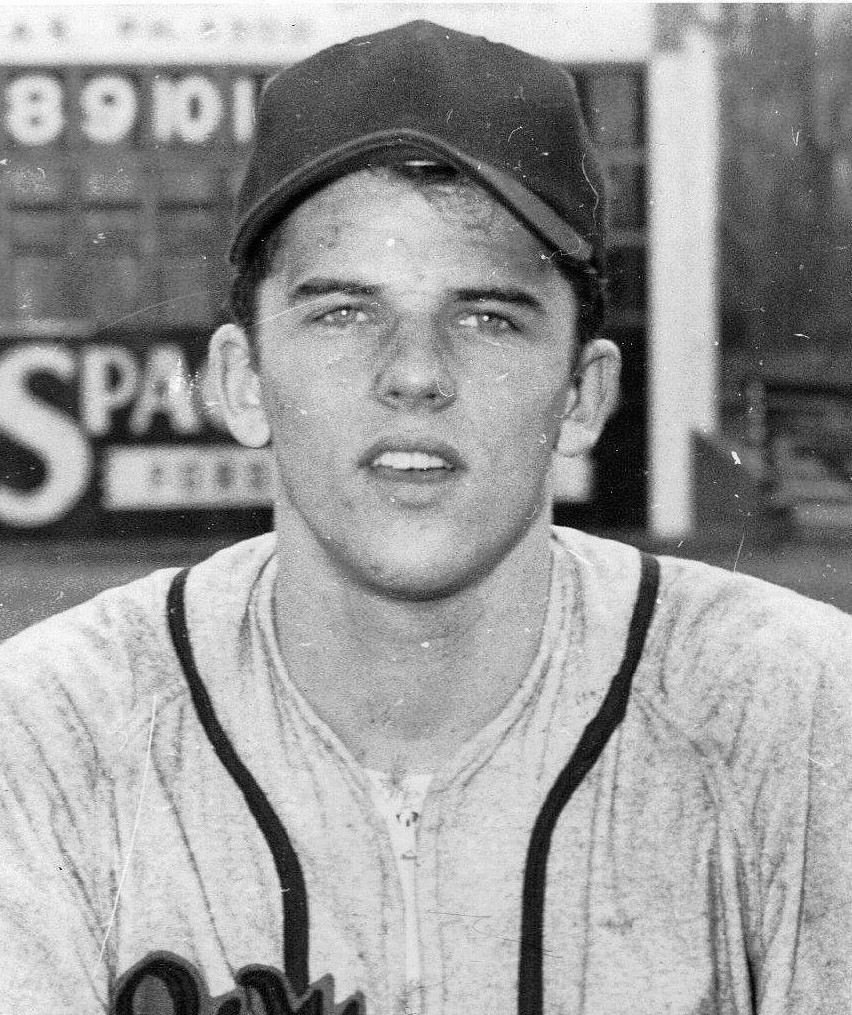
Me at the Jack Rossiter Baseball School
 in 1956.

A 48-hour Greyhound Bus ride later, I arrived at the white-stuccoed Seminole Hotel in Cocoa and was greeted by a rather rotund, smiling Jack Rossiter who emerged from a group of young fellows standing on the sidewalk and looking very much like the baseball players that they were.  After introductions, I was told that I would be billeted in a private home along with three others, all of whom proved to be Americans -- Ronnie Franjello of Boston, Star Todd of Quincey and Art Brizzi of New Jersey.

Baseball workouts and instructional drills were held each day, 11:00 a.m. to 3:30 p.m., at the local baseball field which was the summer home of the Cocoa Indians, a AA club in the Florida Baseball League. Rossiter was a bit of a philosopher who thought outside of the baseball box.  His aim was to not only develop baseball talent, but to build character in the young men under his tutelage. Each day he would gather us together in the outfield for some words of wisdom and exchanges on life in general.  He instructed us on how to conduct ourselves as we blended in to the Cocoa community as representatives of the baseball school.

Included in his lectures were advice on relationships that were inevitable with young ladies of the town and company that we might otherwise keep during our stay in Cocoa.  Borrowing or loaning money was a no-no..."Neither a borrower nor a lender be!" he repeated countless times.  He talked a lot about "focusing" and "extending" ourselves, not only in baseball but in the jobs that we might have as we progressed in life.  A staunch Catholic, Jack conducted prayers at the start of each day's training session.

One day he asked for a volunteer to talk about the person who was most responsible for us attending the camp and I talked about the sacrifices and support that my mother had made in order for me to be there. My verbal presentation sufficiently impressed Jack enough that he awarded me with a $10 bill and a trophy that I was later to give to my mother.

The aforementioned Bob Peters who followed me to Rossiter's school the next year, took copious notes during the group meetings convened by Rossiter.  One of the typically profound statements notarized by Bob had Jack stating emphatically: "Any fool can learn from his own mistakes but a wise man learns from the mistakes of others."

Bob attended the school in 1957 to better learn the art of catching but unfortunately suffered a health setback only a few months before his departure. "I probably should not have attended the school because I had been quarantined in the Wallaceburg hospital in November with suspected meningitis which necessitated a spinal tap," he explained recently.  "The baseball experience was great though and the coaching exceeded anything I had received before," he added.
~~~~~~~~~~~~~~~~~~~~~~~~~

Writer Paul Hemphill, in his book "Lost In The Lights" had a rather humorous and less glowing take on attending the Rossiter school the year before me (1955):  "I was deposited before 8 A.M. in front of the shabby Seminole Hotel where all players were told to report.  Lugging a new cardboard suitcase in one hand and my bat and glove in another, I checked into a room with only wooden floors and a creaking overhead fan," he writes.

..."I went to the end of the hall on the first floor and knocked lightly on the door.  'It's open,' a voice rasped, and I stepped inside.  Jack Rossiter -- a fat, garrulous man with bronze skin and blond wavy hair mindful of Liberace -- was sitting at a desk in his shorts and undershirt...

...'Checked in yet?' he said after introductions  'Yeah, I got something down the hall.'

'That's strange.'

'What?  Sir.'

'You don't look like the type.'

"Hunh?'

'Blonde, brunette or readhead?'

'A room!' I said.  'I got a room down the hall.'

"Jack Rossiter, the major league scout, was laughing uncontrollably now, his raucous howl pounding away at me while I wondered what to do with my hands.

"If Roger Kahn's postwar Brooklyn Dodgers were The Boys of Summer, then we were The Boys of Spring:  the culls, the dreamers, the ones who now had to pay someone to look at us...

..."A half dozen (players) had real ability and were quickly signed by Rossiter for the Senators' farm system, but the rest of us had little more than desire.  As the weeks passed working out and playing games under an ex-shortstop named Eddie Miller and an old pitcher named Pete Appleton, a frantic dread set in with those who remained unsigned.

"Where do you go from the Jack Rosseter baseball School?"
~~~~~~~~~~~~~~~~~~~~~~~~

On the field we learned about all aspects of the game of baseball and positional execution, in particular.  Ninety percent of which was completely new to me and very much an eye opener for kids like Bob and I who, unlike our American counterparts, attended with virtually no background of formal coaching. 

The school was very much like spring training with conditioning drills and exercises eventually followed by actual mock games.  Special instructors were former major league veteran players in the persons of Andy Seminick, Walter "Boom Boom" Beck and Pete Appleton, assisted by promising Washington Senators rookies of that year, Lyle Luttrell and John Schaive. Washington catcher Bob Oldis and outfielder Ernie Oravetz, both graduates of the Rossiter School from former years, dropped in for several guest coaching appearances.

As the camp wore on, minor league coaches, managers and scouts began appearing on the scene in the hopes of picking up some raw talent for the 1956 season.  One highly regarded prospect among us was a behemoth by the name of Blair Chapel, an outfielder/infielder.  I was asked to throw some batting practice for Blair so that he could show off his hitting prowess.  

I threw a half dozen soft pitches to Blair so that he could get good wood on the ball, but was subsequently chastised by Instructor Beck who was standing behind me on the mound.  "Those scouts in the stands are looking at you every bit as much as they are at him (Blair)," said a booming Boom Boom.  "Throw the sonofabitch ball past him!"  

With mixed feelings, I turned up the speed a notch or two on poor Blair as he flailed away in the batter's box.  He only managed to foul off several of the next couple of dozen balls I hurled at him and he was promptly instructed to take a seat in the dugout.  I felt bad, but what was I supposed to do?  Ironically, I would later sign a pro contract...Blair did not.  He would eventually go on however to have a respectable career with the Kansas City Monarchs and Satchel Paige's All Stars before ending up in the semi-pro Western Canada Baseball League.

It was customary each year for a select team from Rossiter's school to meet a team from the Sid Gordon Baseball School in neighboring Orlando and I was more than taken aback to be picked as the starting pitcher.  Before the game Rossiter came up to me in the dressing room to say that there was a guy outside who wanted to say hello.  Much to my surprise, it was Art Houle from Wallaceburg who just happened to be attending the Gordon camp.  Art, a lefthanded pitcher, did not play in the game but we had a good chat afterward...Small world!

I had one more trip to Tinkers Field in Orlando as part of a Senators "B"squad playing in a Grapefruit League exhibition game against a New York Yankees "B" team before heading to Donalsonville, Georgia and the lowly Class "D" Florida-Alabama League.  From the 250 players attending the Rossiter school that season, only five were successful in signing contracts -- and two of us were Canadians.  The other Canuck was Bob Crawford, a pitcher from Kenora.  The Americans -- Sammy Hernandez, Rip Sewell and Oddie James -- were older guys with at least one year of minor professional experience under their belts.

Before we broke camp in Cocoa, Rossiter and the other coaching staff invited me into their quarters under the bleachers and surprised me with a cake, complete with 18 candles, on the occasion of my birthday on March 1st. To my knowledge, it was unheard of them to recognize a player in that way and I was not only extremely honored but completely stunned.  To this day I cannot really account for why they singled me out in that special way.  

I have written previously about the "cup of coffee" I had in professional baseball with the Donalsonville Seminole Indians, but it was pretty heady stuff for a kid in his teens and still slightly damp behind the ears.  While it was all too brief, I got to play on my field of dreams and the memories were enough to last a life time.  Paul Hemphill was left slightly depressed by his experience, but his memories were sufficient to devote a chapter to it in his book.  Like me, he discovered another field of dreams as a sports writer.  Bob Peters found a niche in the automotive sales business and became a dealership executive.  All three of us still love the game of baseball and would play it today...If old bodies permitted.
Jack Rossiter with another
prospect.


I honestly feel that I took a major step towards being a man that summer of 1956, thanks to Jack Rossiter who I never had the privilege of meeting again.  I know that he continued running his baseball school well into the 1960s, but it is like he fell off the face of the earth after that.  He was a confirmed bachelor and outside of baseball a private man.  There is very little mention of him in baseball records and my research has yet to uncover even so much as an obituary for him.  Too bad!

Some people come and go in your life, others remain fondly in the far reaches of your mind, only to emerge nostalgically from time to time.  Like when you write a story about them.

15 February, 2016

EVERYONE CAN USE A HUG NOW AND THEN

An ordained friend of mine wrote recently about the need for school students to "connect" through technology today. He also commented on the irony that teachers are cautioned these days about "connecting" with students through old-fashioned hugs.

A sad fact is that spontaneous hugging seems to be on the decline in societies where fears of abuse and litigation override the simple pleasures of an affectionate hug.

What a shame! This, at a time in our day and age when I think that young people need assuring hugs from adults more than ever before. Boy, could I have used a few hugs from teachers in my day. The only physical contact that I can recall was the repetitive sting of a well-placed strap on the palm of my reluctantly outstretched hand.

As a male from the old school, I was naturally cautious about hugging at one time. Initially, when in doubt, I asked whether my potential 'hugee' wished to be hugged. The response was always a receptive one so I now just throw caution to the wind…What the heck! I’m not a school teacher, thank God.

Maybe this subject has something to do with my declining years. According to researchers, hugging and physical touch becomes increasingly important with age. The older you are, the more fragile you are physically, so contact becomes increasingly important for good health. Studies have shown that loneliness, particularly with age, can also increase stress and have adverse health effects. By hugging someone, we instantly feel closer to that person with a resultant decrease in feelings of loneliness.


Researchers also tell us that hugging results in a special chemical reaction that is conducive to a sense of well-being and bonding.

A recent news item from London, ON noted the available services of Dan Oudshoorn, a snuggle therapist who offers non-sexual snuggles to clients needing this kind of human contact. He states simply that "everyone deserves to be held. No one is untouchable."

Personally, I am happy to be the giver and recipient of spontaneous hugs when appropriate. As well as those traditional flowers, chocolates and cards, a hug also remains a timely gift for special occasions -- and beyond.

Let's be honest.  Everybody loves a hug…They cost nothing…They are priceless!

Hugs speak volumes when words fail.

08 February, 2016

ARE YOU A MODERATE-DRINKING SENIOR?... HERE'S TO YA!

Many of North America’s seniors may have an alcohol problem, but not the kind one would expect. It seems that many seniors may not be drinking enough to reap the research-backed benefits of moderate drinking. Those benefits include heart health, improved memory and cognition, better bone density, and reduced risks for some types of cancer and for developing Type 2 diabetes.

The answer to whether those findings mean that seniors should drink is not that clear. The findings apply only to moderate drinking, and that is defined as one drink a day for women and two for men. For the purposes of moderate drinking, a drink is defined as five ounces of wine, 12 ounces of beer and 1.5 ounces of distilled spirits.

Seniors who drink less than that apparently don’t share the benefits and the benefits seem to unravel and disappear with more than moderate drinking, which for seniors can cause its own set of problems. The findings also apply only to seniors in good health and not to those who take prescription drugs for a variety of ailments and over-the-counter medications for problems such as pain, sleep, and allergies, including such seemingly innocuous drugs as aspirin and ibuprofen. Any of them can interact with or be affected by alcohol.

Just how many seniors drink is not clear, though the 2012-13 National Epidemiologic Survey on Alcohol and Related Conditions III showed that 55.2 percent of adults over the age of 65 said they drank alcohol. Most of them did not report having a drinking problem, though some exceeded the “moderate drinking” recommendation.

Seniors tend to be more susceptible to the effects of alcohol than younger people, both because they metabolize it more slowly than younger people do and because they tend to have less water in the body. Consequently, seniors may have a higher concentration of alcohol in the body than younger drinkers, and that concentration stays higher for a longer time -- another reason to stick to moderate drinking.

It is also possible that seniors are more psychologically susceptible to the use of alcohol than their younger counterparts. Many have suffered through multiple losses and/or are themselves facing the possibility of a life-changing disability or a painful, chronic medical problem. While light-to-moderate drinking might be relaxing or sociable, relying on drink as an escape can make depression and a number of health problems worse.

Indeed, the problems associated with too much alcohol are both well-known and well documented, among them poor coordination leading to traffic accidents and falls, liver damage, and increased risk for some kinds of cancer. The combination of alcohol and medications, even those that are prescribed, can magnify those risks and should be sufficient reason to avoid even occasional heavy drinking.

Though dozens of studies show that moderate drinkers seem to be healthier than those who don’t drink at all and, at the opposite end, those who are heavy drinkers, the reasons for this are not clear. Perhaps moderate drinkers are simply healthier than their non-drinking or their heavily imbibing counterparts, or maybe something about the effects of alcohol itself accounts for the documented positive benefits. More than 60 studies suggest that moderate alcohol use can increase the levels of HDL, or good cholesterol, and reduce the incidence of heart attacks.

Also, we learn that alcohol in low doses may help prevent abnormal blood clotting and alcohol seems to have both anti-oxidant and anti-inflammatory properties. These heart-protective benefits do not seem to depend on the type of alcohol consumed, despite the much touted benefits of red wine, suggesting that alcohol itself is the benefactor.

One of the most intriguing findings about the benefits of moderate drinking comes from work done by a team of researchers from the American universities of Maryland, Kentucky and Texas who analyzed data from participants in the original Framingham heart study. Their conclusion: seniors, defined as 60 and older, who were not already suffering any form of dementia, showed improved ability to recall events and memories after light to moderate alcohol use.

Another study from Loyola University showed that moderate drinkers were 23 percent less likely to develop dementia and cognitive impairment. In the case of both heart disease and cognition, the working hypothesis is that moderate drinking improves blood flow, to the heart and heart muscle in one case and to the brain in the other. That improved circulation may account for the benefits.

Other research suggests that alcohol -- again, with the emphasis on “moderate” -- improves bone density, reduces the risk of Type 2 Diabetes by as much as 30 percent, and reduces the risk of developing gallstones. And as an added benefit for older women struggling to control their weight, a study published in the Annals of Internal Medicine in 2010 showed that women who were moderate drinkers were less likely to gain weight than those who did not drink. One suggested explanation was the possibility that moderate drinkers tended to eat less, particularly the kinds of carbohydrates implicated in weight gain.

All things considered, the question of whether seniors should follow the moderate drinking guidance needs to be made by each individual, ideally with input from a physician. Admittedly, this is a tricky question for physicians. While it is easy to advise a senior who exceeds the moderate drinking advice to cut back, a physician may be reluctant to suggest that a non-drinking senior should add a glass of wine to the daily regimen.

Personally, I enjoy a glass of wine as I prepare our evening meals. I also take ibuprofen for arthritic pain on an as-needed basis. My family doctor has never advised me otherwise, of course I have never volunteered the information either. I prefer to consider moderate consumption of the grape as an added tonic in my daily regimen…It works for me!

…But you are on your own dear reader, especially if you are over 65. To drink or not to drink – that is the question!

07 February, 2016

HOCKEY: THE GAME THAT YOUTHFUL DREAMS ARE MADE OF

Me modelling Maple Leafs hockey 

sweater and socks, a Christmas

 gift circa 1946.
As a kid growing up in the 1940s and '50s in the small southwestern Ontario town of Dresden, I was realistic enough to know that playing in the National Hockey League was an impossible dream. We had no arena with artificial ice in those days and, naturally, no organized minor hockey. That did not stop us from skating, however – on the frozen Sydenham River, on “The Gully” at the town’s northern outskirts, on an outdoor rink located at Jackson’s Park (known then as the Market Square) and on our own back yard rinks which were the result of hundreds of buckets of water carried from kitchen sink taps.

Games of “shinny” were played where ever and when ever more than five or six kids congregated at one time. Generally, there were no rules for those games (we did not know the rules anyway)…No such thing as offsides, icing, or penalties, and rest periods were unheard of -- we just played until enough of us dropped from exhaustion. We did know, however, about faceoffs and scoring goals between pieces of wood, bricks, large stones or someone’s boots strategically placed at each end of the ice surface. When we lost a puck, a flattened tin can worked almost as well.  Some of the older guys who cared about such things, kept track of goals-for and goals-against but in the end the score really did not matter.

Eaton’s catalogues, held on by jar rubber rings, saved many a bruised shin. Actual hockey gloves were virtually unheard of. Frozen toes, fingers and ears tended to thaw out on the long walks home at night. Blistered and swollen cauliflower ears were the proud battle scar of an outside hockey warrior the next day in school.

One of the biggest thrills that Dresden kids of my age had was when we travelled to nearby Rutherford to play hockey in good old Pat Johnston’s chicken barn, which to us was the equivalent of Conn Smythe’s Maple Leafs Gardens. When the Dresden Community Arena was finally built in about 1953, a high school hockey team was formed and we played against schools from Wallaceburg and Blenheim. I played goal for a couple of those unforgettable games wearing pads from the 1930s loaned to me by old-time goalie Jack Martin, tan colored army issue hockey pants handed down to me by cousin Jack Sharpe and my baseball first baseman’s glove serving as a trapper. Blenheim players and coaches salivated when they saw me skate out onto the ice for the first time. They subsequently pelted me with more than 60 shots on goal in 45 minutes of no-stop-time hockey and skated away with a 7-2 victory, which was not too bad considering.

No school homework was done during the CBC Radio Hockey Night in Canada broadcasts by Foster Hewitt (“he shoots, he scores”) from the Gondola high in the rafters of Maple Leafs Gardens and Danny Gallivan (“a cannonating shot”) from the historic Forum in Montreal. I lived vicariously through the on-ice exploits of Syl Apps, Teeder Kennedy, Gaye Stewart and Turk Broda of the Toronto Maple Leafs and the Detroit Red Wings “production line” of Gordie Howe, Ted Lindsay and Alex Delvecchio.

It was easy, of course, to keep track of all teams in the National Hockey League in my day because there were only six of them compared to 30 today -- seven in Canada.

This all came back to me this past weekend as Scotiabank's Hockey Day across Canada was celebrated. My own little community of Saugeen Shores marked the event with a weekend skills and drill competition, an invitational hockey tournament and a game featuring the Toronto Furies against the Boston Blades from the Canadian Women's Hockey League.

As I watched the crowds of people flooding in to the Port Elgin Plex and the happy, healthy, enthusiastic faces of the young (and old) players carrying huge bags of equipment, I could not help but think of how times have changed and the remarkable facilities and coaching available to both boys and girls today.

I cannot help but wonder too, if kids dream the same a we oldsters did a half century ago.  Somehow I think that they do...At least I hope that they do! That's half the fun of it, after all.

Colleges and universities now offer hockey scholarships and junior leagues develop hundreds of players with potential professional talent. Playing in the NHL is no longer an impossible dream. Collectively, each year the NHL signs in the neighborhood of 1,000 young players to contracts in the mega bucks range.


Thousands of Canadians also get their weekly hockey fix each year playing for fun in adult recreational (beer) leagues housed in comfortable multi-rink complexes. Hockey-playing days and dreams can be extended well into the senior years.

All I can say is: “born 70 or 75 years too soon!”

05 February, 2016

WILL NEWS STILL BE NEWS IN THE ESCALATING DIGITAL AGE?

Burnt out, conflicted and suffering from acute anxiety, I walked away from a 20-year newspaper career in 1979, leaving behind my first and only vocational love -- the news room.  As I cleared out my Brampton Daily Times managing editor's office in the wee small hours of the morning for the last time, I sobbed uncontrollably. Divorce is never easy, regardless of the circumstances.

Out of a sense of self-preservation I became a quitter with a history.  Place me in an uncompromising stressful situation, outside of marital relations, and I look for an exit...Life is too short, I tell myself to this day. I have always had confidence in the ability of rediscovery, which may have been a lone saving grace in ensuing years.  Having obtained certain marketable skills in newspapering, I re-surfaced in a "media" relations capacity with the general insurance industry in Canada.  I did not skip a beat. In fact I gained certain financial stability.  In retrospect, I was a lucky fish out of water!

I have the utmost admiration for individuals who have the necessary sticktoitevness and toughness to stay the course in any line of endeavor and regret that I have not always been able to emulate that characteristic.  I am not as tough as I would like to appear on the surface.  Life in an insular, often unorthodox and unpredictable world of bipolarism, with associated deprivations, is like that.  I managed to survive and went on to experience at least two other career metamorphosis all the while clinging to the fringes of print journalism with a degree of qualification.

After all these years, I continue to contribute marginally as a free-lance writer/commentator and self-publisher with a preclusion to mourn the demise of news gathering as I once knew it.

Toronto Star columnist Carol Goar, with a 40-year background in newspaper writing, admirably tells what it’s like to be a working journalist in early 2016. "You feel lucky but vulnerable; resolute but apprehensive; concerned about colleagues who have lost their livelihood, but unwilling to walk away from the business," she explains.

"Most of us are too busy to analyze the market forces buffeting our profession. But lately the layoffs, cutbacks, closings and grim statistics have been coming in such rapid succession that we — the news gatherers — have become the news. We trade bits of intelligence in the corridors, speculate in coffee shops, theorize over long dinners. Where will the next blow fall? And when?"

Economists, professors of journalism, digital entrepreneurs, consultants and market watchers are quick to proffer their prognoses. Publishers and proprietors try one alternative after the other in a quest for a sustainable business model. Politicians wring their hands (some sincerely, some disingenuously). Investors shrug.

"Understandably, readers look to us for an inside perspective. We’re on the front lines. We should know what’s happening," the winner of two national newspaper awards adds. "The truth is most of us don’t. We have no more access than the public to our company’s financial information, let alone the economic health of the entire business. As journalists, we are trained to look outward, not focus on ourselves. Our job is to produce fresh, well-written news and commentary while our corporate executives track market trends, monitor consumer tastes, gauge the speed and impact of technological progress and develop a durable business plan."

Journalists are indeed the eyes and ears of the public. They are in places that people on the street cannot be, posing questions the average person can’t ask, exposing wrongdoing they can’t see. News reporters listen to marginalized people and put a spotlight on individuals and groups fighting for change. they check out claims that do not sound quite right, chase down tips. The need to know is part of the DNA.

Others do it too, of course -- upstart bloggers, citizen journalists, online activists, freelancers and digital journalists who work for online magazines, newsletters, niche publications or Internet companies such as BuzFeed and Vice News that are cropping up almost over night. Some of them are more technologically agile and have lower fixed costs. Some of these ventures may turn out to be economically viable. It is hard to tell which, if any, will stand the test of time. But for the time being they are having an enormous impact.

So far, none of them have the resources to do successive in-depth investigations. Some mix news and advertising. Some blur the line between fact and opinion. Some are designed primarily for American users. Others cater to specialized interests. As Carol so readily points out: "The majority of them build on reporting newspapers have already done."

Her view is that newspapers, in some form, will survive. "We’ll have to disseminate our work digitally to remain relevant. We’ll have to compete in a crowded market with many sources of information. We’ll have to win back advertisers or come up with a new source of revenue."

She still believes, however, that newspapers serve three essential purposes. "We help keep democracy healthy. We provide part of the glue that holds communities together. And we serve as a forum for public discussion. Nobody does all three as well — yet."

In the twilight of her career, Carol knows that she will not play much of a part in journalism’s next chapter. But she hopes whatever succeeds print is independent enough to stand up to the powerful; comprehensive enough to serve Canadians with different priorities, backgrounds and interests; and versatile enough to showcase the talent and dedication of the extraordinary storytellers coming along behind her.

I remember when Carol started in the business and I bow totally to her ilk today...Unlike me, she is one who has had the fortitude to stay the course in a demanding media environment that has never been known to over compensate its members. She is of the old school and knows whereof she speaks. She, and others of her vintage, will ultimately walk away with heads held high, knowing that they were part of an honorable and colorful era of Canadian newspaper history that will never be duplicated.

Sad, but true!

Carol Goar has been a member of the Toronto Star's editorial board since 1997 and was editor of the editorial pages from 1998 to 2002. Since then she has written a column focusing on politics and social policy. She’s also won two National Newspaper Awards and was recently the recipient of the CMHA's Ontario Mental Health Media Award.  Prior to joining the Star, Goar worked for Macleans, the Ottawa Citizen and Canadian Press.

01 February, 2016

WHAT'S IN A NAME? PATRICIA PROVES IT'S THE (W)RIGHT STUFF

Patricia Wright
I had never met Patricia Wright but when I hear about someone with the same last name as mine, I am curious and pay special attention.

Come to find out, Patricia is a very special young woman who hates to hear “can’t.” It's as vulgar to her as any swear word.

If she went around saying “can't”, her life-long battle with seizures coupled with the death of her parents, a debilitating car accident and a stroke, would have most certainly kept her from ever trying martial arts. Instead, she persevered and ultimately made Team Ontario, qualifying for the national karate championships.

“I didn't ever consider that I would be able to make it,” said Wright, who trains at Chatham's Zanshin Dojo Karate Club. “I'm not young. I'm 39 years old. I'm going to be 40 in a few months. It's a young person’s game. And I'm disabled. But anything is possible.”

She proved that philosophy again in no uncertain terms recently by winning a gold medal in her division at the Karate Canada championships in Richmond, B.C. Now she's hungry for a bigger stage however but she has to wait to see if her division will be added to the world championships in October in Austria. “Hope and pray,” she said. “Hope and pray. But I'm not going to stop here.”

Wright has had memory problems since 2010 when a car hit her bicycle and sent her head bouncing off the pavement. But she can still recite the credo of her first martial arts class. She reads it often to be sure she doesn't forget.

“I will not use or believe the word cannot.

I will keep my thoughts and words and actions positive.

I will believe anything can be achieved if one has the desire to achieve it.”


She personalizes the credo by adding one more line. “It's my thoughts, my words, my actions, my choice.”


Wright has suffered uncontrolled seizures since she was 22 months old. Her mother, Pearl, was protective but Wright still competed in curling and basketball. She wanted more, though. She started with martial arts in the late '90s in her hometown of Ancaster, ON. It was her form of teenage rebellion, as she puts it.

 “At least I didn't start smoking and doing drugs. It was fitness. It was a good way to rebel,” she emphasized.

She fell in love with karate. When her club switched to teaching krav maga, a self-defence system she found too violent, she joined a new club. As fate would have it, she was on her final day of black-belt testing when a seizure, possibly stress-related, sent her to the hospital. She isn't sure if she'll ever try again to replace her brown belt with black. She's reluctant to again put her body through the strain. She's happy to continue doing kata -- choreographed karate movements that students try to perfect. She competed in kata at the recent national championships, which welcomed athletes with a disability (AWAD) for the first time this year.

“I just want to continue learning,” she explained. “I don't want to get stuck and say, 'Those are all the kata I’m allowed to learn.' As long as I keep learning, it doesn't matter what belt I have.”

Wright's parents owned a catering company in Ancaster and she helped them while studying at George Brown College to be a patisserie, or pastry chef. She was so good, teachers made her compete as a pro instead of a student in her final year of school. She loved making breads and pastries and, most of all, wedding cakes. She also worked at Tim Hortons and was being groomed to be a manager.

When her mother announced in 2009 that the family was moving to Chatham, Wright agreed to put her career on hold. Sadly, her mother died before the move, but Wright promised to look after her ailing father, Phillip, in Chatham for the next year. The one-year deadline was nearing when her world was turned upside down once again.

She was riding her bike on a sidewalk (the risk of a seizure made riding on roads too dangerous) when she was hit by a car exiting a parking lot. “The main thing I remember is my head bouncing off the ground,” she said. “It reminded me of a basketball.” She suffered a traumatic brain injury and was diagnosed with epilepsy. The crash also injured the right side of her body. She still wears braces on her shoulder, knee and ankle.

She was assigned a personal care worker. One day, the worker couldn't understand her. Wright had suffered a stroke. She's gotten better since then, but she's still visited by the Red Cross twice a week. She needs help housecleaning and sometimes must be reminded to eat her meals. Every appointment goes in her iPhone. Even with the reminders, she still sometimes shows up early – maybe a few hours, maybe a whole day.

She gets around with a cane or a walker. If she falls, she goes down hard on her face. She's broken her nose and cheekbone. Her front teeth are fake. “Forgive me for saying, it's hell, but I deal with it,” she said. “... You have to deal with it. Otherwise, it's going to bring you down further and further and further.”

She jokes that doctors “ganged up” and forced her to get a seizure response dog (she’s a cat person) “George” is tethered to her waist whenever she leaves home. The miniature poodle is trained to bark like a demon and get attention if Wright falls.

As she gets older, she needs more recovery time between seizures. Her last was on Dec. 16. “It's been just over a month since I've had one, which is pretty good,” she said, laughing. She also chuckles when noting the car that hit her was leaving a Tim Hortons parking lot. “I guess my career there wasn't meant to be,” she said.

Wright went without participating in karate for at least a year after the accident. She can't remember exactly how long. She tried to rejoin her former club in Chatham, but she was turned away as an insurance risk. She's been at the Zanshin Dojo Karate Club for two years. “She's very determined,” chief instructor Daniel Whittal said. “There are a lot of students in the dojo who are inspired by what she does. She shows them to never quit, no matter how frustrated they might be. She might fall down, but she gets right back up and puts the game face on.”

Her balance isn't what it used to be, but it is improving. She needs longer to learn new tasks. “I've gotten as far as I have now because I used to do martial arts before,” she said. “My muscles remember.” If she can't perform a movement, Whittal will modify it for her. But she'll try almost everything.

“I don't like to say 'no',” she said. “I don't like the word, 'can't.' I try. And if the joints don't agree, I'll stop. But until they start screaming at me, I'll keep going.” She has limited mobility of her right side. Her “lazy leg” sometimes has a mind of its own. Her right shoulder is easily dislocated, so she can't raise her right hand above her waist. Fortunately, she's left-handed.

Many people are worse off, she insists. She meets some at the New Beginnings Club for those who have had strokes or brain injuries. “I see that, and I'm lucky,” she adds.

She doesn't often do kumite, or sparring, but she knows how to punch. If given the chance, she wouldn't turn down a match. “There's no harm in trying, right?”

That’s (W)right Patricia…Once a champion, always a champion!

We can all learn something from you...Keep on “trying” – and achieving!


20 January, 2016

SHOCKING FINDINGS ABOUT THOSE WHO WOULD HURT THE INNOCENT

I study personalities…It helps me understand contrary people in particular and why they do and say certain things -- and why they advocate issues that are not always popular with the “agreeable” mainstream, whatever that may be.

Curious about a person's willingness to obey an authority figure, social psychologist Stanley Milgram a few decades ago began trials on a now-famous experiment. In it, he tested how far a subject would go electrically shocking a stranger (actually an actor faking the pain) simply because they were following orders. Some subjects, Milgram found, would follow directives until the person was dead.


A new Milgram-like experiment published recently in the Journal of Personality took this idea to the next step by trying to understand which kinds of people are more or less willing to obey these kinds of orders. What researchers discovered was surprising: Those who are described as "agreeable, conscientious personalities" are more likely to follow orders and deliver electric shocks that they believe can harm innocent people, while "more contrarian, less agreeable personalities" are more likely to refuse to hurt others.

For an eight-month period, the researchers interviewed the study participants to gauge their social personality, as well as their personal history and political leanings. When they matched this data to the participants' behavior during the experiment, a distinct pattern emerged: People who were normally friendly followed orders because they didn't want to upset others, while those who were described as unfriendly stuck up for themselves.

"The irony is that a personality disposition normally seen as antisocial — disagreeableness — may actually be linked to 'pro-social' behavior,'" writes Psychology Today's Kenneth Worthy. "This connection seems to arise from a willingness to sacrifice one's popularity a bit to act in a moral and just way toward other people, animals or the environment at large. Popularity, in the end, may be more a sign of social graces and perhaps a desire to fit in than any kind of moral superiority."  Some people who are religiously rigid (yes, even Christians) may well fall into the "agreeable, conscientous behavior" category. I can think of a lot of examples, but will let readers make that judgemental call.

The study also found that people holding left-wing political views were less willing to hurt others. One particular group held steady and refused destructive orders: "women who had previously participated in rebellious political activism such as strikes or occupying a factory."

The findings lend themselves even further to Milgram's original goal in the '60s: trying to understand the rise of Nazism. Milgram began his experiments in July 1961, three months after the start of the trial of German Nazi war criminal Adolf Eichmann. He believed his findings might help explain how seemingly nice people can do horrible things if they are ordered to do so.

Does that mean the Nazis were just nice people trying to follow the dictator Hitler's orders and be polite? You probably wouldn't want to go that far, but suffice to say, it turns out nice people just want to appease authorities, while rebels stick to their guns on moral grounds.

For me, I now try to be more understanding of rebel types because they just might be more morally social-minded than meets the eye. In all honesty, I sense some rebellious tendencies in myself and that is not necessarily a bad thing, I am happy to discover.

17 January, 2016

LUCY IS A RESCUE DOG AND A LIFE GIVER ALL WRAPPED INTO ONE

"People do not rescue dogs, dogs rescue people!"  That rather profound statement was made by the comedic George Lopez, emcee of The World Dog Awards Show on television the other night.

The truth in those few words stayed with me long after the TV special went off the air.  I do not think that Lopez was referring specifically to the "rescue" breed of dog, rather he meant all breeds -- purebred to mongrel -- dogs who are loyal and love unconditionally, dogs who are trained to lead the blind and physically disabled, visitor dogs who bring joy to the ill and infirm in hospitals and old-age homes, dogs who bring comfort with the wag of a tail or a well-placed lick on the cheek, dogs who have a sixth sense when it comes to being sensitive to human illness and anxiety.  In other words, dogs just being themselves which is the only way they know how to be.

I would go a step further with the "dogs rescue people" thought...I think that they literally save lives.

Personally, I do not know how I could live without my little dog Lucy, a blind 11-year-old Miniature Rat Terrier who weighs in at 15 pounds soaking wet.  Lucy is absolutely the most pure, unspoiled creature that I know.  She knows nothing of rejection, hate or meanness because we have sheltered her.  She just loves everyone and thinks that everyone loves her too.  She is everyone's best friend.

When glaucoma took her eyesight a little over a year ago, I sadly and reluctantly considered euthanizing her because I could not accept her having to function in a dark world, not seeing her favorite toys, her food bowl, birds and squirrels  -- me.  I even went so far as talking to our vet about it...He understood but suggested I go home and think about it overnight.

Oh ye of little faith, she has more than justified my ultimate faith in her to assimilate and to stay the course.  Her adjustment to a new dark world was virtually overnight...She is the same old Lucy, she just bumps into things more now and I have had to introduce her to new verbal directions enabling her to follow my voice, like "over here", "other way", "stop", "Lucy up", "Lucy go".  She knows our house and yard like the back of her paw...Increased instincts to smell and to hear have compensated for her inability to see.  She still runs to greet friends and family...and strangers too, if we let her.

She is my constant companion, either at my heels or on my lap (her favorite place).  She knows my every mood and anxiety, my bodily pain and heart aches.  I frequently just hold her to my chest for a few minutes and the warmth of her body absorbs the heaviness, the aches and the hurt that tends to localize and overwhelm a soul.  She sleeps with me in bed a night, tucked tightly to my hip.  I have often said that one day they will have to surgically remove her.

Lucy's antics make me laugh, generally at a time when I am not seeing much humor in life.  She brings the first smile of the day to Rosanne's face, likewise the last smile at night.  You simply cannot become too down or depressed when you have a dog in your life.

"Wus" as I often call her, comes to Rosanne for affectionate pats on the head, belly rubs and the odd treat, but understands the delicacy of my wife's condition and has never offered to jump up on her lap, with one remarkable exception a few months ago when we returned from the hospital with a cancer diagnosis for the first time.  Lucy hovered under Rosanne's reclining lift chair and then began to repeatedly and uncharacteristically jump up on the leg rest.

"I think that she wants to comfort you," I offered as I gently placed the little soul on Rosanne's lap. Lucy immediately adjusted herself into position higher up on Rosanne's stomach, directly on the spot where a lymphoma tumor had been discovered, and remained there for the next three hours.  I was astounded and Rosanne was deeply touched.  It was a one-time-only occurrence, but it had great lasting meaning for us.  Dr. Lucy doing her job!

Rosanne's words pretty much sums it all up.  "I never knew that you could love a dog so much!"

Indeed, Lucy has rescued us more times than I can count...She gives us life...She is our life!


15 January, 2016

A LIFE LESSON


Under the scars of a hard life Ugly was beautiful


I know for a fact that many of my readers are pet lovers and for that reason I pass on a story that is sure to tug at the heart strings.  You might even want to have some Kleenex tissue within reach.

Ugly!!??
What’s in a name?  You’d be surprised!

Everyone in the apartment complex knew who “Ugly” was…He was the resident tomcat.

Ugly loved three things in this world – fighting, eating garbage, and shall we say love.  The combination of these, coupled with a life spent outside, had their effect on Ugly.  I’m going to leave the rest of this story to a kindly woman we’ll call “Betty”.
“To start, Ugly had only one eye and where the other should have been was a gaping hole.  He was also missing his ear on the same side, his left foot appeared to have been badly broken at one time and had healed at an unnatural angle making him look like he was always turning the corner.  His tail was missing, leaving only a small stub which he would constantly jerk and twitch.  He would have been a dark gray stripped tabby, except for sores covering his head, neck and shoulders.

“People would say ‘That’s one ugly cat!’  Children were warned not to touch him.  Adults threw rocks at him and sprayed water on him when he approached their homes.
“Ugly always had the same reaction…If you turned the hose on him, he would stand there getting soaked until you gave up.  If you threw things at him, he would not run away.  Rather he would curl his frail body around your feet as if seeking forgiveness.  Whenever he spied children, he would come running and meowing frantically as if begging for their love and attention.

“One day Ugly made the mistake of sharing his love with a neighbor’s Huskies.  The dogs did not respond favorably and Ugly was badly mauled.  From my apartment I could hear his screams and I tried to rush to his aid.  By the time I got to where he was laying, it was apparent that Ugly’s sad life was almost at an end.
“Ugly lay in a wet circle, his back legs and lower back twisted grossly out of shape, a gaping tear in the white strip of fur that ran down his front.  As I picked him up and tried to carry him home I could hear him wheezing and gasping. ‘I must be hurting him terribly’, I thought.

“Then I felt a slight movement followed by a tugging and sucking sensation on my ear…Ugly, in so much pain, suffering and obviously dying, was trying to suckle my ear.  I pulled him closer to me and he bumped the palm of my hand with his head, then turned his one golden eye towards me and I could hear the distinct sound of purring.  Even in the greatest pain, that ugly battle-scarred cat was asking only for a little affection, perhaps some compassion.
“At that moment I thought Ugly was the most beautiful, loving creature I had ever seen.  Never once did he try to bite or scratch me, or even try to get away.  Ugly just looked up, completely trusting me.

“Ugly died in my arms before I got him back to my apartment but I sat and held him for a long time afterwards, thinking how one scarred, deformed little stray could so alter my opinion about what it means to have true pureness of spirit, to love so totally and truly.  He taught me more about giving and compassion than a thousand books or lectures ever could and for that I will always be thankful.
“This tiny, abused ball of fur had been scarred on the outside but I was scarred on the inside and it was time for me to move on and learn to love truly and deeply…To give my all to those I cared for and to those who cared for me.

“Many people want to be richer, more successful, well liked, beautiful, but for me I will always try to be Ugly.”
Note to Betty:  You may always try to be Ugly but to me you will always be beautiful.