WHAT REALLY "MATTERS" IN LIFE TODAY: Of course "All lives matter!", but countless shared posts on Facebook to that affect do not deserve the accompanying request for an "amen". It demeans and minimizes the cause "Black Lives Matter" which draws attention to the undeniable systemic discrimination and abuse suffered by the Black race, primarily African Americans who run afoul of police and the justice system. Black Lives Matter deserves the support, respect and compassionate understanding of all right thinking individuals. Clearly, history shows that black lives have not always mattered and sadly they will continue to not matter as long as attitudes in general across North America do not change accordingly and substantially. For hundreds of years, ours has not been an all-inclusive society...and that, my friends, is just not right. We cannot undo history, but we can learn from it and somehow further learn to live humanely as brothers and sisters, all the while making allowances for each other along the way and until such time as human rights for all are fully and mutually accepted and acted upon. Downtrodden and disrespected for generations, Black people today deserve to know that their lives do matter, as has been the case for the rest of us. That's the point...I hope you get it!
Black Live Matter, not because they are special or different; but because they are just like the rest of we humans -- and should be treated as such.
WHAT YOU SHOULD KNOW ABOUT THE CONTROVERSIAL BLM ORGANIZATION:
While current anti-police protests have adopted the slogan "Back Lives Matter", I feel it pertinent to take a look at the organization under that same name.
Founded: 2015
Mission to foster connections between black people and their allies in the fight against anti-black racism, spark dialogue among black people, and encourage social action and engagement.
About the Organization:
Black Lives Matter works to affirm the lives of all black people, including those who have been marginalized by earlier black liberation movements — LGBTQ people, the disabled, the undocumented, people with conviction records, women, and others. The organization got its start in July 2013, when workers-rights activist Alicia Garza reacted to the news of George Zimmerman’s acquittal in the killing of Trayvon Martin by posting a statement on Facebook: “Black people. I love you. I love us. Our lives matter.” Her friend and fellow California activist Patrisse Cullors added a hashtag, and, with the help of New York-based immigration activist Opal Tometi, the #BlackLivesMatter movement was born. With the help of volunteer cultural workers, artists, designers, and others, the movement became an online forum for efforts to roll back racist policies, practices, and social structures that negatively affect Black lives.
Even though some tactics and training of recruits are questionable, there is nothing wrong with the original intent of the organization. It's all about a segment of society advocating for constitutional rights afforded to most of the rest of us.
The following article states the situation far better than I ever could.
https://thefederalist.com/2020/06/23/the-two-very-different-meanings-of-black-lives-matter/?fbclid=IwAR3jPjeiuyBQOseq2Dz8A9JOG2GKnKqCtxo8qiha4PJp_d1ur_0_o7TZcyY.
23 June, 2020


17 June, 2020
KNOW WHAT I DON'T KNOW?...A LOT!
Funny thing but this morning I had to concede that the more I learn, the more I realize what I don't know! Innocently, or ignorantly, I thought that I had arrived at a rather telling stage of life and the self-confession brought with it a degree of concession and relief.
Come to find out, I am not the first to arrive at that conclusion and I'm in pretty good company too. Similar admissions have been attributed to Socrates and Albert Einstein.
Even more shockingly Donald Trump, in one of his notorious (and convoluted) Twitters a few years ago, wrote "The more you know, the more you realize how much you don't know." Then he had to go and ruin it all by adding "...How can you possibly discover anything if you already know everything?"
But seriously, all this has led me to recognition of the wisdom paradox which tells us that the more we’re exposed to thoughts, points of view, new situations, cultures, ideas, and facts, the more we appreciate just how ignorant we are and that the ways to see the world are virtually infinite.
Don’t worry. There’s a payoff to that growing feeling of cluelessness.
There’s power hidden in it. That power rests in the lack of assumptions:
Learning is a result of listening, which in turn leads to even better listening and attentiveness to the other person. In other words, to learn from the child, we must have empathy, and empathy grows as we learn. We stop assuming there’s an easy answer.
-- We ask more questions.
-- We listen more intently to fully appreciate and understand a point of view.
-- We realize that anyone and everyone can be a teacher.
-- We tend to dismiss comparisons among individuals as irrelevant or at least of little use.
-- We’re comfortable exploring a fuzzy topic, knowing full well we might never get to the bottom of it.
And so, I will continue to accept my incompetence, my deficiencies, my ineptitude, knowing full well that, with every book I read, speech I hear, conversation I engage in, religion that I study, exposure to my own ignorance (even incomprehension) grows. The Catch 22, maybe even a blessing in disguise, is the fact that I tend to forget much of what I learn anymore, and the same applies to worrying about what I don't know.
I’ve learned to finally understand this level of awareness because it means that, just as a good thriller novel can, the curiosity that results will always make a dummy like me want to turn the page and come back for more.
Come to find out, I am not the first to arrive at that conclusion and I'm in pretty good company too. Similar admissions have been attributed to Socrates and Albert Einstein.
Even more shockingly Donald Trump, in one of his notorious (and convoluted) Twitters a few years ago, wrote "The more you know, the more you realize how much you don't know." Then he had to go and ruin it all by adding "...How can you possibly discover anything if you already know everything?"
But seriously, all this has led me to recognition of the wisdom paradox which tells us that the more we’re exposed to thoughts, points of view, new situations, cultures, ideas, and facts, the more we appreciate just how ignorant we are and that the ways to see the world are virtually infinite.
Don’t worry. There’s a payoff to that growing feeling of cluelessness.
There’s power hidden in it. That power rests in the lack of assumptions:
Learning is a result of listening, which in turn leads to even better listening and attentiveness to the other person. In other words, to learn from the child, we must have empathy, and empathy grows as we learn. We stop assuming there’s an easy answer.
-- We ask more questions.
-- We listen more intently to fully appreciate and understand a point of view.
-- We realize that anyone and everyone can be a teacher.
-- We tend to dismiss comparisons among individuals as irrelevant or at least of little use.
-- We’re comfortable exploring a fuzzy topic, knowing full well we might never get to the bottom of it.
And so, I will continue to accept my incompetence, my deficiencies, my ineptitude, knowing full well that, with every book I read, speech I hear, conversation I engage in, religion that I study, exposure to my own ignorance (even incomprehension) grows. The Catch 22, maybe even a blessing in disguise, is the fact that I tend to forget much of what I learn anymore, and the same applies to worrying about what I don't know.
I’ve learned to finally understand this level of awareness because it means that, just as a good thriller novel can, the curiosity that results will always make a dummy like me want to turn the page and come back for more.
And, besides, it kind of feels good not having to pretend to know everything in a world of experts on everything imaginable...It removes a lot of the pressure!
15 June, 2020
GOD'S FIRST APPEARANCE ON EARTH
What I learned today from the Israel Institute of Biblical Studies:
In the midst of the void and darkness, before God says "Let there be light" (Gen. 1:3), we encounter an entity – Ruah Elohim. Now, Elohim is the Hebrew name for God, but who or what is that Ruah? And what role does it play in the creation of the world?
“… a wind from God swept over the face of the waters” (Gen. 1:2). The Hebrew words, Ruah Elohim, describe God's presence at the beginning of Genesis. In Hebrew, ruah means both wind and spirit. How do we know which meaning is referred to in this important verse? The answer is actually in the verb that follows. The verb merahefet occurs only once more in the Torah, expressing the utmost care, love and affection of a mother eagle that flutters (merahefet) over her young and bears them upon her wings (Deut. 32:11). A Hebrew reading of the Bible makes everything clear: A wind cannot express tender love, care and affection! A wind blows dispassionately and indifferently – while the Spirit of God caringly and lovingly flutters over His creation. This loving, passionate hovering that we see in Deut., in Genesis (a wind) can only refer to God’s Spirit! Up to now, I had never thought of it that way. When reading the Bible you really need your thinking cap on...and not just skim over the words and parts interpretive in nature that you do not understand. Seek answers to your questions! |
13 June, 2020
TIME FOR CHURCHES TO STAND UP AND BE NOTICED
We are in the midst of a global pandemic, world-wide uprising over racial discrimination and man's inhumanity to man at historic proportions -- one calling for individual distancing and isolation and the other for mass demonstrations by the thousands in the public square. Talk about an ironic contradiction of purposes that only complicate an already compromised world.
Governments have proven to be ill-prepared and ill-equipped to deal with crisis of this nature and degree and are struggling to play catch-up, let alone find solutions. It is by no means a pretty picture. The resultant costs are astronomical, both monetarily and in terms of public good will and faith in mankind.
My question, in view of all that is happening, is: "where are our churches?"
I'll tell you where our churches are, or aren't...At the community level they have been forced to close down completely because of COVID-19 with all of its mandated restrictions, reduced to conducting less-than-perfect Sunday worship services on line and for the most part putting mission and outreach programs on hold. Personally, I never thought that I would see the day...Did you? Church premises sitting vacant, completely void of people, empty hulls sitting on valuable real estate.
My real concern, however, is where are our national church bodies in all of this. What is happening with the World Council of Churches. In the eyes of a nation, have they become irrelevant? Maybe its the fault of the media in not asking for comments from church leaders during this difficult period, but I look for a more vocal response from our churches, promoting conciliation and compassion, easing public unrest and generally being present.
Certainly, relief wings of religious organisations have been dispatching disinfection supplies, powered air-purifying respirators, face shields, gloves, coronavirus nucleic acid detection reagents, ventilators, patient monitors, syringe pumps, infusion pumps, and food to affected areas. Some churches have offered free COVID-19 testing to the public. Adherents of many religions have gathered together to pray for an end to the COVID-19 pandemic, for those affected by it, as well as for wisdom for physicians and scientists to combat the disease.
All very well and good...churches tend to be low key and not particularly publicity conscious, to their peril.
Right now, our conversations and our action on the subject of racism should begin with police accountability, how black people like George Floyd are perceived by society, and how their lives are affected by that perception. We need to maintain that focus and stay on that topic to work out specifically how we will tackle that problem.
Surely I am not alone in looking to church leaders today to take a more active role in public affairs and the promotion of faith in times of trouble and unrest and being solidly behind all movements to that end. It's all about standing up and being noticed.
I could get more religious in this post, but I fear it would get in the way of my thesis.
Hell, we all matter...and churches are there to remind us of that fact!
Governments have proven to be ill-prepared and ill-equipped to deal with crisis of this nature and degree and are struggling to play catch-up, let alone find solutions. It is by no means a pretty picture. The resultant costs are astronomical, both monetarily and in terms of public good will and faith in mankind.
My question, in view of all that is happening, is: "where are our churches?"
I'll tell you where our churches are, or aren't...At the community level they have been forced to close down completely because of COVID-19 with all of its mandated restrictions, reduced to conducting less-than-perfect Sunday worship services on line and for the most part putting mission and outreach programs on hold. Personally, I never thought that I would see the day...Did you? Church premises sitting vacant, completely void of people, empty hulls sitting on valuable real estate.
My real concern, however, is where are our national church bodies in all of this. What is happening with the World Council of Churches. In the eyes of a nation, have they become irrelevant? Maybe its the fault of the media in not asking for comments from church leaders during this difficult period, but I look for a more vocal response from our churches, promoting conciliation and compassion, easing public unrest and generally being present.
Certainly, relief wings of religious organisations have been dispatching disinfection supplies, powered air-purifying respirators, face shields, gloves, coronavirus nucleic acid detection reagents, ventilators, patient monitors, syringe pumps, infusion pumps, and food to affected areas. Some churches have offered free COVID-19 testing to the public. Adherents of many religions have gathered together to pray for an end to the COVID-19 pandemic, for those affected by it, as well as for wisdom for physicians and scientists to combat the disease.
All very well and good...churches tend to be low key and not particularly publicity conscious, to their peril.
Right now, our conversations and our action on the subject of racism should begin with police accountability, how black people like George Floyd are perceived by society, and how their lives are affected by that perception. We need to maintain that focus and stay on that topic to work out specifically how we will tackle that problem.
Surely I am not alone in looking to church leaders today to take a more active role in public affairs and the promotion of faith in times of trouble and unrest and being solidly behind all movements to that end. It's all about standing up and being noticed.
I could get more religious in this post, but I fear it would get in the way of my thesis.
Hell, we all matter...and churches are there to remind us of that fact!
11 June, 2020
THE VOICES OF FAIRY LAKE...
...as sung(?) by me
My fascination with folklore is no secret. I even initiated a series on some of my favorite Canadian folklore legend stories earlier this year on Wrights Lane, but here is one about as close to home as you can get...Would you believe, from Fairy Lake, just beyond my back yard in Southampton.
 |
Fairy Lake in Southampton, today. The spraying water fountain in the distance is approximately where Samuel Matheson heard voices singing on the ice in the winter of 1905.
|
It was in the winter of 1905 that Samuel Matheson, an Ice Harvester, was on his way home from the famed Walker House, on a dark and blustery night. He was well fortified against the cold, as he trudged along the shore of Fairy Lake, making his way home.
As Matheson passed he saw and heard something very unusual in the middle of the ice-covered lake. It was a bonfire, and around it he heard "Fairies and Goblins" singing this tune:
Round and Round the happy Chorus
Round and Round the Fairy’s ring
Round and Round til sleep comes o’er us
Then to beds, in bands we’ll wing.
The next day, sadly, as his trusted horses Clumpy Dumpy and Old Mick towed his ice harvesting wagon across the lake, just at the spot where the bonfire had been seen the night before, the ice cracked and the whole team went under. With luck some neighbourly wood cutters managed to pull Sam free of the ice and cold water, but they could not save Clumpy Dumpy and Old Mick, who were lost to the depths of the lake.
While I do not frequent the Walker House which to this day remains a downtown landmark; believe it or not, on some late winter evenings when I walk my dog on a nature trail that now surrounds Fairy Lake, I swear that I too hear voices out on the ice and jovially singing "Round and round the happy chorus..." I have been known to join in with the Fairies and Goblins when I hope no one is listening "...round and round the fairies ring...", but that's my secret.
~~~~~~~~~~~~~~~~~~~~~~~~~~~~~~~~~~~~~~~~~
Just for the interest of readers, the average depth of Fairy Lake has been measured to be about 1.7m, but the silt and soft loam can be measured to reach 3.5m in depth before a solid bottom is found. The basin of Fairy Lake was a former Channel of the Saugeen River during the end of the last Ice Age, when melt waters flowed over the surface of Bruce County into what was then Glacial Lake Algonquin.

In an 1857 survey map of the area, a body of water called Small Lake was drawn. This same year a sawmill operated from the outflow of the creek downstream of what was to be re-named Little Lake (and subsequently Fairy Lake). A tanning factory operated by Issac Bowman and Henry Zinkman gained permission to take water from the east bank of the lake in 1880 to use in the production of leather hides.
My home on Grey Street North and adjoining four southerly properties, now sit on the site of the tanning factory which burned to the ground at the turn of the 20th century.
Today. Fairy Lake is located right in the community's core, offering a pleasant respite from a bustling tourist community in the middle of summer. A frothy fountain splashes in the centre of the lake while a nature trail wraps itself around its perimeter.
Swans, ducks and geese can be fed, the corn available at the dispensing machines along the lake's edge. On sunny days, snapping turtles congregate on their favourite log to soak up some sunshine, often finding their way into my backyard to lay eggs. Huge carp can be spotted swimming just beneath the water's surface.
Swans, ducks and geese can be fed, the corn available at the dispensing machines along the lake's edge. On sunny days, snapping turtles congregate on their favourite log to soak up some sunshine, often finding their way into my backyard to lay eggs. Huge carp can be spotted swimming just beneath the water's surface.
I am indeed a neighboring benefactor...."Round and round til sleep comes o're me."
 |
A Tanning Factory and sawmill were first located on the eastern bank of Fairy Lake in the late 1800s. *Note: the blue ink mark to the left of this circa 1890 photo indicates where my home at 62 Grey Street North is now located. The area is known to old Southamptonians as Tannery Hill. |
09 June, 2020
WALPOLE ISLAND'S ED PINNANCE PLAYED MAJOR LEAGUE BASEBALL IN 1903 WITH PHILADELPHIA
I thought that I knew a lot about the select few players from my old Lambton-Kent district stomping grounds who actually made the grade in Major League Baseball. Well, as it turns out, I did not know about Ed Pinnance.
Nicknamed “Peanuts,” the Walpole Island product was one of the first four Indigenous athletes to play professional baseball in Majors (MLB). Pinnance played for the Philadelphia Athletics during the 1903 season. In his first appearance, the right handed pitcher suited up for the Athletics against the Washington Senators.
At the time, he was only 22-years-old. He played seven innings for the Philadelphia Athletics, striking out two batters, and finishing with a 2.57 ERA. He earned a save in his lone decision, and allowed only five hits in the seven innings he pitched.
Prior to his stint in the Major Leagues, Pinnance survived Shingwauk Indian Residential School in Sault Ste. Marie, Ontario. Following this, he went to the Michigan Agricultural College, which later became Michigan State University, playing for the MAC baseball team.
Pinnance played his first professional baseball games for the Lawyers in Mount Clements, Michigan. He later played for Nashua and New Lebanon in the New England League. It was while he was playing in New Lebanon that he received the call to play for the Philadelphia Athletics, who are now the modern day Oakland A’s.
Later in his career, he played professional for Portland in the Pacific Coast League, Amsterdam and Troy in the New York State League, Bay City in the Southern Michigan League and Davenport in the III League.
After his baseball career, Pinnance returned home to live and farm on Walpole and Squirrel Island reserves in the mouth of the St. Clair River on Lake St. Clair. He passed away in 1944.
Only three other Indigenous athletes had competed in Major League Baseball, including Louis Sockalexis (1897), Bill Phyle (1898), and Chief Bender (1903), up to Pinnance's brief appearance with the Athletics. In all, only 47 full blood Indians have played in the major leagues since 1897, including the great all-American athlete Jim Thorpe who is a legend unto himself.
Growing up, my favorite Indigenous player in MLB was Allie “Superchief” Reynolds who pitched for the Cleveland Indians and New York Yankees from 1942-1954.
Nicknamed “Peanuts,” the Walpole Island product was one of the first four Indigenous athletes to play professional baseball in Majors (MLB). Pinnance played for the Philadelphia Athletics during the 1903 season. In his first appearance, the right handed pitcher suited up for the Athletics against the Washington Senators.
 |
| Ed "Peanuts" Pinnance |
At the time, he was only 22-years-old. He played seven innings for the Philadelphia Athletics, striking out two batters, and finishing with a 2.57 ERA. He earned a save in his lone decision, and allowed only five hits in the seven innings he pitched.
Prior to his stint in the Major Leagues, Pinnance survived Shingwauk Indian Residential School in Sault Ste. Marie, Ontario. Following this, he went to the Michigan Agricultural College, which later became Michigan State University, playing for the MAC baseball team.
Pinnance played his first professional baseball games for the Lawyers in Mount Clements, Michigan. He later played for Nashua and New Lebanon in the New England League. It was while he was playing in New Lebanon that he received the call to play for the Philadelphia Athletics, who are now the modern day Oakland A’s.
Later in his career, he played professional for Portland in the Pacific Coast League, Amsterdam and Troy in the New York State League, Bay City in the Southern Michigan League and Davenport in the III League.
After his baseball career, Pinnance returned home to live and farm on Walpole and Squirrel Island reserves in the mouth of the St. Clair River on Lake St. Clair. He passed away in 1944.
Only three other Indigenous athletes had competed in Major League Baseball, including Louis Sockalexis (1897), Bill Phyle (1898), and Chief Bender (1903), up to Pinnance's brief appearance with the Athletics. In all, only 47 full blood Indians have played in the major leagues since 1897, including the great all-American athlete Jim Thorpe who is a legend unto himself.
Growing up, my favorite Indigenous player in MLB was Allie “Superchief” Reynolds who pitched for the Cleveland Indians and New York Yankees from 1942-1954.
08 June, 2020
A SMALL STEP FOR MAN...

....AND WHOPPER FOR MR. GORSKY
I was on the receiving end the other day of an amusing email sharing a hilariously creative account, supposedly exposing the story behind a mysterious name uttered by astronaut Neil Armstrong following his historic walk on the moon. The story has made the rounds on line for a number of years, but I share it on Wrights Lane today just in case it has eluded your inbox. Look for a not-too-surprising reveal at the end.
ON JULY 20, 1969, AS COMMANDER OF THE APOLLO 11 LUNAR MODULE, NEIL ARMSTRONG WAS THE FIRST PERSON TO SET FOOT ON THE MOON.
HIS FIRST WORDS AFTER STEPPING ON THE MOON, "THAT'S ONE SMALL STEP FOR MAN, ONE GIANT LEAP FOR MANKIND," WERE TELEVISED TO EARTH AND HEARD BY MILLIONS. BUT, JUST BEFORE HE RE-ENTERED THE LANDER, ARMSTRONG MADE THE ENIGMATIC REMARK "GOOD LUCK, MR. GORSKY."
MANY PEOPLE AT NASA THOUGHT IT WAS A CASUAL REMARK CONCERNING SOME RIVAL SOVIET COSMONAUT. HOWEVER, UPON CHECKING, THERE WAS NO "GORSKY" IN EITHER THE RUSSIAN OR AMERICAN SPACE PROGRAMS.
OVER THE YEARS, ARMSTRONG WAS QUESTIONED FREQUENTLY AS TO WHAT THE 'GOOD LUCK, MR. GORSKY' STATEMENT MEANT, BUT HE ALWAYS JUST SMILED.
ON JULY 5, 1995, IN TAMPA BAY, FLORIDA, WHILE ANSWERING QUESTIONS FOLLOWING A SPEECH, A REPORTER BROUGHT UP THE 26-YEAR-OLD QUESTION ABOUT MR.GORSKY AND THIS TIME HE FINALLY RESPONDED BECAUSE HIS MR. GORSKY HAD JUST DIED, SO NEIL ARMSTRONG FELT HE COULD NOW ANSWER THE QUESTION.
HERE IS THE ANSWER TO "WHO WAS MR. GORSKY?":
IN 1938, WHEN HE WAS A KID IN A SMALL MID-WESTERN TOWN YOUNG NEIL WAS PLAYING BASEBALL WITH A FRIEND IN THE BACKYARD. HIS FRIEND HIT THE BALL, WHICH LANDED IN HIS NEIGHBOR'S YARD NEAR THE BEDROOM WINDOW OF A MR. AND MRS. GORSKY.
AS HE LEANED DOWN TO PICK UP THE BALL, AN AMUSED ARMSTRONG HEARD MRS. GORSKY SHOUTING AT MR. GORSKY, "SEX! YOU WANT SEX?! YOU'LL GET SEX WHEN THE KID NEXT DOOR WALKS ON THE MOON!"
LOL!!!
In truth, this priceless whopper of a tall tale accompanied by a claim of authenticity, never really happened as can be easily verified by checking the official lunar landing transcript on NASA's Apollo 11 site (audio and video clips are included).
Sometimes attributed to stand-up comedian Buddy Hackett, "Good Luck, Mr. Gorsky" clearly was created as a joke, evolving into an urban legend over time through sheer repetition as a true story. The sex referred to is often "oral". In spite of the ease with which this revisionist history of the Apollo moon landing and moonwalk is debunked, it will doubtless be with us for decades to come.
A related urban legend popular among Muslims claims that Armstrong heard a voice say "Allahu akbar" ("God is great") the moment he stepped on the moon and was inspired to convert to Islam. This, as well, never happened.
Following Neil Armstrong's death, major media outlets including NBC News and CBS News listed the Mr. Gorsky tale as a myth or urban legend, ascribing it to comedian Hackett from an appearance on "The Tonight Show." NBC News also says that the U.S. State Department enabled Armstrong to try to correct the story with journalists. However, as with many stories, it lives on via the Internet.
ON JULY 20, 1969, AS COMMANDER OF THE APOLLO 11 LUNAR MODULE, NEIL ARMSTRONG WAS THE FIRST PERSON TO SET FOOT ON THE MOON.
HIS FIRST WORDS AFTER STEPPING ON THE MOON, "THAT'S ONE SMALL STEP FOR MAN, ONE GIANT LEAP FOR MANKIND," WERE TELEVISED TO EARTH AND HEARD BY MILLIONS. BUT, JUST BEFORE HE RE-ENTERED THE LANDER, ARMSTRONG MADE THE ENIGMATIC REMARK "GOOD LUCK, MR. GORSKY."
MANY PEOPLE AT NASA THOUGHT IT WAS A CASUAL REMARK CONCERNING SOME RIVAL SOVIET COSMONAUT. HOWEVER, UPON CHECKING, THERE WAS NO "GORSKY" IN EITHER THE RUSSIAN OR AMERICAN SPACE PROGRAMS.
OVER THE YEARS, ARMSTRONG WAS QUESTIONED FREQUENTLY AS TO WHAT THE 'GOOD LUCK, MR. GORSKY' STATEMENT MEANT, BUT HE ALWAYS JUST SMILED.
ON JULY 5, 1995, IN TAMPA BAY, FLORIDA, WHILE ANSWERING QUESTIONS FOLLOWING A SPEECH, A REPORTER BROUGHT UP THE 26-YEAR-OLD QUESTION ABOUT MR.GORSKY AND THIS TIME HE FINALLY RESPONDED BECAUSE HIS MR. GORSKY HAD JUST DIED, SO NEIL ARMSTRONG FELT HE COULD NOW ANSWER THE QUESTION.
HERE IS THE ANSWER TO "WHO WAS MR. GORSKY?":
IN 1938, WHEN HE WAS A KID IN A SMALL MID-WESTERN TOWN YOUNG NEIL WAS PLAYING BASEBALL WITH A FRIEND IN THE BACKYARD. HIS FRIEND HIT THE BALL, WHICH LANDED IN HIS NEIGHBOR'S YARD NEAR THE BEDROOM WINDOW OF A MR. AND MRS. GORSKY.
AS HE LEANED DOWN TO PICK UP THE BALL, AN AMUSED ARMSTRONG HEARD MRS. GORSKY SHOUTING AT MR. GORSKY, "SEX! YOU WANT SEX?! YOU'LL GET SEX WHEN THE KID NEXT DOOR WALKS ON THE MOON!"
LOL!!!
In truth, this priceless whopper of a tall tale accompanied by a claim of authenticity, never really happened as can be easily verified by checking the official lunar landing transcript on NASA's Apollo 11 site (audio and video clips are included).
Sometimes attributed to stand-up comedian Buddy Hackett, "Good Luck, Mr. Gorsky" clearly was created as a joke, evolving into an urban legend over time through sheer repetition as a true story. The sex referred to is often "oral". In spite of the ease with which this revisionist history of the Apollo moon landing and moonwalk is debunked, it will doubtless be with us for decades to come.
A related urban legend popular among Muslims claims that Armstrong heard a voice say "Allahu akbar" ("God is great") the moment he stepped on the moon and was inspired to convert to Islam. This, as well, never happened.
Following Neil Armstrong's death, major media outlets including NBC News and CBS News listed the Mr. Gorsky tale as a myth or urban legend, ascribing it to comedian Hackett from an appearance on "The Tonight Show." NBC News also says that the U.S. State Department enabled Armstrong to try to correct the story with journalists. However, as with many stories, it lives on via the Internet.
25 May, 2020
WRIGHTS LANE : IN SPRING MY FANCY TURNS TO THOUGHTS OF A BASEBALL...
WRIGHTS LANE : IN SPRING MY FANCY TURNS TO THOUGHTS OF A BASEBALL...A LINK: E xactly 60 years ago I was exposed to a baseball era that is long gone, but every year at this time memories of attending a baseball school...
I published the above post on Wrights Lane four years ago, reflecting on my time at the Jack Rossiter Baseball School in Cocoa, Fla., in 1956. Much to my surprise and utter joy, I received a telephone call from a chap identifying himself as Andy Rossiter, a nephew of the man I had featured in my original story.
Andy grew up with his uncle Jack in Springfield, Illinois, and not only wanted to express his appreciation for what I had written but to simply talk about his boyhood memories of quite an amasing man. He said that he had made multiple attempts to contact me and kept hitting road blocks. He reminded me that Jack was a diabetic, a confirmed bachelor, and actually passed away at a relatively young 58 years of age in 1963.
If you happened to miss the story when I wrote it away back when in 2016, and if any of this stimulates your interest now, you can CONTINUE READING THE POST BELOW.
*This is a rather happy way for me to take a leave of absence from Wrights Lane for a few weeks as I enter hospital in Owen Sound for further and hopefully final colon cancer surgery.
NOTE: TO SAVE YOU TIME WITH THE ABOVE LINK, HERE'S THE POST REPEATED
Exactly 60 years ago I was exposed to a baseball era that is long gone, but every year at this time memories of attending a baseball school in Cocoa, Florida, come flooding back. I am sure that it is the same for old Dresden high school chum and baseball teammate Bob Peters who followed a similar route to mine.
To the best of my knowledge, baseball training schools can be traced back to the 1930s and a character by the name of Ray L. Doan whose name was synonymous with the phrase “sports promoter” in those days. His clients included Olympian and pro golfer Babe Didrikson, the Kansas City Monarchs of the Negro leagues, and miscellaneous House of David teams known for mixing their version of the national pastime with beards and a fun-to-watch activity called pepper. He was also the self-proclaimed “father of donkey baseball.”
It should be explained that during this time in history, major league clubs commonly held mass tryouts, hundreds of potential players venturing onto the “apple yards” to vie for spots in a given team’s organization. The shotgun strategy was less cruel than it sounds, as professional baseball could not yet rely on the dynamo of intercollegiate athletics to generate prospects. Some minor league teams were quick to stuff their rosters with green youngsters from open-to-anybody combines or from the baseball "factories" like the one pioneered by Doan.
The colorful Doan’s undertaking, however, meant the most to raw hopefuls who made the pilgrimage to his “All-Star Baseball School” at Hot Springs, Arkansas, in the 1930s. Adolescent males came there from practically every U.S. state and several Canadian provinces, the majority of boys no doubt imagining stardom. The stars in their eyes had names, too: Doan recruited a slew of major leaguers to serve as instructors at his school. Grover Cleveland “Pete” Alexander, Clyde “Deerfoot” Milan, Urban “Red” Faber, and many more taught eager prospects over the six years of the Hot Springs incarnation.
The school operated between 1933 and 1938. In 1939 Doan shifted the enterprise to Jackson, Mississippi, where enrollment flagged. In 1940 and 1941, winding down, the Doan school was lodged at Palatka, Florida. He also tried setting up a traveling baseball school for the summer of 1940, but it seems not to have caught fire. By then, a veritable thicket of schools for budding rookies had sprung up, so Doan’s educational institution was hardly unique. There was, in fact, another such nursery in Arkansas in 1937, in Little Rock under Bobby Harper, who caught for numerous minor league aggregations during the 1920s and 1930s. In 1938 yet another baseball school would arise in El Dorado under Frank “Blackie” O’Rourke, an infielder for six major league clubs over 14 seasons.
Soon thereafter a charismatic Jack Rossiter of Springfield, Illinois, saw merit in starting up his own baseball school in Cocoa, Florida, as a way to help find recruits for the major leagues. Rossiter operated an industrial baseball league in Springfield and had ties to the Washington Senators. He was a member of a Senators scouting staff that included such lofty names as Joseph Cambria, Michael Martin, Spencer Abbott, Zinn Beck, Edward Holly, Leo Lentz, Cecil Travis, Horace Milan, Russell Herrick and Wilfred Lefebvre.
As fate would have it, in the fall of 1955 I received a letter from Rossiter inviting me to attend his 1956 edition of the school which was to run for two sessions in the first 10 weeks of the following year. There was only one catch...I had to pay my own way -- $25 a week, plus travel and room and board. At 17-years of age, several major league scouts had already started to pay attention to me during the baseball season of that past summer but I had yet to receive any official overtures from them.
A high school dropout whose only ambition was to be a major league baseball player, I was all too ready to leave my $22.00-a-week clothing store job in Dresden to jump at any chance to launch a career on a far away field of dreams. My widowed mother, realizing that I was ready to spread my wings at such an early age and that I would never achieve the academic excellence that she had expected of me, she reluctantly gave me her blessing and helped me scrape together the necessary financial wherewithal to make my way to Cocoa, Florida on New Years eve of that year. In a nutshell, that was the beginning of the rest of my life!
A 48-hour Greyhound Bus ride later, I arrived at the white-stuccoed Seminole Hotel in Cocoa and was greeted by a rather rotund, smiling Jack Rossiter who emerged from a group of young fellows standing on the sidewalk and looking very much like the baseball players that they were. After introductions, I was told that I would be billeted in a private home along with three others, all of whom proved to be Americans -- Ronnie Franjello of Boston, Star Todd of Quincey and Art Brizzi of New Jersey.
Baseball workouts and instructional drills were held each day, 11:00 a.m. to 3:30 p.m., at the local baseball field which was the summer home of the Cocoa Indians, a AA club in the Florida Baseball League. Rossiter was a bit of a philosopher who thought outside of the baseball box. His aim was to not only develop baseball talent, but to build character in the young men under his tutelage. Each day he would gather us together in the outfield for some words of wisdom and exchanges on life in general. He instructed us on how to conduct ourselves as we blended in to the Cocoa community as representatives of the baseball school.
Included in his lectures were advice on relationships that were inevitable with young ladies of the town and company that we might otherwise keep during our stay in Cocoa. Borrowing or loaning money was a no-no..."Neither a borrower nor a lender be!" he repeated countless times. He talked a lot about "focusing" and "extending" ourselves, not only in baseball but in the jobs that we might have as we progressed in life. A staunch Catholic, Jack conducted prayers at the start of each day's training session.
One day he asked for a volunteer to talk about the person who was most responsible for us attending the camp and I talked about the sacrifices and support that my mother had made in order for me to be there. My verbal presentation sufficiently impressed Jack enough that he awarded me with a $10 bill and a trophy that I was later to give to my mother.
The aforementioned Bob Peters who followed me to Rossiter's school the next year, took copious notes during the group meetings convened by Rossiter. One of the typically profound statements notarized by Bob had Jack stating emphatically: "Any fool can learn from his own mistakes but a wise man learns from the mistakes of others."
Bob attended the school in 1957 to better learn the art of catching but unfortunately suffered a health setback only a few months before his departure. "I probably should not have attended the school because I had been quarantined in the Wallaceburg hospital in November with suspected meningitis which necessitated a spinal tap," he explained recently. "The baseball experience was great though and the coaching exceeded anything I had received before," he added.
Writer Paul Hemphill, in his book "Lost In The Lights" had a rather humorous and less glowing take on attending the Rossiter school the year before me (1955): "I was deposited before 8 A.M. in front of the shabby Seminole Hotel where all players were told to report. Lugging a new cardboard suitcase in one hand and my bat and glove in another, I checked into a room with only wooden floors and a creaking overhead fan," he writes.
..."I went to the end of the hall on the first floor and knocked lightly on the door. 'It's open,' a voice rasped, and I stepped inside. Jack Rossiter -- a fat, garrulous man with bronze skin and blond wavy hair mindful of Liberace -- was sitting at a desk in his shorts and undershirt...
...'Checked in yet?' he said after introductions 'Yeah, I got something down the hall.'
'That's strange.'
'What? Sir.'
'You don't look like the type.'
"Hunh?'
'Blonde, brunette or readhead?'
'A room!' I said. 'I got a room down the hall.'
"Jack Rossiter, the major league scout, was laughing uncontrollably now, his raucous howl pounding away at me while I wondered what to do with my hands.
"If Roger Kahn's postwar Brooklyn Dodgers were The Boys of Summer, then we were The Boys of Spring: the culls, the dreamers, the ones who now had to pay someone to look at us...
..."A half dozen (players) had real ability and were quickly signed by Rossiter for the Senators' farm system, but the rest of us had little more than desire. As the weeks passed working out and playing games under an ex-shortstop named Eddie Miller and an old pitcher named Pete Appleton, a frantic dread set in with those who remained unsigned.
"Where do you go from the Jack Rosseter baseball School?"
On the field we learned about all aspects of the game of baseball and positional execution, in particular. Ninety percent of which was completely new to me and very much an eye opener for kids like Bob and I who, unlike our American counterparts, attended with virtually no background of formal coaching.
The school was very much like spring training with conditioning drills and exercises eventually followed by actual mock games. Special instructors were former major league veteran players in the persons of Andy Seminick, Walter "Boom Boom" Beck and Pete Appleton, assisted by promising Washington Senators rookies of that year, Lyle Luttrell and John Schaive. Washington catcher Bob Oldis and outfielder Ernie Oravetz, both graduates of the Rossiter School from former years, dropped in for several guest coaching appearances.
As the camp wore on, minor league coaches, managers and scouts began appearing on the scene in the hopes of picking up some raw talent for the 1956 season. One highly regarded prospect among us was a behemoth by the name of Blair Chapel, an outfielder/infielder. I was asked to throw some batting practice for Blair so that he could show off his hitting prowess.
I threw a half dozen soft pitches to Blair so that he could get good wood on the ball, but was subsequently chastised by Instructor Beck who was standing behind me on the mound. "Those scouts in the stands are looking at you every bit as much as they are at him (Blair)," said a booming Boom Boom. "Throw the sonofabitch ball past him!"
With mixed feelings, I turned up the speed a notch or two on poor Blair as he flailed away in the batter's box. He only managed to foul off several of the next couple of dozen balls I hurled at him and he was promptly instructed to take a seat in the dugout. I felt bad, but what was I supposed to do? Ironically, I would later sign a pro contract...Blair did not. He would eventually go on however to have a respectable career with the Kansas City Monarchs and Satchel Paige's All Stars before ending up in the semi-pro Western Canada Baseball League.
It was customary each year for a select team from Rossiter's school to meet a team from the Sid Gordon Baseball School in neighboring Orlando and I was more than taken aback to be picked as the starting pitcher. Before the game Rossiter came up to me in the dressing room to say that there was a guy outside who wanted to say hello. Much to my surprise, it was Art Houle from Wallaceburg who just happened to be attending the Gordon camp. Art, a lefthanded pitcher, did not play in the game but we had a good chat afterward...Small world!
I had one more trip to Tinkers Field in Orlando as part of a Senators "B"squad playing in a Grapefruit League exhibition game against a New York Yankees "B" team before heading to Donalsonville, Georgia and the lowly Class "D" Florida-Alabama League. From the 250 players attending the Rossiter school that season, only five were successful in signing contracts -- and two of us were Canadians. The other Canuck was Bob Crawford, a pitcher from Kenora. The Americans -- Sammy Hernandez, Rip Sewell and Oddie James -- were older guys with at least one year of minor professional experience under their belts.
Before we broke camp in Cocoa, Rossiter and the other coaching staff invited me into their quarters under the bleachers and surprised me with a cake, complete with 18 candles, on the occasion of my birthday on March 1st. To my knowledge, it was unheard of them to recognize a player in that way and I was not only extremely honored but completely stunned. To this day I cannot really account for why they singled me out in that special way.
I have written previously about the "cup of coffee" I had in professional baseball with the Donalsonville Seminole Indians, but it was pretty heady stuff for a kid in his teens and still slightly damp behind the ears. While it was all too brief, I got to play on my field of dreams and the memories were enough to last a life time. Paul Hemphill was left slightly depressed by his experience, but his memories were sufficient to devote a chapter to it in his book. Like me, he discovered another field of dreams as a sports writer. Bob Peters found a niche in the automotive sales business and became a dealership executive. All three of us still love the game of baseball and would play it today...If old bodies permitted.
I honestly feel that I took a major step towards being a man that summer of 1956, thanks to Jack Rossiter who I never had the privilege of meeting again. I know that he continued running his baseball school well into the 1960s, but it is like he fell off the face of the earth after that. He was a confirmed bachelor and outside of baseball a private man. There is very little mention of him in baseball records and my research has yet to uncover even so much as an obituary for him. Too bad!
Some people come and go in your life, others remain fondly in the far reaches of your mind, only to emerge nostalgically from time to time. Like when you write a story about them.
~~~~~~~~~~~~~~~~~~~~~~~~~~~~~~~~~~~~~~~~~~~~~~~~~~~~~~~~~~~~~~~~~
I published the above post on Wrights Lane four years ago, reflecting on my time at the Jack Rossiter Baseball School in Cocoa, Fla., in 1956. Much to my surprise and utter joy, I received a telephone call from a chap identifying himself as Andy Rossiter, a nephew of the man I had featured in my original story.
Andy grew up with his uncle Jack in Springfield, Illinois, and not only wanted to express his appreciation for what I had written but to simply talk about his boyhood memories of quite an amasing man. He said that he had made multiple attempts to contact me and kept hitting road blocks. He reminded me that Jack was a diabetic, a confirmed bachelor, and actually passed away at a relatively young 58 years of age in 1963.
If you happened to miss the story when I wrote it away back when in 2016, and if any of this stimulates your interest now, you can CONTINUE READING THE POST BELOW.
*This is a rather happy way for me to take a leave of absence from Wrights Lane for a few weeks as I enter hospital in Owen Sound for further and hopefully final colon cancer surgery.
NOTE: TO SAVE YOU TIME WITH THE ABOVE LINK, HERE'S THE POST REPEATED
Exactly 60 years ago I was exposed to a baseball era that is long gone, but every year at this time memories of attending a baseball school in Cocoa, Florida, come flooding back. I am sure that it is the same for old Dresden high school chum and baseball teammate Bob Peters who followed a similar route to mine.
 |
Jack Rossiter, left, welcomed Canadian Willie
Walasko of Hillcrest, Alberta, to his baseball
school in 1959. Willie's dad and sister were
along for the ride.
|
To the best of my knowledge, baseball training schools can be traced back to the 1930s and a character by the name of Ray L. Doan whose name was synonymous with the phrase “sports promoter” in those days. His clients included Olympian and pro golfer Babe Didrikson, the Kansas City Monarchs of the Negro leagues, and miscellaneous House of David teams known for mixing their version of the national pastime with beards and a fun-to-watch activity called pepper. He was also the self-proclaimed “father of donkey baseball.”
It should be explained that during this time in history, major league clubs commonly held mass tryouts, hundreds of potential players venturing onto the “apple yards” to vie for spots in a given team’s organization. The shotgun strategy was less cruel than it sounds, as professional baseball could not yet rely on the dynamo of intercollegiate athletics to generate prospects. Some minor league teams were quick to stuff their rosters with green youngsters from open-to-anybody combines or from the baseball "factories" like the one pioneered by Doan.
The colorful Doan’s undertaking, however, meant the most to raw hopefuls who made the pilgrimage to his “All-Star Baseball School” at Hot Springs, Arkansas, in the 1930s. Adolescent males came there from practically every U.S. state and several Canadian provinces, the majority of boys no doubt imagining stardom. The stars in their eyes had names, too: Doan recruited a slew of major leaguers to serve as instructors at his school. Grover Cleveland “Pete” Alexander, Clyde “Deerfoot” Milan, Urban “Red” Faber, and many more taught eager prospects over the six years of the Hot Springs incarnation.
The school operated between 1933 and 1938. In 1939 Doan shifted the enterprise to Jackson, Mississippi, where enrollment flagged. In 1940 and 1941, winding down, the Doan school was lodged at Palatka, Florida. He also tried setting up a traveling baseball school for the summer of 1940, but it seems not to have caught fire. By then, a veritable thicket of schools for budding rookies had sprung up, so Doan’s educational institution was hardly unique. There was, in fact, another such nursery in Arkansas in 1937, in Little Rock under Bobby Harper, who caught for numerous minor league aggregations during the 1920s and 1930s. In 1938 yet another baseball school would arise in El Dorado under Frank “Blackie” O’Rourke, an infielder for six major league clubs over 14 seasons.
Soon thereafter a charismatic Jack Rossiter of Springfield, Illinois, saw merit in starting up his own baseball school in Cocoa, Florida, as a way to help find recruits for the major leagues. Rossiter operated an industrial baseball league in Springfield and had ties to the Washington Senators. He was a member of a Senators scouting staff that included such lofty names as Joseph Cambria, Michael Martin, Spencer Abbott, Zinn Beck, Edward Holly, Leo Lentz, Cecil Travis, Horace Milan, Russell Herrick and Wilfred Lefebvre.
As fate would have it, in the fall of 1955 I received a letter from Rossiter inviting me to attend his 1956 edition of the school which was to run for two sessions in the first 10 weeks of the following year. There was only one catch...I had to pay my own way -- $25 a week, plus travel and room and board. At 17-years of age, several major league scouts had already started to pay attention to me during the baseball season of that past summer but I had yet to receive any official overtures from them.
A high school dropout whose only ambition was to be a major league baseball player, I was all too ready to leave my $22.00-a-week clothing store job in Dresden to jump at any chance to launch a career on a far away field of dreams. My widowed mother, realizing that I was ready to spread my wings at such an early age and that I would never achieve the academic excellence that she had expected of me, she reluctantly gave me her blessing and helped me scrape together the necessary financial wherewithal to make my way to Cocoa, Florida on New Years eve of that year. In a nutshell, that was the beginning of the rest of my life!
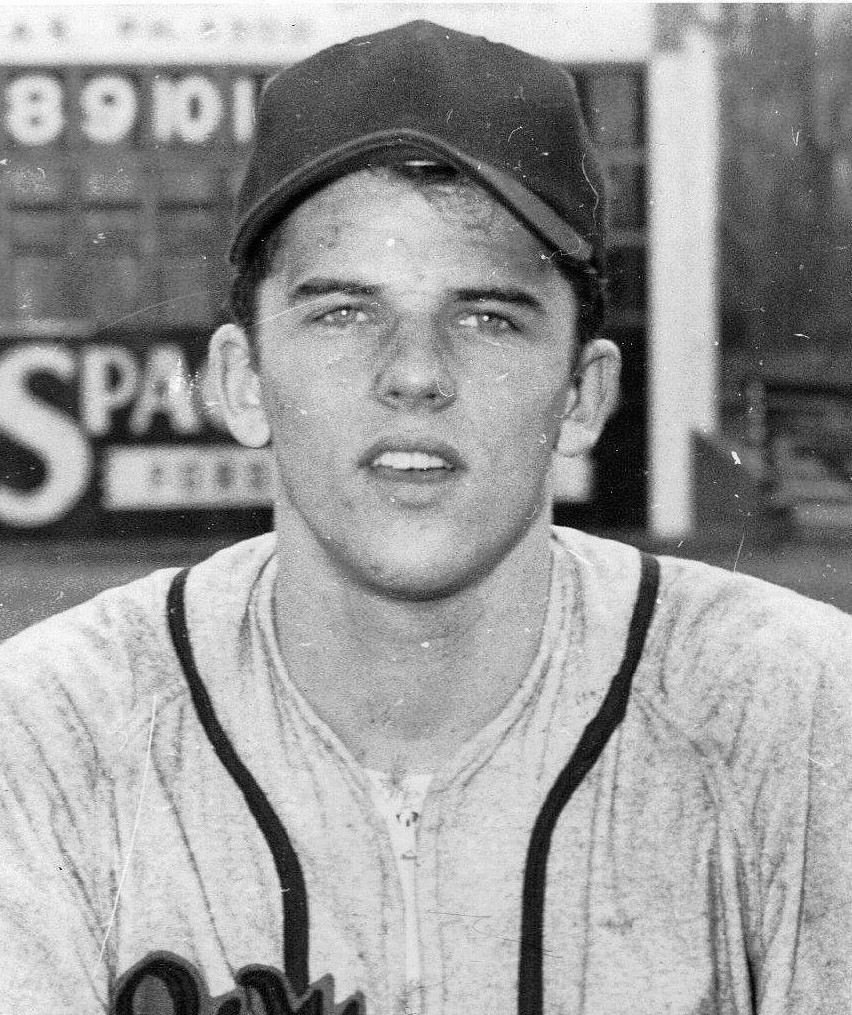 |
| Me at the Jack Rossiter Baseball School in 1956. |
A 48-hour Greyhound Bus ride later, I arrived at the white-stuccoed Seminole Hotel in Cocoa and was greeted by a rather rotund, smiling Jack Rossiter who emerged from a group of young fellows standing on the sidewalk and looking very much like the baseball players that they were. After introductions, I was told that I would be billeted in a private home along with three others, all of whom proved to be Americans -- Ronnie Franjello of Boston, Star Todd of Quincey and Art Brizzi of New Jersey.
Baseball workouts and instructional drills were held each day, 11:00 a.m. to 3:30 p.m., at the local baseball field which was the summer home of the Cocoa Indians, a AA club in the Florida Baseball League. Rossiter was a bit of a philosopher who thought outside of the baseball box. His aim was to not only develop baseball talent, but to build character in the young men under his tutelage. Each day he would gather us together in the outfield for some words of wisdom and exchanges on life in general. He instructed us on how to conduct ourselves as we blended in to the Cocoa community as representatives of the baseball school.
Included in his lectures were advice on relationships that were inevitable with young ladies of the town and company that we might otherwise keep during our stay in Cocoa. Borrowing or loaning money was a no-no..."Neither a borrower nor a lender be!" he repeated countless times. He talked a lot about "focusing" and "extending" ourselves, not only in baseball but in the jobs that we might have as we progressed in life. A staunch Catholic, Jack conducted prayers at the start of each day's training session.
One day he asked for a volunteer to talk about the person who was most responsible for us attending the camp and I talked about the sacrifices and support that my mother had made in order for me to be there. My verbal presentation sufficiently impressed Jack enough that he awarded me with a $10 bill and a trophy that I was later to give to my mother.
The aforementioned Bob Peters who followed me to Rossiter's school the next year, took copious notes during the group meetings convened by Rossiter. One of the typically profound statements notarized by Bob had Jack stating emphatically: "Any fool can learn from his own mistakes but a wise man learns from the mistakes of others."
Bob attended the school in 1957 to better learn the art of catching but unfortunately suffered a health setback only a few months before his departure. "I probably should not have attended the school because I had been quarantined in the Wallaceburg hospital in November with suspected meningitis which necessitated a spinal tap," he explained recently. "The baseball experience was great though and the coaching exceeded anything I had received before," he added.
~~~~~~~~~~~~~~~~~~~~~~~~~
Writer Paul Hemphill, in his book "Lost In The Lights" had a rather humorous and less glowing take on attending the Rossiter school the year before me (1955): "I was deposited before 8 A.M. in front of the shabby Seminole Hotel where all players were told to report. Lugging a new cardboard suitcase in one hand and my bat and glove in another, I checked into a room with only wooden floors and a creaking overhead fan," he writes.
..."I went to the end of the hall on the first floor and knocked lightly on the door. 'It's open,' a voice rasped, and I stepped inside. Jack Rossiter -- a fat, garrulous man with bronze skin and blond wavy hair mindful of Liberace -- was sitting at a desk in his shorts and undershirt...
...'Checked in yet?' he said after introductions 'Yeah, I got something down the hall.'
'That's strange.'
'What? Sir.'
'You don't look like the type.'
"Hunh?'
'Blonde, brunette or readhead?'
'A room!' I said. 'I got a room down the hall.'
"Jack Rossiter, the major league scout, was laughing uncontrollably now, his raucous howl pounding away at me while I wondered what to do with my hands.
"If Roger Kahn's postwar Brooklyn Dodgers were The Boys of Summer, then we were The Boys of Spring: the culls, the dreamers, the ones who now had to pay someone to look at us...
..."A half dozen (players) had real ability and were quickly signed by Rossiter for the Senators' farm system, but the rest of us had little more than desire. As the weeks passed working out and playing games under an ex-shortstop named Eddie Miller and an old pitcher named Pete Appleton, a frantic dread set in with those who remained unsigned.
"Where do you go from the Jack Rosseter baseball School?"
~~~~~~~~~~~~~~~~~~~~~~~~
On the field we learned about all aspects of the game of baseball and positional execution, in particular. Ninety percent of which was completely new to me and very much an eye opener for kids like Bob and I who, unlike our American counterparts, attended with virtually no background of formal coaching.
The school was very much like spring training with conditioning drills and exercises eventually followed by actual mock games. Special instructors were former major league veteran players in the persons of Andy Seminick, Walter "Boom Boom" Beck and Pete Appleton, assisted by promising Washington Senators rookies of that year, Lyle Luttrell and John Schaive. Washington catcher Bob Oldis and outfielder Ernie Oravetz, both graduates of the Rossiter School from former years, dropped in for several guest coaching appearances.
As the camp wore on, minor league coaches, managers and scouts began appearing on the scene in the hopes of picking up some raw talent for the 1956 season. One highly regarded prospect among us was a behemoth by the name of Blair Chapel, an outfielder/infielder. I was asked to throw some batting practice for Blair so that he could show off his hitting prowess.
I threw a half dozen soft pitches to Blair so that he could get good wood on the ball, but was subsequently chastised by Instructor Beck who was standing behind me on the mound. "Those scouts in the stands are looking at you every bit as much as they are at him (Blair)," said a booming Boom Boom. "Throw the sonofabitch ball past him!"
With mixed feelings, I turned up the speed a notch or two on poor Blair as he flailed away in the batter's box. He only managed to foul off several of the next couple of dozen balls I hurled at him and he was promptly instructed to take a seat in the dugout. I felt bad, but what was I supposed to do? Ironically, I would later sign a pro contract...Blair did not. He would eventually go on however to have a respectable career with the Kansas City Monarchs and Satchel Paige's All Stars before ending up in the semi-pro Western Canada Baseball League.
It was customary each year for a select team from Rossiter's school to meet a team from the Sid Gordon Baseball School in neighboring Orlando and I was more than taken aback to be picked as the starting pitcher. Before the game Rossiter came up to me in the dressing room to say that there was a guy outside who wanted to say hello. Much to my surprise, it was Art Houle from Wallaceburg who just happened to be attending the Gordon camp. Art, a lefthanded pitcher, did not play in the game but we had a good chat afterward...Small world!
I had one more trip to Tinkers Field in Orlando as part of a Senators "B"squad playing in a Grapefruit League exhibition game against a New York Yankees "B" team before heading to Donalsonville, Georgia and the lowly Class "D" Florida-Alabama League. From the 250 players attending the Rossiter school that season, only five were successful in signing contracts -- and two of us were Canadians. The other Canuck was Bob Crawford, a pitcher from Kenora. The Americans -- Sammy Hernandez, Rip Sewell and Oddie James -- were older guys with at least one year of minor professional experience under their belts.
Before we broke camp in Cocoa, Rossiter and the other coaching staff invited me into their quarters under the bleachers and surprised me with a cake, complete with 18 candles, on the occasion of my birthday on March 1st. To my knowledge, it was unheard of them to recognize a player in that way and I was not only extremely honored but completely stunned. To this day I cannot really account for why they singled me out in that special way.
I have written previously about the "cup of coffee" I had in professional baseball with the Donalsonville Seminole Indians, but it was pretty heady stuff for a kid in his teens and still slightly damp behind the ears. While it was all too brief, I got to play on my field of dreams and the memories were enough to last a life time. Paul Hemphill was left slightly depressed by his experience, but his memories were sufficient to devote a chapter to it in his book. Like me, he discovered another field of dreams as a sports writer. Bob Peters found a niche in the automotive sales business and became a dealership executive. All three of us still love the game of baseball and would play it today...If old bodies permitted.
 |
| Jack Rossiter with another prospect. |
Some people come and go in your life, others remain fondly in the far reaches of your mind, only to emerge nostalgically from time to time. Like when you write a story about them.
22 May, 2020
CHANGE IS POSSIBLE, CAN HAPPEN QUICKLY, WITHOUT CHANGING OUR CORE VALUES
Audrey (not her real name) is an educational consultant and she talks intelligently and frankly about the big coronavirus changes that are impacting the two institutions that she has vested interest in -- education and the church. For some unexplained reason, her words spoke to me.
Here is what she had to say recently:
Here is what she had to say recently:
"Both systems were woefully archaic pre-virus, in my opinion. While I've seen some steps, say in utilizing technology or adapting to our faster-pace of life, happening around the fringes, the mainstream core of both sectors felt lodged in the 20th century (too generous, perhaps 19th century is more appropriate). With the onset of this virus, both systems accelerated decision-making processes and closed both physical buildings and their traditional ways of "being" in an incredibly short amount of time.
"Not saying this was easy, smooth, better, or worse- just saying that it did in fact happen. A huge change in a short amount of time for two systems that are known for moving at "a glacial pace" normally, to quote a recent Boston Business Journal article.
"I am in no way hoping that this 'new normal' of online is going to be our forever normal-- relationship, connection, being together are so important for the work of these two sectors to happen. But I AM DEEPLY HOPING that these institutions, and the many others I have less insider knowledge of, can acknowledge that change (1) is possible, (2) can happen in quick and organized ways even moving through (unnecessary layers of) committees/bureaucracy, and (3) can bring about new, good things without altering their core values.
"I've worried, for most of my adult life, that both institutions are already "on hospice" in their pre-virus status. Changes were desperately needed to be effective and relevant; even as a middle-aged person, entering into the structures of either system felt like time travelling backwards. Going online isn't the change I was looking for, nor is it solving any of the deeper issues present in both types of organizations; but it is, I hope, forcing everyone involved to realize how necessary and possible change is."
And in a follow up post on her web site the other day she changed the subject only slightly.
"I am in no way hoping that this 'new normal' of online is going to be our forever normal-- relationship, connection, being together are so important for the work of these two sectors to happen. But I AM DEEPLY HOPING that these institutions, and the many others I have less insider knowledge of, can acknowledge that change (1) is possible, (2) can happen in quick and organized ways even moving through (unnecessary layers of) committees/bureaucracy, and (3) can bring about new, good things without altering their core values.
"I've worried, for most of my adult life, that both institutions are already "on hospice" in their pre-virus status. Changes were desperately needed to be effective and relevant; even as a middle-aged person, entering into the structures of either system felt like time travelling backwards. Going online isn't the change I was looking for, nor is it solving any of the deeper issues present in both types of organizations; but it is, I hope, forcing everyone involved to realize how necessary and possible change is."
And in a follow up post on her web site the other day she changed the subject only slightly.
"One of the gifts I’ve found in this odd, hard season is the reminder that being the church really has little to do with being “in” the church building. The physical building can become a crutch or even a barrier for genuinely following Christ in this world.
"Change is hard, and we’ve been forced to change— I hope it will be an opportunity to reshape what it means to be the church. I worry the clamor we’re seeing by some church groups is a frantic attempt to return to a familiar norm, as opposed to thoughtful, prayerful consideration of what God may be calling us into that might be new or different. Scary words, I know!"
I share Audrey's words because she underlines perfectly a statement I made in this same space a week ago: "It is the uncontrolled spread of radical ideas like nonviolent resistance, distributive economic justice, radically inclusive community, and a situational ethics of compassion—that has the creative power to transform the world—and may even ultimately transform the church and the concept of religion in general. In spite of ourselves, the way we have done church in the past may be just that -- in the past!"
We'll wait and see!
Meantime, I hope to hear more from Audrey and people like her who really have something of substance to say about the future of education and our places of worship in the unknown days ahead.
"Change is hard, and we’ve been forced to change— I hope it will be an opportunity to reshape what it means to be the church. I worry the clamor we’re seeing by some church groups is a frantic attempt to return to a familiar norm, as opposed to thoughtful, prayerful consideration of what God may be calling us into that might be new or different. Scary words, I know!"
I share Audrey's words because she underlines perfectly a statement I made in this same space a week ago: "It is the uncontrolled spread of radical ideas like nonviolent resistance, distributive economic justice, radically inclusive community, and a situational ethics of compassion—that has the creative power to transform the world—and may even ultimately transform the church and the concept of religion in general. In spite of ourselves, the way we have done church in the past may be just that -- in the past!"
We'll wait and see!
Meantime, I hope to hear more from Audrey and people like her who really have something of substance to say about the future of education and our places of worship in the unknown days ahead.
21 May, 2020
WHAT'S IN A NAME?...LOTS, JUST ASK JESUS AND BOB FELLER
In Biblical times, peoples' attitudes toward names and titles were steeped in meaning. For example, in invoking the Name of God, the pious Jews used the word "Yahweh," which, standing alone, was a complete expression of their understanding of the Divine. Spelled out in our own terms, Yahweh means something like this: "The Self-Existent Being who determines His own destiny and that of the world." Invoking the Name of "Yahweh" was a profound expression of faith in the God who presides over all creation. For pious Jews, it summarized God's destiny, as Lord and Master of all He created.
Properly invoked, the Name of the Messiah is a profound statement of Christian Faith. In Luke’s Gospel we read: "the name Jesus was given the child, the name the angel had given Him before He was conceived" (Luke 2:21). The symbolic Name the angel had given Him was "Emmanuel," which means "God with us." Jesus' messianic mission -- His destiny, if you will -- was to reveal to the world the Good News that God is indeed "with us." Thus, Jesus' fate is summed up in His Name: God With Us!

Properly invoked, the Name of the Messiah is a profound statement of Christian Faith. In Luke’s Gospel we read: "the name Jesus was given the child, the name the angel had given Him before He was conceived" (Luke 2:21). The symbolic Name the angel had given Him was "Emmanuel," which means "God with us." Jesus' messianic mission -- His destiny, if you will -- was to reveal to the world the Good News that God is indeed "with us." Thus, Jesus' fate is summed up in His Name: God With Us!

And speaking of names meaning something, I am reminded of an old baseball story about a Major League Baseball game in which the Cleveland Indians were playing the Chicago White Sox in the Windy City. It was the bottom of the ninth inning and Cleveland was leading 3-0 as Chicago came to bat for the last time. The first three Chicago batters reached base safely. With the bases loaded, the Cleveland manager called in a young relief pitcher. The first ball thrown by the new pitcher was promptly hit over the center-field fence for a grandslam walk-off home run! The game was over; Chicago had won, 4-3.
Later, in the clubhouse, the young relief pitcher went over to the Cleveland team's star pitcher, "Rapid Robert" (Bob) Feller -- one of baseball's "all-time greats." "Bob," he said to the biggest name in baseball at the time, "Tell me how you would have pitched that ball?"
Feller replied with typical soberness as he laced up his oxfords, "Under an assumed name!"
Later, in the clubhouse, the young relief pitcher went over to the Cleveland team's star pitcher, "Rapid Robert" (Bob) Feller -- one of baseball's "all-time greats." "Bob," he said to the biggest name in baseball at the time, "Tell me how you would have pitched that ball?"
Feller replied with typical soberness as he laced up his oxfords, "Under an assumed name!"
20 May, 2020
PEOPLE I'VE TEASED, YOU KNOW WHO YOU ARE...
Alright...I confess. I'm one of the world's worst teasers.
It is just the way I am. I have come to rationalize it as a means for an otherwise basically shy person to break through all formality by creating a moment of levity that has instant potential for individual connection. My type of teasing is always good-natured, revolving around a very minor quirk or something offbeat someone says or does and, ideally, both parties find it funny.
I may tease about an item of clothing that is just a little different, a new hairdo or something unusual that I have just observed or overheard in conversation...That sort of thing. The intent generally to leave the impression that I actually noticed. And always with at least a hint of a smile.
I tease people I like, or think I would like if I knew them better. I also tease friends on Facebook, a tricky chance I take with potential to backfire without the benefit of body language and voice tone. I strongly suspect that I may have overspent my welcome in certain isolated cases of this nature.

A teaser has to be careful though because teasing can often be mistaken for sarcasm. It has to be done in a jovial, friendly way. There are those who do not understand the humor or purpose for levity.
I understand too that humor can unnerve people with insecurities because it uncloaks their wounds and weaknesses. They feel vulnerable, out of control and emotionally naked. In a nutshell, while you’re feeling pleasure, they’re feeling pain.
As a “rule of thumb,” I am forever conscious of having fun at the expense of others. Seriously, if they’re not laughing at one of my witty cracks, it isn’t funny. It is hurtful. Simply respecting the other person’s feelings without saying the proverbial, “You’re just too sensitive!” or “Can’t you take a joke?” is my ultimate hard-earned attitude.
I cannot begin to enumerate the times that I have said to myself: "I've got to stop doing that!" But you know what they say about old habits...
Admittedly, our world does have people that do in fact take themselves and others way too seriously. However, happily there are more people who get or understand humor and I derive satisfaction in walking away in the end feeling that I have generated a chuckle, maybe even provided the one bright spot in someone's day.
I do it with complete strangers too, and more often than not generate a positive response. In fact, I delight in wearing the "funny guy" or "friendly guy" labels often applied to me after an unsolicited, teasing or good-natured comment of some sort.
It is imperative, however, to know the where, the when, with whom, and how much humor is good enough in given situations. It is all about sensitivity!
“Let no corrupting talk come out of your mouths, but only such as is good for building up, as fits the occasion, that it may give grace to those who hear.” —from the English Standard Version of the Bible.
It is just the way I am. I have come to rationalize it as a means for an otherwise basically shy person to break through all formality by creating a moment of levity that has instant potential for individual connection. My type of teasing is always good-natured, revolving around a very minor quirk or something offbeat someone says or does and, ideally, both parties find it funny.
I may tease about an item of clothing that is just a little different, a new hairdo or something unusual that I have just observed or overheard in conversation...That sort of thing. The intent generally to leave the impression that I actually noticed. And always with at least a hint of a smile.
I tease people I like, or think I would like if I knew them better. I also tease friends on Facebook, a tricky chance I take with potential to backfire without the benefit of body language and voice tone. I strongly suspect that I may have overspent my welcome in certain isolated cases of this nature.

A teaser has to be careful though because teasing can often be mistaken for sarcasm. It has to be done in a jovial, friendly way. There are those who do not understand the humor or purpose for levity.
I understand too that humor can unnerve people with insecurities because it uncloaks their wounds and weaknesses. They feel vulnerable, out of control and emotionally naked. In a nutshell, while you’re feeling pleasure, they’re feeling pain.
As a “rule of thumb,” I am forever conscious of having fun at the expense of others. Seriously, if they’re not laughing at one of my witty cracks, it isn’t funny. It is hurtful. Simply respecting the other person’s feelings without saying the proverbial, “You’re just too sensitive!” or “Can’t you take a joke?” is my ultimate hard-earned attitude.
I cannot begin to enumerate the times that I have said to myself: "I've got to stop doing that!" But you know what they say about old habits...
Admittedly, our world does have people that do in fact take themselves and others way too seriously. However, happily there are more people who get or understand humor and I derive satisfaction in walking away in the end feeling that I have generated a chuckle, maybe even provided the one bright spot in someone's day.
I do it with complete strangers too, and more often than not generate a positive response. In fact, I delight in wearing the "funny guy" or "friendly guy" labels often applied to me after an unsolicited, teasing or good-natured comment of some sort.
It is imperative, however, to know the where, the when, with whom, and how much humor is good enough in given situations. It is all about sensitivity!
“Let no corrupting talk come out of your mouths, but only such as is good for building up, as fits the occasion, that it may give grace to those who hear.” —from the English Standard Version of the Bible.
19 May, 2020
MOTIVATION IN THE ART OF WRITING

I do not write to be reactionary. I do not write just to hear myself talk -- or to see my work in print.
I write to exercise my imagination and creativity. I write as a form of venting what is going on in my mind. Ideally, I write to inspire like-mindedness; acknowledging hesitantly that you can't win 'em all.
I die a thousand deaths when something I've written seems to have drifted off into nothingness. And I worry when I get the impression that I have been dismissed, or not taken seriously by my targeted audience. I take utmost pride in authorship.
I have a compulsive sense of mission in what I write and I frequently battle demons in order to keep that direction alive. Generally there is satisfaction in fulfilling what is a need within me to express myself to the limits of my creative ability.
I believe that writing is a form of art because of the three aforementioned reasons:
it exercises imagination,
it is a form of expression,
it is a powerful influencer.
If you’re a DIY enthusiast, a woodworker, or a handyman, you know that imagination plays a vital role when creating something. Without imagination, it’s almost impossible to be creative at all. Fortunately, writing enables me to form ideas that are beyond the box. It allows me to maximize thinking and analytic skills.

Writing, in all its varied forms, is an empowering and complex process. It calls upon the writer to bring together the random thoughts in the left and right sides of the brain and shape them into something useful, beautiful and inspiring so that another person can understand and appreciate it.
The need to feel understood and to know what one thinks about it, matters and is universal. We have all probably heard that writing is not only an art, but a science too. That may be true for the artistic endeavors, but how does it play out in actually writing a meaningful story?
If you break the aspect down into two elements, art and science, it helps to explain the how and the why. Writing craft is the technical-science side, while storytelling is the art side. The science of writing includes sentence structure, grammar and POV-active sentences. It’s all about knowing the difference between ‘telling’ and ‘showing’ the added layers to your characters.
The science of writing is all the details that go in to developing good craft and it is absolutely essential. Once in every great while, a gifted story teller comes along, sweeping people off their feet despite a lack of craft, but mostly it is practiced craft that enables a good story to be received –ungirding it, making it beautiful and shiny. Without effective craft writing, the story gets lost in a jumble of a poor backstory and POV issues.
I get the sense that people on the outside think there’s something magical about writing, that you go up in the attic at midnight and cast the bones and come down in the morning with a story, but it isn’t like that at all. You do it with the seat of your pants planted firmly in a chair in front of a computer monitor calling on all your creative skills and imagination, at all hours of the day and night. It's not a question of sitting down and letting it all pour out in mega seconds (i.e. I sat down to develop this simple Wrights Lane entry at 3:10 p.m. and it is now exactly 6:09 p.m. and I should have put supper in the oven an hour ago).
Succinctly, when it comes to writing, innovative speculation is critical. Whether planning to drench oneself in composing a poetic verse, believe that there is a novel in you, or just handling a blog entry or an article, creativity is what can transform it into a work of art.
Straightforward factual writing or news reporting might not be artful, but there is somehow one or more element of creativity in the way information is presented. They make you need to peruse and discover more. Basically, any sort of composing can be called art, yet genuine creativity is what transforms it into something extraordinary. It is not what you have that matters, but rather what you do with it...and in the end, how you present it.
As with any form of art, writing takes practice. Ideally, the more you do of it, the better you get.
I liken it to what former Toronto Blue Jay pitcher Dave Stieb said in his book -- "Tomorrow I'll be Perfect!"
18 May, 2020
THE MAGIC IN DREAMING AN IMPOSSIBLE DREAM

I awoke to streams of early morning light filtering through bedroom curtains, but there was something about this particular awakening that was different from all others -- an at-peace recognition that I had just been blessed in a way that I had felt would never again be possible. Without dressing, I rushed to permanently capture in words the soul-satisfying rapture that I had just experienced; lest it should escape me yet again and for one last time.
Oh My God, how I need that...To relive unconditional giving and receiving in a loving one-on-one human context that heretofore had been lost to me. To know that I could be capable of experiencing any of that, if only in a dream, was consolidational and soothing to my weary, deficient soul and failing body. I faced the day ahead with renewed hope for the possibility of things to come and the beauty of the unknown. That's all I needed!
That's truly all any of us needs -- to love and be loved; freely, instinctively and unconditionally. Or, failing all else, to be reminded of it in one magical and dreamy God-given moment of blessed unconscious slumber where anything is possible.
17 May, 2020
FAITH AS A WAY OF LIFE...

A THOUGHT FOR AN OVERLY-QUIET, OVERCAST SUNDAY: Have you heard the term "religionless Christianity". Simply explained, this is faith as a way of life, not as a system of beliefs and doctrines or institutional rites and rituals. Therein lies the challenge to contemporary Christian churches today to become more passionate about Jesus and his vision of personal and social transformation. Jesus himself explained that the reign of God was like a mustard plant—a fast-growing weed that invades well-cultivated and protected gardens and that spreads with chaotic growth. It is the uncontrolled spread of radical ideas like nonviolent resistance, distributive economic justice, radically inclusive community, and a situational ethics of compassion—that has the creative power to transform the world—and may even ultimately transform the church and the concept of religion in general. In spite of ourselves, the way we have done church in the past may be just that -- in the past! Will that be a good thing, or a bad thing? Time alone will tell!
12 May, 2020
WORTHY NOTES ON TAKING A STAND
I took advantage of a few idle moments today to clean out my computer files of notes and downloads that are no longer of any value to me. I hesitated, however, before pressing the delete key on several notes related to the subject of "taking a stand". In considering their enduring relevance, I reproduce them here, unedited, just because I can.
Taking a stand on something -- your product, your writing or your personal views -- has practical benefit. On the other hand, if you try to please everyone, you’ll end up pleasing no one. Trust me!
Yes, you stand a chance of upsetting someone. You may even make the odd person mad. You may offend some who in the end may unsubscribe or unfriend you, but that’s life. I have a proclivity, however, for taking a stand and, ideally, gaining a few like-minded supporters (even converts) along the way.
Truthfully, I am convinced that I write for the majority. I strive to leave a feel-good or thought-provoking message, otherwise I would not waste my time (countless hours of thought, research and eventual commitment to the printed word). Strangely enough, when I do not elicit reactions (pro or con), that's when I am disappointed and left feeling that I have failed to leave a mark...Only a writer would understand that!
No question about it, If you take a stand you will certainly get noticed. That’s why many people don’t take a stand. They don’t want to get noticed by someone who doesn’t agree with what they are saying...It’s better to play it safe. But who ever got any place by playing it safe?
I find myself drawn to and respecting people who take a principled stand even if it is diametrically opposed to my own. I would rather have a principled foe who frustrates the hell out of me, than a wishy-washy friend. What challenge is there in that?
Aside from the practical benefit in attracting passionate supporters, there is another and maybe more important benefit of taking a stand – your self-respect. Whenever I’m quiet about something that is important to me in the face of strong opposition, I end up feeling troubled about it later. Whenever I hold back on writing something because I’m afraid it might offend someone, I lose a little respect for myself. When I stand up for what I believe, I feel good about myself no matter what anyone else thinks.
I've always liked what good old actor/U.S. President Ronald Reagan had to say on the subject: “If some among you fear taking a stand because you are afraid of reprisals from customers, clients, or even government, recognize that you are just feeding the crocodile hoping he’ll eat you last.”
Taking a stand on something -- your product, your writing or your personal views -- has practical benefit. On the other hand, if you try to please everyone, you’ll end up pleasing no one. Trust me!
Yes, you stand a chance of upsetting someone. You may even make the odd person mad. You may offend some who in the end may unsubscribe or unfriend you, but that’s life. I have a proclivity, however, for taking a stand and, ideally, gaining a few like-minded supporters (even converts) along the way.
Truthfully, I am convinced that I write for the majority. I strive to leave a feel-good or thought-provoking message, otherwise I would not waste my time (countless hours of thought, research and eventual commitment to the printed word). Strangely enough, when I do not elicit reactions (pro or con), that's when I am disappointed and left feeling that I have failed to leave a mark...Only a writer would understand that!
No question about it, If you take a stand you will certainly get noticed. That’s why many people don’t take a stand. They don’t want to get noticed by someone who doesn’t agree with what they are saying...It’s better to play it safe. But who ever got any place by playing it safe?
I find myself drawn to and respecting people who take a principled stand even if it is diametrically opposed to my own. I would rather have a principled foe who frustrates the hell out of me, than a wishy-washy friend. What challenge is there in that?
Aside from the practical benefit in attracting passionate supporters, there is another and maybe more important benefit of taking a stand – your self-respect. Whenever I’m quiet about something that is important to me in the face of strong opposition, I end up feeling troubled about it later. Whenever I hold back on writing something because I’m afraid it might offend someone, I lose a little respect for myself. When I stand up for what I believe, I feel good about myself no matter what anyone else thinks.
I've always liked what good old actor/U.S. President Ronald Reagan had to say on the subject: “If some among you fear taking a stand because you are afraid of reprisals from customers, clients, or even government, recognize that you are just feeding the crocodile hoping he’ll eat you last.”
09 May, 2020
REMEMBERING GRACE HELENA WRIGHT, 1903-1994

Me and my mother Grace, winter of 1938.
I've always been conscious of wet feet...Can't understand why, unless...
When I was a boy, and it chanced to rain,
Mother would always watch for me;
She used to stand by the window pane,
Worried and troubled as she could be.
Worried and troubled as she could be.
And this was the question I used to hear,
The very minute that I drew near;
The words she used, I can't forget,
"Tell me, my boy, if your feet are wet."
Worried about me was mother dear.
As healthy a lad as ever strolled
Over a turnpike, far and near,
As healthy a lad as ever strolled
Over a turnpike, far and near,
'Fraid to death that I'd catch a cold.
Always stood by the window pane,
Watching for me in the pouring rain;
And her words in my ears are ringing yet:
"Tell me, my boy, if your feet are wet."
And her words in my ears are ringing yet:
"Tell me, my boy, if your feet are wet."
Stockings warmed by the kitchen stove,
And slippers ready for me to wear;
Seemed that mother would never tire,
Giving her boy the best of care,
Thinking of him the long day through,
In the worried way that all mothers do;
Whenever it rained she'd start to fret,
Always fearing my feet were wet.
And now, whenever it rains, I see
A vision of mother in the days of yore,
A vision of mother in the days of yore,
Still waiting there to welcome me,
As she used to do by the open door.
And always I think as I enter there
Of a mother's love and a mothers care;
Her words in my ears are ringing yet;
"Tell me, my boy, if your feet are wet."
08 May, 2020
A PORTAL BETWEEN ONE WORLD AND THE NEXT AWAITS

"Nothing could be worse than a return to 'normality'."
Facebook is a great place for people to share special quotations and statements -- some profound, some provocative and some outright funny. Trouble is, the originator is rarely identified and I always try to take it upon myself to determine the source, if for no other reason than to attach identity and authenticity. Such has been the case with the above remarkable quotation, as it turns out by a woman from another part of the world by the name Suzanna Arundhati Roy. I highlight the above sentence taken from this impactful statement because it resonated with me. It is a point I have less effectively been trying to make in recent days, all the while perhaps erroneously referring to a "return to normal" when this COVID-19 mess is all over. Thanks to Roy, I am now convinced that when pandemic restraints are lifted we will have an opportunity to leave behind our "normal" baggage, ready to imagine a new world -- and to fight for it. As I suggested to a church co-op group the other day: "Hit the ground running (with new vitality and commitment) when our church doors finally swing open again." How often do we get a chance like that IN ALL ASPECTS OF LIFE...To start anew!
Suzanna Arundhati Roy is an Indian author best known for her novel The God of Small Things (1997), which won the Man Booker Prize for Fiction in 1997 and became the best-selling book by a non-expatriate Indian author. She is also a political activist involved in human rights and environmental causes. Incidentally, that's a rather pensive Roy shown in the background of her powerful words.
She is brilliant, articulate, provocative and out-spoken...One of the great thinkers of present times. And she often gets herself in trouble which goes with the territory.
One could literally write a book on Roy but very briefly, early in her career she worked for television and movies. She wrote the screenplays for In Which Annie Gives It Those Ones (1989), a movie based on her experiences as a student of architecture, in which she also appeared as a performer, and Electric Moon (1992). Both were directed by her husband, Pradip Krishen, during their marriage. Roy won the National Film Award for Best Screenplay in 1988 for In Which Annie Gives It Those Ones. She attracted attention in 1994 when she criticised Shekhar Kapur's film Bandit Queen, which was based on the life of Phoolan Devi. In her film review titled "The Great Indian Rape Trick", she questioned the right to "re-stage the rape of a living woman without her permission", and charged Kapur with exploiting Devi and misrepresenting both her life and its meaning.

Roy began writing her first novel, The God of Small Things, in 1992, completing it in 1996. The book is semi-autobiographical and a major part captures her childhood experiences in Aymanam. Since the success of her novel, Roy has written a television serial, The Banyan Tree, and the documentary DAM/AGE: A Film with Arundhati Roy (2002).
She contributed to We Are One: A Celebration of Tribal Peoples, a book released in 2009, that explores the culture of peoples around the world, portraying their diversity and the threats to their existence. The royalties from the sale of this book go to the indigenous rights organisation Survival International.
She has written numerous essays on contemporary politics and culture. In 2014, they were collected by Penguin India in a five-volume set. In 2019, her nonfiction was collected in a single volume, My Seditious Heart, published by Haymarket Books.
In October 2016, Penguin India and Hamish Hamilton UK announced that they would publish her second novel, The Ministry of Utmost Happiness, in June 2017. The novel was chosen for the Man Booker Prize 2017 Long List. The Ministry of Utmost Happiness was nominated as a finalist for the National Book Critics Circle Award for fiction in January 2018.
Since publishing The God of Small Things in 1997, Roy has spent most of her time on political activism and nonfiction (such as collections of essays about social causes). She is a spokesperson of the anti-globalization/alter-globalization movement and a vehement critic of neo-imperialism and U.S. foreign policy. She opposes India's policies toward nuclear weapons as well as industrialization and economic growth (which she describes as "encrypted with genocidal potential" in Listening to Grasshoppers: Field Notes on Democracy). She has also questioned the conduct of Indian police and administration in the case of 2001 Indian Parliament attack and the Batla House encounter case contending that the country has had a "shadowy history of suspicious terror attacks, murky investigations, and fake encounters".
Environmental historian Ramachandra Guha has been critical of Roy's Narmada dam activism. While acknowledging her "courage and commitment" to the cause, Guha writes that her advocacy is hyperbolic and self-indulgent, "Ms. Roy's tendency to exaggerate and simplify, her Manichaean view of the world, and her shrill hectoring tone, have given a bad name to environmental analysis". He faulted Roy's criticism of Supreme Court judges who were hearing a petition brought by the Narmada Bachao Andolan as careless and irresponsible.
Roy counters that her writing is intentional in its passionate, hysterical tone: "I am hysterical. I'm screaming from the bloody rooftops. And he (Guha) and his smug little club are going 'Shhhh... you'll wake the neighbours!' I want to wake the neighbours, that's my whole point. I want everybody to open their eyes". I just love her attitude.
She disputes U.S. claims of being a peaceful and freedom-loving nation, listing China and 19 Third World "countries that America has been at war with—and bombed—since World War II ", as well as previous U.S. support for the Taliban movement and the Northern Alliance (whose "track record is not very different from the Taliban's"). She does not spare the Taliban:
"Now, as adults and rulers, the Taliban beat, stone, rape, and brutalize women, they don't seem to know what else to do with them."
In the final analysis, Roy sees American-style capitalism as the culprit: "In America, the arms industry, the oil industry, the major media networks, and, indeed, U.S. foreign policy, are all controlled by the same business combines".
She puts the attacks on the World Trade Center and on Afghanistan on the same moral level, that of terrorism, and mourns the impossibility of beauty after 2001: "Will it be possible ever again to watch the slow, amazed blink of a newborn gecko in the sun, or whisper back to the marmot who has just whispered in your ear—without thinking of the World Trade Centre and Afghanistan?"
Roy was featured in the 2014 list of Time 100, the 100 most influential people in the world. I think she deserves to be at the top of that list and we need to hear more from her...Too bad she's from another side of the world that doesn't always make our North American media headlines!
Suzanna Arundhati Roy is an Indian author best known for her novel The God of Small Things (1997), which won the Man Booker Prize for Fiction in 1997 and became the best-selling book by a non-expatriate Indian author. She is also a political activist involved in human rights and environmental causes. Incidentally, that's a rather pensive Roy shown in the background of her powerful words.
She is brilliant, articulate, provocative and out-spoken...One of the great thinkers of present times. And she often gets herself in trouble which goes with the territory.
One could literally write a book on Roy but very briefly, early in her career she worked for television and movies. She wrote the screenplays for In Which Annie Gives It Those Ones (1989), a movie based on her experiences as a student of architecture, in which she also appeared as a performer, and Electric Moon (1992). Both were directed by her husband, Pradip Krishen, during their marriage. Roy won the National Film Award for Best Screenplay in 1988 for In Which Annie Gives It Those Ones. She attracted attention in 1994 when she criticised Shekhar Kapur's film Bandit Queen, which was based on the life of Phoolan Devi. In her film review titled "The Great Indian Rape Trick", she questioned the right to "re-stage the rape of a living woman without her permission", and charged Kapur with exploiting Devi and misrepresenting both her life and its meaning.

Roy began writing her first novel, The God of Small Things, in 1992, completing it in 1996. The book is semi-autobiographical and a major part captures her childhood experiences in Aymanam. Since the success of her novel, Roy has written a television serial, The Banyan Tree, and the documentary DAM/AGE: A Film with Arundhati Roy (2002).
She contributed to We Are One: A Celebration of Tribal Peoples, a book released in 2009, that explores the culture of peoples around the world, portraying their diversity and the threats to their existence. The royalties from the sale of this book go to the indigenous rights organisation Survival International.
She has written numerous essays on contemporary politics and culture. In 2014, they were collected by Penguin India in a five-volume set. In 2019, her nonfiction was collected in a single volume, My Seditious Heart, published by Haymarket Books.
In October 2016, Penguin India and Hamish Hamilton UK announced that they would publish her second novel, The Ministry of Utmost Happiness, in June 2017. The novel was chosen for the Man Booker Prize 2017 Long List. The Ministry of Utmost Happiness was nominated as a finalist for the National Book Critics Circle Award for fiction in January 2018.
Since publishing The God of Small Things in 1997, Roy has spent most of her time on political activism and nonfiction (such as collections of essays about social causes). She is a spokesperson of the anti-globalization/alter-globalization movement and a vehement critic of neo-imperialism and U.S. foreign policy. She opposes India's policies toward nuclear weapons as well as industrialization and economic growth (which she describes as "encrypted with genocidal potential" in Listening to Grasshoppers: Field Notes on Democracy). She has also questioned the conduct of Indian police and administration in the case of 2001 Indian Parliament attack and the Batla House encounter case contending that the country has had a "shadowy history of suspicious terror attacks, murky investigations, and fake encounters".
Environmental historian Ramachandra Guha has been critical of Roy's Narmada dam activism. While acknowledging her "courage and commitment" to the cause, Guha writes that her advocacy is hyperbolic and self-indulgent, "Ms. Roy's tendency to exaggerate and simplify, her Manichaean view of the world, and her shrill hectoring tone, have given a bad name to environmental analysis". He faulted Roy's criticism of Supreme Court judges who were hearing a petition brought by the Narmada Bachao Andolan as careless and irresponsible.
Roy counters that her writing is intentional in its passionate, hysterical tone: "I am hysterical. I'm screaming from the bloody rooftops. And he (Guha) and his smug little club are going 'Shhhh... you'll wake the neighbours!' I want to wake the neighbours, that's my whole point. I want everybody to open their eyes". I just love her attitude.
She disputes U.S. claims of being a peaceful and freedom-loving nation, listing China and 19 Third World "countries that America has been at war with—and bombed—since World War II ", as well as previous U.S. support for the Taliban movement and the Northern Alliance (whose "track record is not very different from the Taliban's"). She does not spare the Taliban:
"Now, as adults and rulers, the Taliban beat, stone, rape, and brutalize women, they don't seem to know what else to do with them."
In the final analysis, Roy sees American-style capitalism as the culprit: "In America, the arms industry, the oil industry, the major media networks, and, indeed, U.S. foreign policy, are all controlled by the same business combines".
She puts the attacks on the World Trade Center and on Afghanistan on the same moral level, that of terrorism, and mourns the impossibility of beauty after 2001: "Will it be possible ever again to watch the slow, amazed blink of a newborn gecko in the sun, or whisper back to the marmot who has just whispered in your ear—without thinking of the World Trade Centre and Afghanistan?"
Roy was featured in the 2014 list of Time 100, the 100 most influential people in the world. I think she deserves to be at the top of that list and we need to hear more from her...Too bad she's from another side of the world that doesn't always make our North American media headlines!