The Beatles (remember them?) once sang: "I don't care too much for money, money can't buy me love."
It was just around the time of the release of that record (we called them records in those days) that colour television sets came on the market and we could no longer see the world in such a black and white manner. We know, of course, that love and money are not mutually exclusive...It is perfectly possible to have both. All that is required is an understanding that the two are not necessarily connected.
We are the wealthiest when we have love in our hearts!
Personally though, I'll take a liberal dollop of legal tender mixed in with all my "love" diet recipes. It is the ingredient that binds, so to speak.
28 October, 2012


26 October, 2012
IT'S GIVE AND TAKE SEASON ON THE SAUGEEN

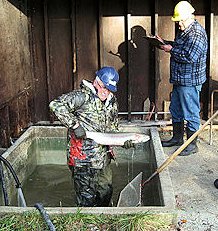 |
| Measuring a fine specimen |
During the spring, the volunteers move salmon up-river and, now, in the fall, they do the same with rainbow trout. According to sources, the fishing on the Saugeen this year is the
best in over 20 years -- thanks to the dedicated volunteer members of these
organizations.
Details of each fish are individually documented for the government. They are measured and a scale sample is taken. Fertilization in the hatcheries is generally 70 to 80 per cent while in nature it is only approximately four per cent.
Not every fish taken has sperm or eggs because they are too young. These "green" fish are subsequently placed in two portable tanks, one for females and the other for males, and taken to sites further up the river to tributaries where the water is cooler and more conducive to the development of sperm.
Regardless of weather conditions, anglers will be out in droves on the Saugeen again this weekend.
 |
| There ya go, me beauty! |
Not every fish taken has sperm or eggs because they are too young. These "green" fish are subsequently placed in two portable tanks, one for females and the other for males, and taken to sites further up the river to tributaries where the water is cooler and more conducive to the development of sperm.
Regardless of weather conditions, anglers will be out in droves on the Saugeen again this weekend.
23 October, 2012
A VISIT TO THE SCHOOL SYSTEM OF YESTERYEAR
 |
| School in Dresden attended by my parents and their son, demolished in 1960s. |
You only have to look at vintage news reels to see that our parents' and grandparents' generations suffered a tawdry, monochromatic education, dismally devoid of colour and imagination. It is not too surprising that many students dropped out before ever making it to high school. Of course, apprenticeships were readily available in many vocations in those days and economics were also a factor...Out of necessity, young people (boys in particular) were required to start making a living for themselves as soon as they were physically able. School start times were also adjusted to accommodate farm kids who were required to work in the fall harvest.
Punishment and discipline were high on the agenda too. Not learning math or neglecting homework often resulted in teachers administering the strap for insubordination. If work was not up to standard, students were actually failed and held back a year...Just ask me! I failed a grade when my father passed away during my first year in high school...An embarrassing and belittling experience that haunts me to this day, forever carrying the stigma of the "dummy" label. There was a certain regimentation too and the old school in Dresden (see photo above) that both my parents and I attended was no exception.
Extra curricular activities were virtually non existent. The biggest "social" event of the school year was the annual commencement exercises. An activity highlight was "track and field day" held in October of each year.
During elementary years, boys were assigned to one side of the school yard, and girls the other. Heaven help anyone who ever strayed beyond that invisible dividing line. Students also had separate entrances at the back of the school. Upon graduation (moving up) to high school on the second storey, boys and girls were privileged to use the same front entrance to the school as a first exposure to co-ed, co-existence in the society that awaited them. For most kids, it was a rite of passage -- an "I have finally arrived" sort of thing. Teachers, of course, had their own private entrance.
Children in my old hometown spent a good 12 years going to the same continuation school with primary grades on the first floor and senior grades (high school) on the second. This may account for why so many of us have a special feeling for our old schools. Kind of like our second home, in a way. We spent almost half of the first years of our life walking those familiar halls of learning. A place where our minds and personalities were formed, for better or worse. By my rough calculations, I figure that I and my dad each walked 7,200 miles over the Sydneham River Bridge, to and from the same school in our formative years.
.jpg)
 |
| Slate board and slate pencil. |
Just imagine how many trees could be spared today by re-introducing slate boards to the education system. Guess we won't hold our breath on that one...!
Remarkably, schools in the first half of the 20th century turned out many brilliant minds and top scholars, so don't get me wrong. There were redeeming features. There will be a few (like me) reading this post who were virtual products of that very system; so I choose my words carefully.
18 October, 2012
WE ALL HAVE EXCITING LIFE STORIES TO TELL AND THE BEST CHAPTERS MAY BE YET TO COME
I have fun following the curmudgeonly astronomer Jonathan Cainer. There are times when he makes absolutely no sense at all and there are other times when he is eerily close to the mark. He was talking about people's life stories the other day and he struck a chord with me.
Just think about it for a minute. We all have amazing life stories to tell, if only we were so moved. Some publishers would no doubt reject many of our life tales because they feel that they are just not believable enough. Other publishing brain trusts may determine that some of our stories are beyond belief, perhaps better portrayed as fiction.
Of course, certain aspects of our life experiences would require selective self-editing and may not bear repeating publicly. But that's another story, right?
For some of us, there have been so many uncanny coincidences and inexplicable developments in our life stories. Even with all the nuances and details accounted for, we still find it hard to explain exactly why and how some things have happened to us.
Once we simplify some of those details, it all starts to seem faintly miraculous, doesn't it...Great stories that most of us will ultimately take untold to the grave with us, and that is a shame.
But you know what, if you are reading this post, your story is not finished yet. What miraculous next chapter is just around the next corner for each and every one of us? Exciting thought, isn't it!
If I were a publisher today, I'd love to hear all about it...Keep your pencils sharp dear friends. You may yet have a best seller on your hands. Keep living the tale and adding exciting new chapters as you go!
Make your life story a long and good one.
Just think about it for a minute. We all have amazing life stories to tell, if only we were so moved. Some publishers would no doubt reject many of our life tales because they feel that they are just not believable enough. Other publishing brain trusts may determine that some of our stories are beyond belief, perhaps better portrayed as fiction.
Of course, certain aspects of our life experiences would require selective self-editing and may not bear repeating publicly. But that's another story, right?
For some of us, there have been so many uncanny coincidences and inexplicable developments in our life stories. Even with all the nuances and details accounted for, we still find it hard to explain exactly why and how some things have happened to us.
Once we simplify some of those details, it all starts to seem faintly miraculous, doesn't it...Great stories that most of us will ultimately take untold to the grave with us, and that is a shame.
But you know what, if you are reading this post, your story is not finished yet. What miraculous next chapter is just around the next corner for each and every one of us? Exciting thought, isn't it!
If I were a publisher today, I'd love to hear all about it...Keep your pencils sharp dear friends. You may yet have a best seller on your hands. Keep living the tale and adding exciting new chapters as you go!
Make your life story a long and good one.
16 October, 2012
ONLY A DAY AWAY, SUN CAME OUT THIS MORNING
"dreary, wet fall days" we had just experienced in Southampton, I could not help but keep repeating in my mind the hauntingly delightful and promising words from the ever-popular Broadway show "Anne": "The sun'll come out tomorrow. Bet your bottom dollar that tomorrow there'll be sun!..."
Well, sure enough, this morning we had sun ever so hesitantly finding its way through thick, gray clouds that had hung overhead for almost 100 hours. As the warm rays continued to penetrate and open up the heavy cloud cover to a clear blue sky, I swear I could hear a heavenly crescendo piercing the fall air: "...Tomorrow! Tomorrow! I love ya. Tomorrow you're always a day a way."
After writing yesterday's post about the depressing four consecutive
 |
| Sun piecing through clouds and branches of towering pine tree in our front yard. |
 |
| Finally, full sun this morning revealed colors of autum on our street. |
15 October, 2012
WET, DREARY DAYS NOT EVEN FOR THE BIRDS
If there is anything that I hate more than a dreary, wet and windy day in October, it is four consecutive dreary, wet and windy days in October.. It doesn't help that Rosanne and I are at different stages of struggling with bouts of pneumonia.
At the best of times, fall is the most depressing of the four seasons for me, but this is ridiculous. Enough already! I've had it up to my over-stuffed sinuses!
In the old days you might say that we have "walking pneumonia". We're able to be up and about (most of the time), but most of the time why bother. Sleep is a better option, providing you can stop coughing long enough.
Yesterday (Sunday), with plans to attempt to go to church, I got up at the usual time, showered, shaved and -- subsequently tossed in the towel. One look out the window convinced me that I was making right decision. It was just not a fit day outside for man nor beast. Even Lucy needed gentle persuasion to venture off our back porch step in order to perform her routine morning duty.
The rest of the day I rotated prone positions on my recliner chair and the couch. Rosanne continued to be a permanent fixture on her recliner, moaning, hacking and coughing her way around the clock. At about 4:30 in the afternoon I reached the point where I'd had enough. "I need some fresh air in spite of the weather,"I reasoned. "I need to see people. Maybe some Tim Horton's coffee will help liven us up."
You could shoot a cannon down the main street of Southampton...Not a soul to be seen, which was not a surprise to me, given the kind of day that it was. The parking lot at Tim Horton's was vacant and there were no customers inside. "Just one of those off days," commented the young pony-tailed clerk with a yawn. "Except for breakfast, it's been quiet like this all day. People are staying home where it's dry, I guess."
Just one of those days, to be sure. But God help me, not four in a row. I'd check the weather report for the next couple of days, but in truth I simply do not have the energy right now. I'd rather just make it through today and rely on the philosophy that "tomorrow will be another day" -- and take my chances.
Henry Wadsorth Longfellow kind of hit the nail on the head with the following poem written in the mid 1800s:
The day is cold, and dark, and dreary;
It rains, and the wind is never weary;
The vine still clings to the moldering wall,
But at every gust the dead leaves fall,
And the day is dark and dreary.
My life is cold, and dark, and dreary;
It rains, and the wind is never weary;
My thoughts still cling to the moldering Past,
But the hopes of youth fall thick in the blast
And the days are dark and dreary.
Be still, sad heart! and cease repining;
Behind the clouds is the sun still shining;
Thy fate is the common fate of all,
Into each life some rain must fall,
Some days must be dark and dreary.
Thanks Henry. I think we all needed that!
 |
| Make it a quick one, Lucy! |
In the old days you might say that we have "walking pneumonia". We're able to be up and about (most of the time), but most of the time why bother. Sleep is a better option, providing you can stop coughing long enough.
Yesterday (Sunday), with plans to attempt to go to church, I got up at the usual time, showered, shaved and -- subsequently tossed in the towel. One look out the window convinced me that I was making right decision. It was just not a fit day outside for man nor beast. Even Lucy needed gentle persuasion to venture off our back porch step in order to perform her routine morning duty.
The rest of the day I rotated prone positions on my recliner chair and the couch. Rosanne continued to be a permanent fixture on her recliner, moaning, hacking and coughing her way around the clock. At about 4:30 in the afternoon I reached the point where I'd had enough. "I need some fresh air in spite of the weather,"I reasoned. "I need to see people. Maybe some Tim Horton's coffee will help liven us up."
You could shoot a cannon down the main street of Southampton...Not a soul to be seen, which was not a surprise to me, given the kind of day that it was. The parking lot at Tim Horton's was vacant and there were no customers inside. "Just one of those off days," commented the young pony-tailed clerk with a yawn. "Except for breakfast, it's been quiet like this all day. People are staying home where it's dry, I guess."
Just one of those days, to be sure. But God help me, not four in a row. I'd check the weather report for the next couple of days, but in truth I simply do not have the energy right now. I'd rather just make it through today and rely on the philosophy that "tomorrow will be another day" -- and take my chances.
Henry Wadsorth Longfellow kind of hit the nail on the head with the following poem written in the mid 1800s:
The day is cold, and dark, and dreary;
It rains, and the wind is never weary;
The vine still clings to the moldering wall,
But at every gust the dead leaves fall,
And the day is dark and dreary.
My life is cold, and dark, and dreary;
It rains, and the wind is never weary;
My thoughts still cling to the moldering Past,
But the hopes of youth fall thick in the blast
And the days are dark and dreary.
Be still, sad heart! and cease repining;
Behind the clouds is the sun still shining;
Thy fate is the common fate of all,
Into each life some rain must fall,
Some days must be dark and dreary.
Thanks Henry. I think we all needed that!
12 October, 2012
TOMORROW MAY NEVER COME, EXPRESS WHAT IS ON YOUR HEART BEFORE IT IS TOO LATE
I have talked and written frequently on the subject of death. It is an area in which I have had more experience than I would have liked but it is, nonetheless, unavoidable in all of our lives and will most certainly catch up with every one of us in the end.
Someone once said: "It's not that I'm afraid to die -- I just don't want to be their when it happens." That is probably how many of us feel, but the fact remains, death is as much a part of life as life itself. Every family faces death at one time or another. Death reminds us of how tender and fragile life can really be.
Death can take the form of a reward for a life well lived. It can also be a blessed release from a devastating and debilitating illness or the ravages of old age. Death is hardest to take for loved ones when it comes unexpectedly and prematurely.
I am thinking especially of an acquaintance, my same age, who died in an unthinkable plane crash this past weekend. What must his family, in particular his widow, be feeling and thinking at this very moment. It hurts the heart to even speculate on such personal losses.
If we are religious, we can gain a degree of solace from The Book of Ecclesiastics: "To everything there is a season, a time for every purpose under heaven; a time to be born and a time to die." It also says in another chapter: "The day of death is better than the day of birth."...Try wrapping your mind around that one, if you can.
Regardless of the circumstances, it is fair to say that we are all the same in one lament when a loved one passes away. We are left with things unsaid and things undone. We experience knawing doubts.
There is a lesson here for all of us...We should be more open and forthcoming with our feelings. We should not save them for another time and place because another time and place may never come.
The specter of death reveals our relationships to be our most precious possessions. I'm sure that virtually everyone reading this post has lost count of the number of times they've met people who have expressed deep regret over things they wish they had said before a grandparent, parent, spouse, sibling or friend, passed away. They cannot change what was, but without fail their regrets have fueled a healthy resolve to say what needs to be said before it is too late -- to clear away hurt feelings, to express deep emotions, to connect in profound ways with the ones who mean the most to them.
Relationships, even the most loving, have occasional rough spots. We assume that people we love know that we love them, even if we've had disagreements and tense moments. It is so easy to forget that when there is nothing of profound importance left unsaid, relationships tend to take on a glorious aspect of celebration.
A deep, natural drive to connect with others lies at the heart of what it means to be human. We need not wait until we or someone we love is seriously ill. By taking the time and by caring enough to express our feelings, we can renew and revitalize our most precious connections before another day passes.
Take it from someone who speaks from experience.
Someone once said: "It's not that I'm afraid to die -- I just don't want to be their when it happens." That is probably how many of us feel, but the fact remains, death is as much a part of life as life itself. Every family faces death at one time or another. Death reminds us of how tender and fragile life can really be.
Death can take the form of a reward for a life well lived. It can also be a blessed release from a devastating and debilitating illness or the ravages of old age. Death is hardest to take for loved ones when it comes unexpectedly and prematurely.
I am thinking especially of an acquaintance, my same age, who died in an unthinkable plane crash this past weekend. What must his family, in particular his widow, be feeling and thinking at this very moment. It hurts the heart to even speculate on such personal losses.
If we are religious, we can gain a degree of solace from The Book of Ecclesiastics: "To everything there is a season, a time for every purpose under heaven; a time to be born and a time to die." It also says in another chapter: "The day of death is better than the day of birth."...Try wrapping your mind around that one, if you can.
Regardless of the circumstances, it is fair to say that we are all the same in one lament when a loved one passes away. We are left with things unsaid and things undone. We experience knawing doubts.
There is a lesson here for all of us...We should be more open and forthcoming with our feelings. We should not save them for another time and place because another time and place may never come.
The specter of death reveals our relationships to be our most precious possessions. I'm sure that virtually everyone reading this post has lost count of the number of times they've met people who have expressed deep regret over things they wish they had said before a grandparent, parent, spouse, sibling or friend, passed away. They cannot change what was, but without fail their regrets have fueled a healthy resolve to say what needs to be said before it is too late -- to clear away hurt feelings, to express deep emotions, to connect in profound ways with the ones who mean the most to them.
Relationships, even the most loving, have occasional rough spots. We assume that people we love know that we love them, even if we've had disagreements and tense moments. It is so easy to forget that when there is nothing of profound importance left unsaid, relationships tend to take on a glorious aspect of celebration.
A deep, natural drive to connect with others lies at the heart of what it means to be human. We need not wait until we or someone we love is seriously ill. By taking the time and by caring enough to express our feelings, we can renew and revitalize our most precious connections before another day passes.
Take it from someone who speaks from experience.
07 October, 2012
"ETERNAL" MEMORIES OF MY OLD HOME
 |
| Home of my birth on Sydenham Street in Dresden. A water colour painting of how I remember it, circa 1945. Note: original front door key, inset. |
It was with a degree of surprise that I learned that a number of others knew exactly what I meant and the majority related it to memories of the home in which they grew up. I don't mind saying that there was comfort in being in the company of kindred spirits on this particular occasion.
With self-admitted resolve, I mentioned that the sad reality of visits to old homes is that they change. They do not look the same and they do not feel the same. They are not our homes any more -- they belong to someone else.
But you know what, no amount of paint, structural changes and landscaping can ever change our fond memories and what remains in our hearts of the home in which we grew up -- of the home we shared with loved ones, of the home that was our adolescent refuge from a world we had yet to understand, of the home where we could just be comfortably ourselves.
Indeed, places change and people change, but the memories that are etched on our hearts are indelible.
I was born and raised in an old brick home on Sydenham Street in Dresden, built by my grandfather Wesley Wright in 1878. Both sets of grandparents (Wes and Louise Wright and Nelson and Harriet Perry) died there, as did my mother and father. When my mother Grace passed away in 1994, I had no choice but to sell the property with mixed emotions. The new owners have done a wonderful job of remodelling the century home and I am happy that they have taken pride in much needed upgrading and renovations. In essence, they have made it their own, as it should be.
I have been back to Dresden numerous times in the past 18 years, but I now purposely avoid Sydenham Street. I passed by it again just two weekends ago. In fact the surroundings at the corner of Sydenham and North Street (Highway 21) had changed so drastically from what I remember that I was well on my way out of town before I realized that I had passed the old intersection. I did not turn around and go back.
I resist the impulse to "see" the house as it is today. I prefer to cling to the "eternal" memories of my old home as it was -- our comfortable front porch where we spent so many summer evenings drinking ice tea and visiting with neighbors and family, my bedroom where I listened to Lux Radio Theatre, Jack Benny, Amos and Andy, Hockey Night in Canada, and Detroit Tigers broadcasts on my Northern Electric table radio when I should have been doing my school homework, the living room where my father roled back the carpet to allow me to pound nails into the hardwood floor when my mother was out for the evening, the lingering smells of my mother's pot roast dinners, the large back yard where I played catch with my dad and grandfather Perry and helped tend to a substantial vegetable garden; the laughter, tears, times of prayer, Christmas, Easter and Thanksgiving family gatherings. A place where my imagination and sense of creativity was allowed to develop quietly and freely, unencumbered by the influences of the outside world.
I can, and do, visit often, however -- in my mind and in recurring dreams too. I imagine the old home on Sydenham Street as being unchanged with the passage of time. It continues to be the home of my youth, even though I do not live there anymore and someone else does.
I now live in what may well be my last home and, be it ever so humble, I love it just as much as that first grand old place on Sydenham Street in Dresden. With all its cracks and blemishes, it is me. It is my contentment. There is no place I would rather be at this stage of my life. It helps to have Rosanne and Lucy there too.
28 September, 2012
THE MAN WHO CAME TO DINNER WAS A HOBO
I was doing some work on a special project recently and was reminded of an era in Canadian history that is all but gone and forgotten.
The 1920s and 1930s were unquestionably the leanest and most difficult period of the 20th Century. The country was still in the throes of getting back on its feet after World War 1 when it was plunged into more than a decade of The Great Depression. No one escaped the devastating effects of the depressed "Dirty Thirties". Unemployment was at an all time high and there was a general tightening of the belt at all levels of society. People out of necessity learned to make do with very little, relying on thrift and resourcefulness for survival.
.jpg) Many who lost their jobs in the 1930s, women included, were forced to leave their homes in search of a better life. In most of the cases they felt like a burden to their families or felt ashamed because they had no jobs and no money. As they drifted across the country, they relied heavily on the generosity of others for subsistence. It became the era of the "hobo" (not to be confused with tramps, bums or yeggs). Hobos were simply people who were down on their luck through no particular fault of their own.
Many who lost their jobs in the 1930s, women included, were forced to leave their homes in search of a better life. In most of the cases they felt like a burden to their families or felt ashamed because they had no jobs and no money. As they drifted across the country, they relied heavily on the generosity of others for subsistence. It became the era of the "hobo" (not to be confused with tramps, bums or yeggs). Hobos were simply people who were down on their luck through no particular fault of their own.
As a youngster growing up in Southwestern Ontario in the late 1930s and early 40s, it was not unusual to see at least one or two hobos passing through my hometown of Dresden every day, carrying their worldly possessions in a sack flung over their shoulder. Most of them "rode the rails" and would come into town on Pere Marquette freight cars, a dangerous mode of travel to say the least.
The Canadian Division of Pere Marquette included lines in Windsor and Sarnia via Dresden and Blenheim through to St. Thomas and (via trackage rights) east to Buffalo, so our hobo friends came from a wide area of the country and from both sides of the border.
One hot summer evening around supper time, we had a knock at our front door. I saw the unfamiliar, dishevelled figure of a middle aged man on the other side of the screened door. "How can I help you?" ask my mother. "I was wondering, lady, if you could spare a sandwich...I haven't had anything to eat since yesterday," came the reply.
My mother invited him to have a seat on our front porch, brought him a large glass of ice water and proceeded to fill a plate with hot roast beef, mashed potatoes and gravy and vegetables -- exactly what we ourselves were going to have for supper that evening. She finished off the handout with two pieces of bread and butter and a generous slice of lemon meuringe pie (there'd be no seconds for my dad that night).
In no time at all, our guest(?) was knocking on the door again with empty plates in hand. "Thanks very much lady," he said. "I feel just as good now as if I'd had a full course meal."
My mother was speechless, hardly knowing how to take the comment. We sat silent as the man made his way down the sidewalk. When he was out of hearing distance, we broke out in uncontrolable laughter over what was truly a lefthanded compliment.
From that day on, I never finished one of my mother's meals without saying, "Thank you very much lady...I feel just as good now as if I'd had a full course meal." It became a family saying that did not go away with the passage of time.
I'd give anything today to be able to repeat that hobo's words just one more time.
The 1920s and 1930s were unquestionably the leanest and most difficult period of the 20th Century. The country was still in the throes of getting back on its feet after World War 1 when it was plunged into more than a decade of The Great Depression. No one escaped the devastating effects of the depressed "Dirty Thirties". Unemployment was at an all time high and there was a general tightening of the belt at all levels of society. People out of necessity learned to make do with very little, relying on thrift and resourcefulness for survival.
.jpg)
As a youngster growing up in Southwestern Ontario in the late 1930s and early 40s, it was not unusual to see at least one or two hobos passing through my hometown of Dresden every day, carrying their worldly possessions in a sack flung over their shoulder. Most of them "rode the rails" and would come into town on Pere Marquette freight cars, a dangerous mode of travel to say the least.
The Canadian Division of Pere Marquette included lines in Windsor and Sarnia via Dresden and Blenheim through to St. Thomas and (via trackage rights) east to Buffalo, so our hobo friends came from a wide area of the country and from both sides of the border.
One hot summer evening around supper time, we had a knock at our front door. I saw the unfamiliar, dishevelled figure of a middle aged man on the other side of the screened door. "How can I help you?" ask my mother. "I was wondering, lady, if you could spare a sandwich...I haven't had anything to eat since yesterday," came the reply.
My mother invited him to have a seat on our front porch, brought him a large glass of ice water and proceeded to fill a plate with hot roast beef, mashed potatoes and gravy and vegetables -- exactly what we ourselves were going to have for supper that evening. She finished off the handout with two pieces of bread and butter and a generous slice of lemon meuringe pie (there'd be no seconds for my dad that night).
In no time at all, our guest(?) was knocking on the door again with empty plates in hand. "Thanks very much lady," he said. "I feel just as good now as if I'd had a full course meal."
My mother was speechless, hardly knowing how to take the comment. We sat silent as the man made his way down the sidewalk. When he was out of hearing distance, we broke out in uncontrolable laughter over what was truly a lefthanded compliment.
From that day on, I never finished one of my mother's meals without saying, "Thank you very much lady...I feel just as good now as if I'd had a full course meal." It became a family saying that did not go away with the passage of time.
I'd give anything today to be able to repeat that hobo's words just one more time.
24 September, 2012
WHAT IS A 21st CENTURY FEMINIST?
I cannot believe that feminism continues to be a contentious issue a dozen years into the 21st century.
With all the talk of a “war on women” during this explosive election year south of the border, the notion of feminism is once again in the news – and open to debate, especially among women. Nothing illustrates that better than the rash of commentary following the recent death of sexual-revolution era author Helen Gurley Brown, says Heather Huffman (www.heatherhuffman.net), a 35-year-old author whose newest book, “Devil in Disguise,” continues her tradition of upbeat romances featuring strong female protagonists.
“Some writers took her to task for advocating sexual freedom for women,” Huffman says about Gurley Brown. “They say she wasn’t a ‘feminist’ because she was all for promiscuity, not women’s rights, and her actions led to an explosion of single moms and STDs. “Others viewed her as the ultimate ‘feminist,’ a heroine who chopped through a cultural thicket to break down repressive social mores.” The truth is, Huffman contends, that Gurley Brown did important work on behalf of women.
“While I don’t advocate promiscuity, I do acknowledge that Gurley Brown’s boundary-pushing stance brought the topic of women’s rights to the forefront, paving the way for change,” she says. The problem is, she sugessts, that when people hear the word “feminist,” they picture a woman from another time, like Helen Gurley Brown. They don’t see themselves at all.
“I hear some women say, ‘I’m not a feminist!’ They think a feminist is a strident, angry man-hater who gets up in arms over any perceived slight,” Huffman adds. “That’s too bad, because the world needs feminists as much as it needs any group that advocates for human rights.”
Feminism changes with the times, she says. So what is a 21st century feminist? Huffman offers her observations:
Heather Huffman is a women’s advocate, writer, former human relations specialist and mother of three. She and her family are currently homesteading 10 acres in the American Ozarks. She is the author of seven novels, including “Throwaway” and its prequel, “Tumbleweed.” A portion of proceeds from sales of her books benefit groups fighting human trafficking.
With all the talk of a “war on women” during this explosive election year south of the border, the notion of feminism is once again in the news – and open to debate, especially among women. Nothing illustrates that better than the rash of commentary following the recent death of sexual-revolution era author Helen Gurley Brown, says Heather Huffman (www.heatherhuffman.net), a 35-year-old author whose newest book, “Devil in Disguise,” continues her tradition of upbeat romances featuring strong female protagonists.
“Some writers took her to task for advocating sexual freedom for women,” Huffman says about Gurley Brown. “They say she wasn’t a ‘feminist’ because she was all for promiscuity, not women’s rights, and her actions led to an explosion of single moms and STDs. “Others viewed her as the ultimate ‘feminist,’ a heroine who chopped through a cultural thicket to break down repressive social mores.” The truth is, Huffman contends, that Gurley Brown did important work on behalf of women.
“While I don’t advocate promiscuity, I do acknowledge that Gurley Brown’s boundary-pushing stance brought the topic of women’s rights to the forefront, paving the way for change,” she says. The problem is, she sugessts, that when people hear the word “feminist,” they picture a woman from another time, like Helen Gurley Brown. They don’t see themselves at all.
“I hear some women say, ‘I’m not a feminist!’ They think a feminist is a strident, angry man-hater who gets up in arms over any perceived slight,” Huffman adds. “That’s too bad, because the world needs feminists as much as it needs any group that advocates for human rights.”
Feminism changes with the times, she says. So what is a 21st century feminist? Huffman offers her observations:
She (or he) supports a woman’s right to be a mom – or not. When women won acceptance and equal rights in the workplace, they were released from one box and plopped right into another one. “We went from raising children to raising children and working. Too often, that’s the expectation now,” Huffman says. Feminists support a woman’s right to choose her life’s direction, whether that’s staying at home and being mothers, choosing never to become mothers, or some hybrid of work and motherhood. “Having equal rights is having the freedom to choose our life’s direction without being subjected to discrimination because of what other people expect our role to be,” Huffman says.Supports removing double standards. “You still see, in the workplace and at home, the tough guy gets praised, and the tough woman, well, she’s a ‘witch’ or worse,” Huffman says. More smart, savvy women have earned respect professionally and that’s progress, but we still have work to do. “Professional women still get criticized about their hair style, their fashion choices. Rarely are professional men snubbed for these things.”
Understands what rights are being legislated and by whom. We all know the hot-button “values” issues that polarize voters. “The reality is a politician’s party affiliation doesn’t paint an accurate picture of who they are or what they stand for. Voting records, corporate associations, and actions are much more telling. As citizens, as women with a voice, we must do our homework to ensure our values are being reflected. And, in truth, feminism is more than a political movement – it’s the empowerment of women to live the life they were created for.”
19 September, 2012
MEMORIAL SERVICE FOR A DRESDEN NATIVE
I have the distinct honor and pleasure of being asked to conduct a Memorial Service in Chatham on Saturday, Sept. 22, for the late Dorothy Jeanne (Elgie) Ellis, a native of Dresden, ON.
Mrs. Ellis passed away in her 97th year at Windsor Regional Hospital on Sunday, October 16, of last year. She was the daughter of the late James and Mary Jane Elgie of Dresden. She was the beloved wife of the late Clarence Alvin Ellis (1966) and mother of Roy and his wife Katherine of Kearny, Missouri; Lynda Ellis, Susan Ellis and husband Jim Pugsley, all of Windsor, and mother-in-law of Judith Ellis also of Windsor. She was predeceased by a son Douglas, sister Charlotte Sanders and brothers Charles, Alfred and Allan Elgie. Lovingly remembered by four grandchildren and four great-grandchildren.
The focus of the Memorial will be Mrs. Elgie's lifelong fondness for her formative years growing up in Dresden, 1915 to 1935. By invitation only.
Mrs. Ellis passed away in her 97th year at Windsor Regional Hospital on Sunday, October 16, of last year. She was the daughter of the late James and Mary Jane Elgie of Dresden. She was the beloved wife of the late Clarence Alvin Ellis (1966) and mother of Roy and his wife Katherine of Kearny, Missouri; Lynda Ellis, Susan Ellis and husband Jim Pugsley, all of Windsor, and mother-in-law of Judith Ellis also of Windsor. She was predeceased by a son Douglas, sister Charlotte Sanders and brothers Charles, Alfred and Allan Elgie. Lovingly remembered by four grandchildren and four great-grandchildren.
The focus of the Memorial will be Mrs. Elgie's lifelong fondness for her formative years growing up in Dresden, 1915 to 1935. By invitation only.
14 September, 2012
TRUTH AND RECONCILLIATION AT A COST
This is a story you won't read in your daily newspaper or see on television. It deserves wider coverage. The Canadian public needs to be aware.
For some First Nations
people, memories bring back the reality of life...A life that
was taken away from them in order to impose a new way of living.
Last weekend, Saugeen Ojibway Nation (SON) held two days of Truth and
Reconciliation ... "Minjimendaamin" or "We Will Remember". The weekend was part of a national healing to recognize the sad legacy of residential
schools throughout Canada.
 |
| Every red ribbon seen here represents a residential school child of Saugeen and Cape Crocker First Nations. |
In the 1800s, the Canadian government thought it best
that the country's aboriginal peoples be educated and assimilated into the
European way of life and established schools that would do that by
completely abolishing everything "native" in the children. An aggressive assimilation program saw government agents remove
children, aged four to 16, from their homes and taken to the new boarding
schools.
Although federally operated by the Department of Indian Affairs, the schools
were given over to churches for supervision. All native children were forced to
attend. They were given no choice.
In the beginning, approximately 1,100 students attended 69 schools but, by 1931, there were 80 schools in Canada and then,
finally there were approximately 130.
Almost 150,000 aboriginal, Inuit and Métis
children were eventually taken from their homes. Many experienced severe physical and sexual abuse. They were also
forced to speak either English or French and, if caught speaking their first
language they would be severely punished. The children of residential schools lived away from home for 10
months of the year in below standard living conditions and, once they returned
home, they no longer spoke their native language or understood family ways.
Siblings from the same family would be separated from each other by gender and students often became ashamed of their native heritage. Saugeen First Nations had 90 children removed by the government and taken to schools on the north shore of Lake Huron and to Manitoba. Some returned home, some did not -- they died at school. On Saturday, red ribbons for those children removed from Saugeen and Cape Croker homes were tied on cedar trees that will be planted in their memory.
Acceptance of the CEP payment automatically releases the government and churches from any future liability relating to the residential schools, except in cases of severe sexual or physical abuse. The two-day SON event featured many moving moments, including "honour drumming" and survivor stories by those brave enough to recount them.
Siblings from the same family would be separated from each other by gender and students often became ashamed of their native heritage. Saugeen First Nations had 90 children removed by the government and taken to schools on the north shore of Lake Huron and to Manitoba. Some returned home, some did not -- they died at school. On Saturday, red ribbons for those children removed from Saugeen and Cape Croker homes were tied on cedar trees that will be planted in their memory.
The government has, over the years, worked with the Catholic,
Anglican, United and Presbyterian churches to design a plan to compensate the
former students with a formal $1.9 billion compensation package being established. As of April of this year, there were 75,800 cases with $1.55 billion paid
out.
Acceptance of the CEP payment automatically releases the government and churches from any future liability relating to the residential schools, except in cases of severe sexual or physical abuse. The two-day SON event featured many moving moments, including "honour drumming" and survivor stories by those brave enough to recount them.
Unfortunately, many survivors of residential schools still cannot talk about their experiences, let alone come out publicly to make an application for compensation. In the end, what would the money buy them anyway and how long would it last? Regretfully, no amount of money can ever buy back
what was taken away.
Sad but true, I am convinced that the ill-advised government of the day actually thought that it was doing the right thing and what was in the best interests of the native children. Lessons were learned the costly way.
Talk about man's inhumanity to man...There has been far too much of it in the history of our country. We certainly have nothing to be smug about as we continue to live and learn.
With thanks to the Saugeen Times
12 September, 2012

09 September, 2012
YOU HAVE TO PRIME A PUMP TO GET WATER OUT
Ever since I passed myself off as a newspaper ad salesman in 1975 in order to attend a motivational seminar conducted by Zig Ziglar, I have been a fan of his.
"Zig" Hilary Hinton Ziglar is an amazing man. The 10th of 12 children, he was just six years old when his father died suddenly of a stroke. He began his career working as a salesman and transformed that career into a motivational speaking career with emphasis on Christian values.
.jpg) Highly entertaining and with uplifting energy he remains a master story teller. He is now 86 years of age and still going strong. His southern charm, common sense and sharp wit always come through in his stories that each offer great insights for a better life.
Highly entertaining and with uplifting energy he remains a master story teller. He is now 86 years of age and still going strong. His southern charm, common sense and sharp wit always come through in his stories that each offer great insights for a better life.
I recently picked up on a tape from one of his latest talks in which he used a hand water pump to illustrate what he termed "the story of life, the story of success." Pumping vigorously on the pump, he empasized the need to prime it with a cup of water before ever expecting to get anything out of it.
"Just like in life, you've got to put something into it before you can get anything out of it," he added. "If you pump long enough, hard enough and enthusiastically enough, eventually the reward will follow the effort and you will have more water than you can ever use. Once that water starts to flow, all you have to do is keep a slow steady pumping action going in order to keep the water coming." he said. "The deeper the well, the sweeter, cooler and purer the water."
"We'll never know how many kids missed out on a scholarship because they did not study just 10 minutes more a day. We'll never know how close we came to a promotion because we quit too soon. We'll never know how much success we could have had if only we had pumped a little more."
He said there is a prevailing "reward me now and I'll produce later" line of thinking in society today. "It just does not work that way. You've got to put something in to get something out."
"Anything worth doing is worth doing poorly...until you can learn to do it well."
You have to think about that last line a bit but, as with everthing that comes out of Zig's mouth, it does make a lot of sense.
"Zig" Hilary Hinton Ziglar is an amazing man. The 10th of 12 children, he was just six years old when his father died suddenly of a stroke. He began his career working as a salesman and transformed that career into a motivational speaking career with emphasis on Christian values.
.jpg)
I recently picked up on a tape from one of his latest talks in which he used a hand water pump to illustrate what he termed "the story of life, the story of success." Pumping vigorously on the pump, he empasized the need to prime it with a cup of water before ever expecting to get anything out of it.
"Just like in life, you've got to put something into it before you can get anything out of it," he added. "If you pump long enough, hard enough and enthusiastically enough, eventually the reward will follow the effort and you will have more water than you can ever use. Once that water starts to flow, all you have to do is keep a slow steady pumping action going in order to keep the water coming." he said. "The deeper the well, the sweeter, cooler and purer the water."
"We'll never know how many kids missed out on a scholarship because they did not study just 10 minutes more a day. We'll never know how close we came to a promotion because we quit too soon. We'll never know how much success we could have had if only we had pumped a little more."
He said there is a prevailing "reward me now and I'll produce later" line of thinking in society today. "It just does not work that way. You've got to put something in to get something out."
"Anything worth doing is worth doing poorly...until you can learn to do it well."
You have to think about that last line a bit but, as with everthing that comes out of Zig's mouth, it does make a lot of sense.
06 September, 2012
IT'S A DOG'S LIFE
.jpg) |
| Peter Petrik lives just a few blocks from us on Grey Street South in Southampton. In the summer months he is a regular on downtown streets with his pride and joy "Brindle", a Boston Bull Terrier. Brindle, with her favorite red and white kerchief around her neck, rides majestically in the carrier of Peter's three-wheeled bike. I simply could not resist sharing this photo. I never get enough of watching Brindle. She always makes my heart smile! Thanks to the Saugeen Times. |
03 September, 2012
Don't make this your "LAST" long weekend
``````````````````````````````````````````````````````
It's Labor Day Weekend. The last long weekend of Summer. Let's not make it the last long weekend, period. Please be alert on the highways and biways, dear friends.Labor Day weekend is one of the deadliest for drivers.
Since 60 per cent of people admit to driving while drowsy. This is a major cause of accidents, so stay safe by having a good night's sleep before heading out on the road. And of course, skip the booze, before you get behind the wheel.
This from Arrive Alive Canada: "Writing to wish everyone a great safe, most awesome, last long weekend of summer. In the last long weekend of 2011 there were several serious, even fatal, crashes. This, despite the fact that everyone knows not to drink and drive! And we have been raising awareness to fight this cause since the late 1980’s.
"So...this long weekend, we are hoping for an empty-stretcher weekend with no injuries and no fatalities. You are already helping us – but in case you need more ammunition to help us achieve our goal – here is some information to engage your followers and motivate them to plan ahead for a safe ride home and maybe stop a friend from driving impaired as well..."
One “over .08” drink drive charge and conviction (WITHOUT A CRASH) carries the following MINIMUM consequences:
Minimum (immediate) consequences for drivers when CHARGED with operating a vehicle with a BAC over .08, or refusing to provide a breath sample are: Immediate 90-day licence suspension. Immediate seven-day vehicle impoundment.
Minimum consequences for drivers upon CONVICTION of impaired driving; operating a vehicle with over .08 BAC; or refusing to provide a breath sample are:
- Criminal Record
- Minimum fine paid as part of federal consequences ($1,000)
- One-year driver licence suspension (reducible to three months under certain circumstances)
- One-year ignition interlock condition on reinstatement (“offender pay” about $1,350)
- Back on Track program (alcohol assessment and education) (“offender pay” about $578)
- Licence reinstatement fee ($150)
- Increased insurance premiums ($5,000 annually x minimum three years = $15,000)
- Legal costs (if retained; paid to your own legal counsel) ($2,000 - $10,000)
Note also that since May 1, 2009, Ontario toughened the consequences for driver with a BAC from .05 to .08. New consequences are licence suspensions from 3-30 days – the escalating sanctions include education and treatment and the six0-month ignition interlock condition (the occurrence is noted on your driving abstract).
Thankfully, most of us drive sober. Certainly none of the above applies to any of my readers(?). I'm just saying...
30 August, 2012
.jpg)

CHANGING TIMES: A CHAT WITH OLD HUMPHREY
George Mogridge (1787 – 1854) was a prolific 19th century writer, poet and author of children's books and religious tracts. I have written extensively on Wrights Lane about his "Old Humphrey" character.
In 1833 The Religious Tract Society of London invited Mogridge to contribute "articles on a variety of familiar topics treated in a popular manner." Mogridge chose to write these under a new pen-name, "Old Humphrey". He originally intended "Old Humphrey" to be no more than a pseudonym, but with the unexpected popularity of the articles, the public were soon keen to know more about "Old Humphrey", and the author's identity became a matter of popular speculation in the press. In response Mogridge began to imbue his pseudonym with the character of an elderly, kind hearted gentleman, responding to one newspaper's article, "Who is Old Humphrey?" with an enigmatic description beginning:
"If you see an elderly-looking man parting two passionate boys who are fighting; giving twopence to a poor girl who has by accident broken her jug, to make all right again; picking up a fallen child out of the dirt; guiding a blind man carefully across the street; or hesitating for a moment if an importunate beggar is an impostor or not and then deciding in his favour; if you see such a one, so occupied, he is not unlikely to be Old Humphrey."
The 'Old Humphrey' articles proved so popular with the public that Mogridge was eventually to write 46 articles and books under that name over a period of 20 years.
From the time I began putting pen to paper, I adopted "Old Humphrey" as my alter ego. His homespun philosophy and unique 19th century writing style completely captivated me and I have patterned much of my work after him. I have even concocted imaginary conversations with him. In fact, I visited him during a quiet spell this evening and we chatted about a number of things, most notably the "changing times". Typically, it was a rather one-sided conversation -- me the listener and he the talker.
Knowing full well that I was touching a nerve, I marvelled at how much times have changed since Humphrey was a young man at the peak of his writing career.
"We're always talking about the changing times; but though we moralize much, I fear we mend but little," Humphrey remarked, almost scolding me for bringing up the subject. "It seems to be kind of privilege, charter and birthright among aged people to praise the past times, and deplore the present. The shadowy future is not so frequently the subject of conversation."
"In my day, the pulling down of old houses and the building of new ones; the deaths of old men; alterations in the customs and fashions that once prevailed, and the changes in opinions of mankind, have so altered the world that it is indeed other than it was. We used to take matters quietly and move about more at our ease, but now bustle is the order of the day..."
I took the opportunity to suggest that older people, in particular, might do well to remember that they too are changing. "You're absolutely right," replied Humphrey. "My limbs used to be more active than they are; and my brow was once free from wrinkles. Whether I regard it or not, these grey hairs tell a tale to which I ought to listen.
"Have the years through which I have passed been many? You bet, and the fewer then are those that remain to me and the stronger the reason for my thinking less of seasons gone by and more of those that are to come.
"Let me, then, amid the alterations of the times and the sundry and manifold changes of the world, look to Him who changes not and fix my heart where true joys are alone to be found."
I'll be darned if you haven't done it again Humphrey. Time stands still for no man, but It is never too late to seek spiritual stability in our lives and we do not have to look far to find it. Hope you don't mind if I quote you on this, old friend.
.jpg) |
| George Mogridge "Humphrey" |
"If you see an elderly-looking man parting two passionate boys who are fighting; giving twopence to a poor girl who has by accident broken her jug, to make all right again; picking up a fallen child out of the dirt; guiding a blind man carefully across the street; or hesitating for a moment if an importunate beggar is an impostor or not and then deciding in his favour; if you see such a one, so occupied, he is not unlikely to be Old Humphrey."
The 'Old Humphrey' articles proved so popular with the public that Mogridge was eventually to write 46 articles and books under that name over a period of 20 years.
From the time I began putting pen to paper, I adopted "Old Humphrey" as my alter ego. His homespun philosophy and unique 19th century writing style completely captivated me and I have patterned much of my work after him. I have even concocted imaginary conversations with him. In fact, I visited him during a quiet spell this evening and we chatted about a number of things, most notably the "changing times". Typically, it was a rather one-sided conversation -- me the listener and he the talker.
Knowing full well that I was touching a nerve, I marvelled at how much times have changed since Humphrey was a young man at the peak of his writing career.
"We're always talking about the changing times; but though we moralize much, I fear we mend but little," Humphrey remarked, almost scolding me for bringing up the subject. "It seems to be kind of privilege, charter and birthright among aged people to praise the past times, and deplore the present. The shadowy future is not so frequently the subject of conversation."
"In my day, the pulling down of old houses and the building of new ones; the deaths of old men; alterations in the customs and fashions that once prevailed, and the changes in opinions of mankind, have so altered the world that it is indeed other than it was. We used to take matters quietly and move about more at our ease, but now bustle is the order of the day..."
I took the opportunity to suggest that older people, in particular, might do well to remember that they too are changing. "You're absolutely right," replied Humphrey. "My limbs used to be more active than they are; and my brow was once free from wrinkles. Whether I regard it or not, these grey hairs tell a tale to which I ought to listen.
"Have the years through which I have passed been many? You bet, and the fewer then are those that remain to me and the stronger the reason for my thinking less of seasons gone by and more of those that are to come.
"Let me, then, amid the alterations of the times and the sundry and manifold changes of the world, look to Him who changes not and fix my heart where true joys are alone to be found."
I'll be darned if you haven't done it again Humphrey. Time stands still for no man, but It is never too late to seek spiritual stability in our lives and we do not have to look far to find it. Hope you don't mind if I quote you on this, old friend.
 |
| "Thoughts for The Thoughtful" by Old Humphrey, a book left to me by my grandmother Harriet (Peck) Perry. It was given to her when she was "a little girl", approx. 1865. |
26 August, 2012
OUR NEW FRIEND LIZ SHARES SOME THOUGHTS ON HER RELUCTANT ROLE AS ROGER'S WIDOW
"Yes, I cry and feel an intense loneliness that is beyond comprehension. I can be surrounded by people, even laughing, yet feel like my other half is missing, but I also feel that I must remain British and 'stay calm, carry on.' I could feel my late father's presence in Roger's hospital room -- 'Steady as she goes dear, steady as she goes; don't flap now'." -- Liz
Those who read the original story will recall that we did not get the name of the woman who entered our lives in such an impactful way in a Tim Horton's parking lot and of my wish to eventually meet her again. (For refreshment purposes, the original "Roger's Vegetables..." item is reproduced at the conclusion of this post.)
Well, just as miraculous as our first meeting and every bit as co-incidental, I thought that I recognized the woman placing an order at the same Tim Horton's late last week. "Excuse me, are you the person who gave us some vegetables from your late husband's garden?" I asked. The audible gasp and subsequent embrace told me that she was indeed "that" woman.
"I've been hoping that I'd see you again," she said.
A wide-ranging, non-stop, 10-minute conversation ensued during which we shared personal information. I told "Liz" that I had written about her and gave her the link to Wrights Lane. We have met several times since then and our supply of Roger's vegetables has been substantially replenished. I've even heard from a sister-in-law, Katherine, who is married to Roger's older brother. Our new friendship continues to grow and snowball.
I have discovered a brave and articulate 50-year-old woman with a kind heart and infectious smile -- the type of person who radiates warmth. You feel like you have always known her. In an email message to me earlier this week she revealed some things about her self that are reflective of her unique character. She is the mother of three (two teenagers) and the grandmother of one.
Widowhood is a whole new domain for Liz. "A walk through no-man's land," as she puts it. She talked about her journey, her "lifeboat" crew and the new life that lays ahead for her.
"There are no road maps for this journey. Many women have worn the path smooth, and yet it is still rocky for me," Liz explained. "Friends and family hold you up for the first few days as one blindly moves through a time warp of surreal proportions. Then over the course of the next few weeks you find out who the real lifeboat crew are going to be."
She continued: "My dear friend Celia and I both turned 50 this year. She started a lifeboat list -- a careful reflection of one's world and the names of those we wanted in our lifeboat if and when the ship was sinking. We each came up with a mental list.
"Who knew just a few weeks later that my boat would in fact sink with as much forewarning as the Titanic. I went from listening on Friday, June 29, as a doctor told my husband that she had found possible tumors during an endoscopy, to being told they were performing aggressive life support and finally holding him as he slipped away on the 3rd. of July."
Celia held on to Liz, draped across her back, as life slipped away from Roger. She then got out the paddles and started rowing her to safety. Somehow they got through telling the children, arranging a funeral, standing through a visitation of over 150 people and saying goodbye. They were a very quiet family that kept to themselves. Liz had friends, but no big social circles.
"Celia steered our lifeboat and many helped her -- people from my list and to my surprise, a number who I had not considered," Liz went on to explain. "Some people I assumed would be in my lifeboat, jumped ship and swam quickly in the other direction. Others paddled furiously for a day or two and then slipped beneath the waters of their own grief.
"When it was time to finally move on and to stand on my own two feet -- a little doddery and with a sometimes painfully forced smile -- I let my lifeboat crew take a well-deserved rest. One day I will need to paddle for them with as much energy as they gave me, or more.
"It was during this period that I met you and your lovely wife. I think that Roger gave me a little nudge towards new friends.
"So to my new friends, Dick and Rosanne, 'thank you'. You are a prime example of why my children and I have decided to stay on in Port Elgin. We had planned on retiring here anyway. Roger's soul is here, his garden is here and our life will be here."
Roger passed away at a cancer centre in Hamilton, near his hometown of Beamsville. He will be interred in the Port Elgin Cemetery later this month in a lovely columbarium looking out over towering maple trees. "We will walk one step at a time through our new lives," concludes Liz.
I know that I speak for Rosanne when I assure this wonderful young woman who is the same age as our oldest daughter, that we will be with her every step of the way. God is our witness.
Yes, things do happen for a reason...And people come into our lives for a reason. People always need people!
And yet, it all still gives us cause to think -- and to wonder.
Do you believe things happen for a reason? I have always leaned in that direction.
More often than not, when something happens in my life, it isn’t long before I can see why. And when I understand the reason why something happened – whether that “something” was good or bad – I get a sense that something, or Someone, has had a hand in my life, or that a anachronistic energy is at work, or some power is putting events into place quite consciously with my/our highest good in mind.
I cannot pass up the opportunity to share with my readers an incident that happened to Rosanne and I today. Most unusual, touching, coincidental -- predestined in retrospect.
We were sitting in the parking lot of our local Tim Horton's this afternoon enjoying a refreshing Ice Cap with a shot of Espresso. Because of the bright sun we did not park in our usual handicapped spot, opting instead for the partially shaded protection of the front entrance. Rosanne had just expressed a craving for Borscht (Ukrainian beet soup) and was wondering if the weather was too hot to make it. A van momentarily pulled up beside us and a pleasant-looking middle-aged woman got out and opened the side door of her vehicle, pulling out two large plastic bags overflowing with green leaves. Obviously, vegetables of some kind. Rosanne said she thought she saw beet greens, marvelling at the coincidence.
Very curious, I thought. Why was she going into Tim Horton's with something like that?
In a matter of minutes she returned to her van, hesitating as she again opened her side door. "Do you people have a garden?" she asked through Rosanne's open window.
"No we don't," we replied simultaneously (due primarily to my recent hip replacement surgery).
"Well would you like some cucumbers? I was going to give them to some ladies but they are not here today", she explained.
"Of course," said Rosanne..."How much do we owe you?"
"Nothing. They're from my husband's garden and he just died. I have far more than I can ever use now. Here, would you like some beets and kohlrabi too? You might as well have it all, if you would like."
"Oh, thank you so much," said Rosanne. "I'm Ukrainian and we'll make some Borscht...We just love beets!"
I can't believe it," said our benefactor, top lip quivering. I just knew there was something special about you and I don't even know your name. My husband was Ukrainian too and he would be so pleased that I am giving this to you."
Rosanne, being Rosanne, immediately welled up. The emotion was just too much for her to contain. "I'm so sorry. What was your husband's name?" she asked, tears streaming down her cheeks.
"His name was Roger and he was as much Ukrainian as you could get," she explained with a forced smile as she settled behind the steering wheel of her vehicle. "Don't be sad," she added..."Roger sent me to you!"
"Enjoy your borscht!"
With that, she pulled away from her parking spot and was gone. It all happened so quickly that we did not think to get her name. We sat silent for a few minutes, processing what had just transpired.
We'll toast Roger tonight...and make some Borscht in his honor tomorrow. Maybe even throw in a little kohlrabi for good measure.
Rosanne and I will continue to rationalize all of this in the next few days. One thing for sure, we are glad that Roger chose to connect with us in such a special and unusual way. We will not rest until we meet his dear widow once again...We need her to know that we totally understand and appreciate this other-worldly happenstance that she initiated ever so spontaneously. If it is meant to be, it will happen.
~~~~~~~~~~~~~
Two weeks ago I posted a rather personal story under the heading "Things Happen for a Reason." It was an account of how, by happenstance, a young widow gifted Rosanne and I with an assortment of vegetables from her dead husband's garden. The story touched the hearts of many readers of Wrights Lane and for that reason I feel that an update is warranted.Those who read the original story will recall that we did not get the name of the woman who entered our lives in such an impactful way in a Tim Horton's parking lot and of my wish to eventually meet her again. (For refreshment purposes, the original "Roger's Vegetables..." item is reproduced at the conclusion of this post.)
Well, just as miraculous as our first meeting and every bit as co-incidental, I thought that I recognized the woman placing an order at the same Tim Horton's late last week. "Excuse me, are you the person who gave us some vegetables from your late husband's garden?" I asked. The audible gasp and subsequent embrace told me that she was indeed "that" woman.
"I've been hoping that I'd see you again," she said.
A wide-ranging, non-stop, 10-minute conversation ensued during which we shared personal information. I told "Liz" that I had written about her and gave her the link to Wrights Lane. We have met several times since then and our supply of Roger's vegetables has been substantially replenished. I've even heard from a sister-in-law, Katherine, who is married to Roger's older brother. Our new friendship continues to grow and snowball.
I have discovered a brave and articulate 50-year-old woman with a kind heart and infectious smile -- the type of person who radiates warmth. You feel like you have always known her. In an email message to me earlier this week she revealed some things about her self that are reflective of her unique character. She is the mother of three (two teenagers) and the grandmother of one.
Widowhood is a whole new domain for Liz. "A walk through no-man's land," as she puts it. She talked about her journey, her "lifeboat" crew and the new life that lays ahead for her.
"There are no road maps for this journey. Many women have worn the path smooth, and yet it is still rocky for me," Liz explained. "Friends and family hold you up for the first few days as one blindly moves through a time warp of surreal proportions. Then over the course of the next few weeks you find out who the real lifeboat crew are going to be."
She continued: "My dear friend Celia and I both turned 50 this year. She started a lifeboat list -- a careful reflection of one's world and the names of those we wanted in our lifeboat if and when the ship was sinking. We each came up with a mental list.
"Who knew just a few weeks later that my boat would in fact sink with as much forewarning as the Titanic. I went from listening on Friday, June 29, as a doctor told my husband that she had found possible tumors during an endoscopy, to being told they were performing aggressive life support and finally holding him as he slipped away on the 3rd. of July."
Celia held on to Liz, draped across her back, as life slipped away from Roger. She then got out the paddles and started rowing her to safety. Somehow they got through telling the children, arranging a funeral, standing through a visitation of over 150 people and saying goodbye. They were a very quiet family that kept to themselves. Liz had friends, but no big social circles.
"Celia steered our lifeboat and many helped her -- people from my list and to my surprise, a number who I had not considered," Liz went on to explain. "Some people I assumed would be in my lifeboat, jumped ship and swam quickly in the other direction. Others paddled furiously for a day or two and then slipped beneath the waters of their own grief.
"When it was time to finally move on and to stand on my own two feet -- a little doddery and with a sometimes painfully forced smile -- I let my lifeboat crew take a well-deserved rest. One day I will need to paddle for them with as much energy as they gave me, or more.
"It was during this period that I met you and your lovely wife. I think that Roger gave me a little nudge towards new friends.
"So to my new friends, Dick and Rosanne, 'thank you'. You are a prime example of why my children and I have decided to stay on in Port Elgin. We had planned on retiring here anyway. Roger's soul is here, his garden is here and our life will be here."
Roger passed away at a cancer centre in Hamilton, near his hometown of Beamsville. He will be interred in the Port Elgin Cemetery later this month in a lovely columbarium looking out over towering maple trees. "We will walk one step at a time through our new lives," concludes Liz.
I know that I speak for Rosanne when I assure this wonderful young woman who is the same age as our oldest daughter, that we will be with her every step of the way. God is our witness.
Yes, things do happen for a reason...And people come into our lives for a reason. People always need people!
And yet, it all still gives us cause to think -- and to wonder.
~~~~~~~~~~~~~~~~~~~~~~~~~~~~~~~~~~~
ROGER'S VEGETABLES: THE ORIGINAL STORY
 |
| OUR BOUNTY, THANKS TO A LATE HUSBAND |
More often than not, when something happens in my life, it isn’t long before I can see why. And when I understand the reason why something happened – whether that “something” was good or bad – I get a sense that something, or Someone, has had a hand in my life, or that a anachronistic energy is at work, or some power is putting events into place quite consciously with my/our highest good in mind.
I cannot pass up the opportunity to share with my readers an incident that happened to Rosanne and I today. Most unusual, touching, coincidental -- predestined in retrospect.
We were sitting in the parking lot of our local Tim Horton's this afternoon enjoying a refreshing Ice Cap with a shot of Espresso. Because of the bright sun we did not park in our usual handicapped spot, opting instead for the partially shaded protection of the front entrance. Rosanne had just expressed a craving for Borscht (Ukrainian beet soup) and was wondering if the weather was too hot to make it. A van momentarily pulled up beside us and a pleasant-looking middle-aged woman got out and opened the side door of her vehicle, pulling out two large plastic bags overflowing with green leaves. Obviously, vegetables of some kind. Rosanne said she thought she saw beet greens, marvelling at the coincidence.
Very curious, I thought. Why was she going into Tim Horton's with something like that?
In a matter of minutes she returned to her van, hesitating as she again opened her side door. "Do you people have a garden?" she asked through Rosanne's open window.
"No we don't," we replied simultaneously (due primarily to my recent hip replacement surgery).
"Well would you like some cucumbers? I was going to give them to some ladies but they are not here today", she explained.
"Of course," said Rosanne..."How much do we owe you?"
"Nothing. They're from my husband's garden and he just died. I have far more than I can ever use now. Here, would you like some beets and kohlrabi too? You might as well have it all, if you would like."
"Oh, thank you so much," said Rosanne. "I'm Ukrainian and we'll make some Borscht...We just love beets!"
I can't believe it," said our benefactor, top lip quivering. I just knew there was something special about you and I don't even know your name. My husband was Ukrainian too and he would be so pleased that I am giving this to you."
Rosanne, being Rosanne, immediately welled up. The emotion was just too much for her to contain. "I'm so sorry. What was your husband's name?" she asked, tears streaming down her cheeks.
"His name was Roger and he was as much Ukrainian as you could get," she explained with a forced smile as she settled behind the steering wheel of her vehicle. "Don't be sad," she added..."Roger sent me to you!"
"Enjoy your borscht!"
With that, she pulled away from her parking spot and was gone. It all happened so quickly that we did not think to get her name. We sat silent for a few minutes, processing what had just transpired.
We'll toast Roger tonight...and make some Borscht in his honor tomorrow. Maybe even throw in a little kohlrabi for good measure.
Rosanne and I will continue to rationalize all of this in the next few days. One thing for sure, we are glad that Roger chose to connect with us in such a special and unusual way. We will not rest until we meet his dear widow once again...We need her to know that we totally understand and appreciate this other-worldly happenstance that she initiated ever so spontaneously. If it is meant to be, it will happen.
23 August, 2012
ANTIQUE BOOKS FROM MY COLLECTION
I derive great comfort from my collection of old books, the majority being handed down to me by late family members, primarily my parents and grandparents. For any readers interested in such things, I feature a few of them herewith.
.jpg) |
Shown here are six religious books of Irish origin, published between 1830 and 1840. In spite of extensive research, I have yet to determine how they happened to come into Wright/Perry hands. Inscriptions in the books indicate that they were gifts to members of the Hewitt family (Sarah J. Hewitt and Fredrick Hewitt) of Corunna, ON. at various intervals in the 1800s. Last year I ran and ad in the Sarnia Observer newspaper in an attempt to connect with Hewitt family descendants still living in the Lambton County area but I did not receive any responses. Included in the collection are (front, left) "The Lord's Supper" by Rt. Rev. Thomas Wilson, D.D., sometime Lord Bishop of Sodor and Man; "Irish Melodies", front centre, (oldest in the collection) by Thomas Moore, ESQ; "The History of Joseph", right front, by The Religious Tract Society, Instituted 1799; top left, "Solomon's Temple Spiritualized" by John Bunyan; top centre, "Prayer" book, The Church of England and, back right, "Haromy of the Gospels" compiled from the headings to the sections of Creswell's Harmonia Evangelica. The mystery of the collection and how it came into my family's possession, will more than likely never be solved.
|
.jpg) |
| Here's a prized collector's item, "Uncle Tom's Cabin" or Negro Life in the Slave States of America, by Harriet Beecher Stowe, published 1852. "Uncle Tom" Josiah Henson, of course, found his way to Kent County in Southwestern Ontario by means of the "Undergound Railway" and settled on a tract of land called the Dawn Settlement which would eventually encompass the Town of Dresden. In February, 1852, Messrs Jewett and Co., of Boston, Mass, put Harriet's manuscript to press in book form and on the 20th of March it was published, selling more than 5,000 copies in the first week -- a record in those days. It is believed that this particular copy is a second printing of the book. I regret its deteriorating condition and handle it with extreme care. |
 |
| Interesting ads, reflective of the times, appear on the inside of the front and back covers of "Uncle Tom's Cabin". Click the image to enlarge. |
 |
| I still find remnants of Four-Leaf Clovers like this one pressed with wax paper in to books formerly belonging to my grandmother Louise Wright. This particular "good luck" clover leaf is at least 140 years old, by my estimation. |
22 August, 2012
A SIMPLE THOUGHT FOR TODAY...
It is so very important that we all try very hard not to dwell in the past. It gets us absolutely nowhere. It is a different story, of course, if we learn from past experience and rationalize it to better our lives in the future.
Ever notice that young children often experiment with walking backwards? They like to see how far they can get and how fast they can go while their eyes are fixed on where they have just been, rather than where they are going next.
Why do we adults rarely do this? Because we have all learned at an early age that it is a bad idea. The same thing, then, should apply to "backward" thinking or reflecting.
Every so often I find that it is in my best interest to consider the amount of attention that I am giving in my life to an issue that really relates to the past and is now totally out of my control. Invariably this little exercise in self-shaking results in an abrupt turnaround for me.
It feels much better when I can see where I am going. Kind of helps me get there.
Ever notice that young children often experiment with walking backwards? They like to see how far they can get and how fast they can go while their eyes are fixed on where they have just been, rather than where they are going next.
Why do we adults rarely do this? Because we have all learned at an early age that it is a bad idea. The same thing, then, should apply to "backward" thinking or reflecting.
Every so often I find that it is in my best interest to consider the amount of attention that I am giving in my life to an issue that really relates to the past and is now totally out of my control. Invariably this little exercise in self-shaking results in an abrupt turnaround for me.
It feels much better when I can see where I am going. Kind of helps me get there.
20 August, 2012
A DREAM THAT MADE ME HAPPY, IMAGINE THAT
Rosanne has always surprised and amazed me with off-the-wall things that she says. Regular readers of Wrights Lane well remember numerous stories about her ability to give words a new/wrong twist. I have likened her to comedian Norm Crosby, the master of malapropism.
She has been on an extremely heavy dose of medication this past year in an attempt to counteract and minimize the effects of a severe case of colitis. She is currently on a program designed to gradually wean her off the drug Prednisone and it is causing her to be constantly exhausted. In other words, she sleeps a lot...and dreams a lot.
When she wakes up from numerous sleeps throughout the day, it is often as if she is still in a dreamland state. Sometimes she is annoyed because she has been unable to finish a particularly engrossing dream.
The other day when she awoke from a lengthy nap in her recliner chair, she was typically bleary-eyed but had a satisfied smile on her face. "What are you smiling about?" I asked.
"I was making you happy," she replied.
"You were making me happy? I repeated.
"Ya...You were so happy!" she said as if reinforcing the reason for the smile that was still on her face.
I chose not to ask for further details. Some things are better left to the imagination.
She has been on an extremely heavy dose of medication this past year in an attempt to counteract and minimize the effects of a severe case of colitis. She is currently on a program designed to gradually wean her off the drug Prednisone and it is causing her to be constantly exhausted. In other words, she sleeps a lot...and dreams a lot.
When she wakes up from numerous sleeps throughout the day, it is often as if she is still in a dreamland state. Sometimes she is annoyed because she has been unable to finish a particularly engrossing dream.
The other day when she awoke from a lengthy nap in her recliner chair, she was typically bleary-eyed but had a satisfied smile on her face. "What are you smiling about?" I asked.
"I was making you happy," she replied.
"You were making me happy? I repeated.
"Ya...You were so happy!" she said as if reinforcing the reason for the smile that was still on her face.
I chose not to ask for further details. Some things are better left to the imagination.
18 August, 2012
CONVERSATIONS I'VE HAD, CONTINUED:
A boy, hospital waiting room and a coffee
I was sitting in the ambulatory care department of the Owen Sound Hospital along with at least 30 other people earlier this week. We were all in various stages of recovery from fractures and knee and hip replacement surgeries and there for follow up consultation appointments with our doctor.
I was sitting in the ambulatory care department of the Owen Sound Hospital along with at least 30 other people earlier this week. We were all in various stages of recovery from fractures and knee and hip replacement surgeries and there for follow up consultation appointments with our doctor.
Seating was at a premium because typically everyone (except me) brought along a husband, wife, friend or various other companions. Typically too, the clinic was running an hour behind and it was only 8:45 a.m. I took one of the few vacant seats next to a young woman with three boys between the ages of six and 11. I would later find out that the eight-year-old had a broken arm, the result of a fall off his bicycle.
Understandably, the boys were quickly becoming bored and had adolescent ants in their pants. At one point they left the waiting area to go exploring up the hallway and when they came back their seats were naturally taken. "I told you," said their mom. "This is a busy place and you can't leave and expect your seat to be there when you come back."
One young lad sat on the floor and another found a spot on a magazine table. I squeezed over on my two-seater and invited the older boy to sit beside me. Without hesitation, he took me up on the offer with a satisfied sigh of relief.
"Thanks," he said. "What's wrong with you?"
Not quite believing what he had just asked me, I repeated his question: "What's wrong with me?"
"Ya," he replied.
"Well I have a problem with my hip," I explained, choosing to spare him the details; but that wasn't good enough for him. "Oh, are you here to have it xrayed or something?"
"No, I've already had that done and I had surgery a couple of months ago. I'm here today just to have the doctor take a look at my hip and to hopefully say that I'm good to go."
"That's good," he answered. "My brother is getting his cast off today and I hope he is good to go too."
I put aside the Sports Illustrated magazine that I had been reading, knowing that this was no ordinary crew-cut 11-year-old. I sensed that I was in for a good old fashioned chat.
I asked him what he was doing for excitement this summer and he quickly replied that he spent a lot of time racing his dirt bike. "It's a 300cc, two-stroke engine BMX and it really goes," he enthused, sounding very much like an expert on the subject.
That prompted me to ask what he planned to do when he grew up and he said that he was not really sure. Putting the ball quickly back in my court, he caught me off guard once again with a question out of left field : "What do you want to do?"
Pressed for an answer, I jokingly said that I always wanted to be a fireman because it looked like a fun job to me.
"What do you do?" he responded, not letting me off the hook that easily. I explained that I became a newspaper writer instead, but that I am now retired. "That's interesting," he said. I could almost hear the wheels spinning in his head.
Since we had long passed the one hour mark in the waiting room, I asked him if he had breakfast before coming to the hospital and he said "no, we were in too much of a hurry to get here, but we're going to McDonald's after." I suggested that since we still had a long wait ahead of us, maybe he could go down to the cafeteria and get something to tide he and his family over until lunch time -- maybe a cookie or a muffin.
"That's a good idea," his mother chimed in as she dug into her wallet for some money. "Why don't you do exactly that? Get us each a muffin."
He and his brothers were no sooner gone on their muffin mission when the mother lamented the fact that she did not ask for a coffee too. I thought the same thing myself as I was also breakfastless on this particular morning and for the same reason.
In no time at all the energetic trio was back and digging into their bag of muffins. The older boy carried a tray with two coffees on it. "Here," he said to this mother, "I got this for you too," prompting an "O, you are so awesome," hug from her.
"I got one for you too, sir," he added in re-claiming his seat next to me. Totally shocked (what 11-year-old is that considerate?) I thanked him profusely and offered to pay him but he said "That's okay, it was my mom's money." Everyone within hearing distance laughed at that one and his mother winked and silently mouthed the words "don't worry about it" in my direction.
The coffee never tasted so good, even though I do not take sugar in it.
Eventually the attendant nurse announced "Jeffrey Hunter" and my not-so-little-anymore buddy jumped to his feet exclaiming "that's us!" as he led the charge up the hallway to the examination rooms. The next 15 minutes were suddenly very quiet and I returned to my Sports Illustrated.
When the family finally emerged, one member minus a cast on his arm, I commented "free at last" and the mother nodded in agreement. "Good talking to you," said my new young friend, pausing for a moment before asking: "Are you finished reading your sports magazine...Can I have it?"
"You sure can, young man...You sure can. It was nice talking to you too!"
I put aside the Sports Illustrated magazine that I had been reading, knowing that this was no ordinary crew-cut 11-year-old. I sensed that I was in for a good old fashioned chat.
I asked him what he was doing for excitement this summer and he quickly replied that he spent a lot of time racing his dirt bike. "It's a 300cc, two-stroke engine BMX and it really goes," he enthused, sounding very much like an expert on the subject.
That prompted me to ask what he planned to do when he grew up and he said that he was not really sure. Putting the ball quickly back in my court, he caught me off guard once again with a question out of left field : "What do you want to do?"
Pressed for an answer, I jokingly said that I always wanted to be a fireman because it looked like a fun job to me.
"What do you do?" he responded, not letting me off the hook that easily. I explained that I became a newspaper writer instead, but that I am now retired. "That's interesting," he said. I could almost hear the wheels spinning in his head.
Since we had long passed the one hour mark in the waiting room, I asked him if he had breakfast before coming to the hospital and he said "no, we were in too much of a hurry to get here, but we're going to McDonald's after." I suggested that since we still had a long wait ahead of us, maybe he could go down to the cafeteria and get something to tide he and his family over until lunch time -- maybe a cookie or a muffin.
"That's a good idea," his mother chimed in as she dug into her wallet for some money. "Why don't you do exactly that? Get us each a muffin."
He and his brothers were no sooner gone on their muffin mission when the mother lamented the fact that she did not ask for a coffee too. I thought the same thing myself as I was also breakfastless on this particular morning and for the same reason.
In no time at all the energetic trio was back and digging into their bag of muffins. The older boy carried a tray with two coffees on it. "Here," he said to this mother, "I got this for you too," prompting an "O, you are so awesome," hug from her.
"I got one for you too, sir," he added in re-claiming his seat next to me. Totally shocked (what 11-year-old is that considerate?) I thanked him profusely and offered to pay him but he said "That's okay, it was my mom's money." Everyone within hearing distance laughed at that one and his mother winked and silently mouthed the words "don't worry about it" in my direction.
The coffee never tasted so good, even though I do not take sugar in it.
Eventually the attendant nurse announced "Jeffrey Hunter" and my not-so-little-anymore buddy jumped to his feet exclaiming "that's us!" as he led the charge up the hallway to the examination rooms. The next 15 minutes were suddenly very quiet and I returned to my Sports Illustrated.
When the family finally emerged, one member minus a cast on his arm, I commented "free at last" and the mother nodded in agreement. "Good talking to you," said my new young friend, pausing for a moment before asking: "Are you finished reading your sports magazine...Can I have it?"
"You sure can, young man...You sure can. It was nice talking to you too!"
16 August, 2012
DO YOU WANT TO GET RID OF A SALESMAN? SUGGEST THAT YOU HAVE SOME COMPLAINTS
I am amused by door-to-door sales people. Sometimes I ignore them. Sometimes I tolerate them. Sometimes I have fun with them. It all depends on my mood.
This afternoon I was attempting to to clean out a sadly neglected flower bed at the front of my home. From up the street I noticed the give-away figure of a young salesman dressed all in black and carrying a clip board. I just knew he was going to stop and talk to me.
"Doing some gardening today?" asked the lad of East Indian extraction, trying to be conversationally observant as he approached me. "Nice weather," he quickly added without giving me a chance to come up with a hoped-for sarcastic answer to his first question.
"It's not a bad day," I replied, before posing the natural next question: "What are you going to try to sell me today?"
"Nothing," he smiled. "Are you going to buy something?"
ME: "Not likely...But what aren't you going to try to sell me?"
HIM: "I'm with Eastlink Communications. Have you heard about us?"
ME: "Yes I have. As a matter of fact, I'm a subscriber."
HIM: "Is that right? What services do you get from us?"
ME: "We get telephone and TV cable from Eastlink."
HIM: "Is that all?"
ME: "What more do you want?"
HIM: "If you have a computer we can bundle Internet for you too and save you some money?
ME: "I know all that but I prefer to stay with Bell Sympatico for my computer. I just do not want to disrupt a system that is already working well for me."
HIM: "Okay then. Do you have any complaints or problems that I can pass on to our people at Eastlink?"
ME: "Glad you asked...We have lots of complaints and problems. Got a few more minutes?" I was joking of course. But I don't think he knew that.
"Alright. Have a good day!" he said evasively as he turned and hustled up the street without looking back. I think he had selective hearing.
(Tomorrow: A conversation with a 10-year-old boy in a hospital waiting room.)
This afternoon I was attempting to to clean out a sadly neglected flower bed at the front of my home. From up the street I noticed the give-away figure of a young salesman dressed all in black and carrying a clip board. I just knew he was going to stop and talk to me.
"Doing some gardening today?" asked the lad of East Indian extraction, trying to be conversationally observant as he approached me. "Nice weather," he quickly added without giving me a chance to come up with a hoped-for sarcastic answer to his first question.
"It's not a bad day," I replied, before posing the natural next question: "What are you going to try to sell me today?"
"Nothing," he smiled. "Are you going to buy something?"
ME: "Not likely...But what aren't you going to try to sell me?"
HIM: "I'm with Eastlink Communications. Have you heard about us?"
ME: "Yes I have. As a matter of fact, I'm a subscriber."
HIM: "Is that right? What services do you get from us?"
ME: "We get telephone and TV cable from Eastlink."
HIM: "Is that all?"
ME: "What more do you want?"
HIM: "If you have a computer we can bundle Internet for you too and save you some money?
ME: "I know all that but I prefer to stay with Bell Sympatico for my computer. I just do not want to disrupt a system that is already working well for me."
HIM: "Okay then. Do you have any complaints or problems that I can pass on to our people at Eastlink?"
ME: "Glad you asked...We have lots of complaints and problems. Got a few more minutes?" I was joking of course. But I don't think he knew that.
"Alright. Have a good day!" he said evasively as he turned and hustled up the street without looking back. I think he had selective hearing.
(Tomorrow: A conversation with a 10-year-old boy in a hospital waiting room.)